Buying priorities
Plain microwaveable original sachets
Choose this when: You have a bowl and microwave or hob, and want to compare dry per-100g salt declarations on the same basis.
Bear in mind: You need separate equipment, and adding milk can change the prepared serving’s nutrition information.
Hot-water instant porridge pots
Choose this when: A kettle and an included eating container matter more than achieving the lowest dry-sachet comparison figure.
Bear in mind: Prepared-pot figures are not directly comparable with dry-sachet per-100g values, and the cited Tesco and Sainsbury’s pots are not for microwave cooking.
Flahavan’s Quick Oats Pot
Consider this when: You are shopping in Tesco Northern Ireland and want a pot the manufacturer says can be made with boiling water or in a microwave.
Bear in mind: Flahavan’s states that this Original pot is available only in Tesco Northern Ireland, and its cited page does not give a numerical salt value for comparison.
The NHS defines low salt as 0.3g of salt or less per 100g. Use that rule only for labels reported on a comparable per-100g basis.
| Priority |
What to check |
Your needs |
| Comparable salt information |
Compare dry sachets with dry sachets, using salt per 100g as sold. The NHS low-salt benchmark is 0.3g or less per 100g. Do not treat “plain”, “original” or “reduced salt” as proof on its own. |
I want a low-salt option without mixing dry-product and prepared-product figures. |
| Preparation method |
Check whether you need a microwave-safe bowl, boiling water or both. Read the exact pot instructions: some pots are intended for hot water and standing only. |
I need breakfast to work with the equipment available at home, work or while travelling. |
| Allergen and dietary suitability |
Read ingredients, “may contain” wording and any coeliac or free-from statement on the current pack. Milk powder, cereals and cross-contact warnings vary between products. |
I need to avoid choosing a convenient option that conflicts with an allergy or stated dietary requirement. |
Joybuy product options
These Joybuy options focus on Quaker instant oat packs for quick breakfasts. Check the individual pack format, preparation instructions and allergen statement before choosing for a microwave, office or travel routine.
 Image unavailable
Quaker Oat So Simple Big Bowl Original 6 Pack, 231g
For a quick breakfast where a microwave and bowl are available, this six-portion pack states a 2½-minute microwave method and 0g salt per 100g for the dry mix.
It requires a microwave-safe bowl and water or milk rather than serving as a self-contained hot-water pot. Check the current pack if wheat, barley or other allergen cross-contact is a concern.
Joybuy
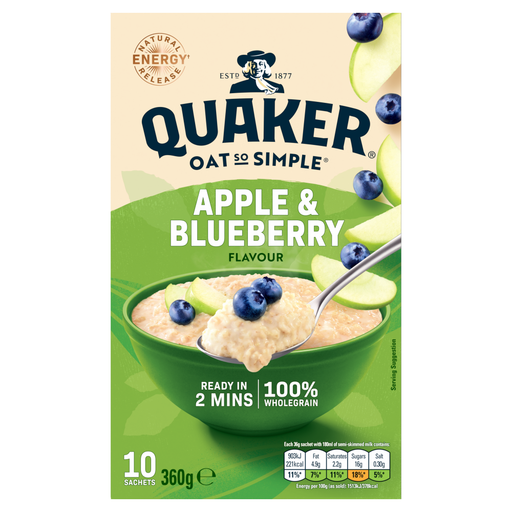 Image unavailable
Quaker Oat So Simple Apple & Blueberry Porridge 10 Pack, 360g
The listing states two-minute preparation and 0.2g salt per 100g for the dry product, making it an option to compare against the NHS low-salt benchmark.
Check the pack format before buying, as the listing does not clearly confirm whether the inner portions are sachets or cups. It contains oats and may contain wheat, barley and soya; preparation with milk changes the prepared-serving nutrition.
Joybuy
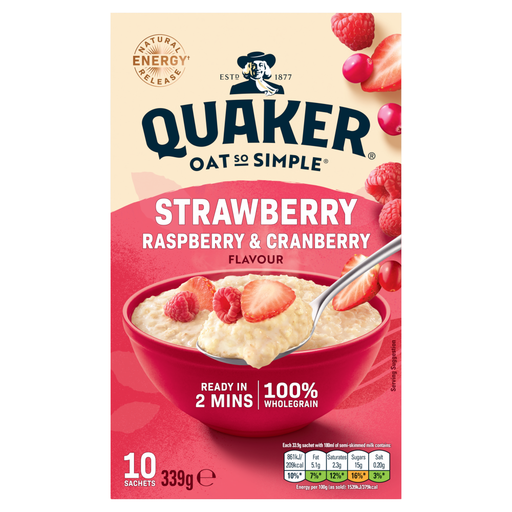 Image unavailable
Quaker Oat So Simple Strawberry, Raspberry & Cranberry 10 Sachets, 339g
This 10-sachet pack states a two-minute microwave method and 0g salt per 100g as sold for a portioned breakfast when a bowl is available.
The stated method requires milk and a microwave-safe bowl, so it is not a hot-water pot. Check the current label for barley, soya and wheat warnings and for allergy or coeliac suitability.
Joybuy
Frequently asked questions
What counts as low salt for instant oats in the UK?
The NHS defines a food as low in salt when it has 0.3g of salt or less per 100g, or 0.1g sodium or less per 100g. Compare products on the same basis: dry sachet with dry sachet, or prepared food with prepared food.
Are the lowest-salt verified quick options sachets or pots?
For the comparable plain dry sachets cited by Tesco, Sainsbury’s and M&S, Quaker Original declares 0g salt per 100g, Sainsbury’s Original declares less than 0.01g, and M&S Traditional declares 0.03g. Pot labels are often expressed after preparation or per pot, so they should not be inserted into that dry-sachet comparison.
Can I microwave every instant-oat pot?
No. The cited Tesco Instant Oats Original and Sainsbury’s Original Porridge Pot instructions say they are not suitable for microwave cooking; both use boiling water followed by a two-to-three-minute stand. Check each product’s instructions, as Flahavan’s describes its Original Quick Oats Pot as suitable for boiling water or microwave preparation.
Do plain instant oats necessarily suit a milk allergy or coeliac requirement?
No. The cited Tesco and Sainsbury’s pot products include milk powder, while the cited Quaker sachet has possible wheat, barley and soya warnings. M&S states that its Traditional Porridge is not suitable for people with coeliac disease or several listed allergies, so always check the current pack label.


