For a quick Bonfire Night pasta meal, compare ready-made tomato sauces by their declared salt per 100g and by the amount you will serve; low-fat or no-added-sugar wording does not answer the salt question. If you have time to prepare the sauce, passata lets you choose the seasoning, but pasta water, cheese and other additions still affect the finished meal.
Who is choosing the sauce?
Group-meal cooks watching the salt
When serving pasta to several people, you want to account for the sauce as well as salt added to the cooking water and toppings. The NHS suggests using herbs, spices, garlic, chilli or lemon to add flavour instead of salt.
Shoppers who need a quick sauce
A ready-made sauce can simplify a Bonfire Night dinner, but its salt line needs checking separately from claims about fat or sugar. Listings from ASDA Groceries and Tesco Groceries show why those front-of-pack messages cannot settle the comparison.
Cooks who want to season from a tomato base
If you have time to make the sauce, passata gives you control over what else goes into it. Napolina describes its passata as a pasta-sauce base and declares 0.12g salt per 100g for the 500g product.
What matters when buying?
For consumers choosing sauce for a Bonfire Night meal with salt in mind, the decision turns on salt comparison, preparation time and how the finished recipe fits the household.
| Concern |
What to check |
Who this matters to |
| Salt in the sauce |
Compare salt per 100g between similar sauces, then use the portion size to work out what you will serve. |
If I am feeding a group, I want to know how much salt the sauce contributes to each plate. About 50% of consumers put that comparison first. |
| Preparation time |
Check whether the product is a finished sauce or a base that needs cooking and seasoning; read its salt line regardless of other pack claims. |
When dinner needs to come together quickly, I want a sauce that fits the time available without relying on a low-fat or no-added-sugar label as a salt guide. Convenience is the primary concern for about 30% of consumers. |
| Household and recipe fit |
Read the exact pack's ingredients and dietary statement, then consider the toppings and seasoning you plan to add. |
If the meal must suit different dietary preferences, I need to check the sauce alongside the rest of the recipe. For about 20% of consumers, that fit comes first. |
What is easy to overlook?
-
Reading “reduced salt” as an absolute salt level
The claim describes a reduction relative to a comparable product; it does not tell you how much salt will be in your portion.
Compare the declared salt per 100g with similar sauces, then check the quantity you expect to serve.
-
Using a fat or sugar claim to judge salt
ASDA Groceries lists 0.67g salt per 100g for Dolmio Low Fat Bolognese, while Tesco Groceries lists 0.64g per 100g for its No Added Sugar Bolognese. Those claims describe different characteristics.
Use the salt entry on each nutrition panel for the salt comparison.
-
Comparing declared servings without checking their size
A jar's stated portion may differ from the amount served at your table, making per-serving figures hard to compare on their own.
Start with salt per 100g for similar products, then calculate it for the amount of sauce you will use.
-
Forgetting additions to the pasta
Salt added to cooking water, cheese and processed toppings can change the salt content of the complete meal even when you choose a sauce with a lower declared figure.
Plan the toppings as well as the sauce, and taste before adding salt; the NHS suggests herbs, spices, garlic, chilli or lemon for flavour.
Brands to consider
Dolmio
Ready-made bolognese-style sauces for a pasta meal.
- ASDA Groceries lists the 450g Low Fat Bolognese as a vegetarian sauce with four stated servings.
- The same listing declares 0.67g salt per 100g and marks its stated serving medium for salt. “Low fat” does not establish a lower salt figure.
Napolina
Passata that can be used as the tomato base for a pasta sauce.
- Napolina declares 0.12g salt per 100g for its 500g passata.
- Passata is a cooking base, not a finished flavoured sauce; the ingredients and seasoning you add will affect the result.
Tesco
Own-label ready-made pasta sauces, including No Added Sugar Bolognese.
- Tesco Groceries marks the 500g No Added Sugar Bolognese as suitable for vegans.
- Its listed salt figure is 0.64g per 100g. Check the current pack rather than treating the sugar wording as a salt claim.
Sainsbury's
Own-label ready-made sauces, including Tomato & Herb Bolognese.
- Sainsbury's describes the 500g Tomato & Herb Bolognese jar as four servings.
- Its listing declares 0.65g salt per 100g and 0.82g per stated quarter-jar serving, marked medium for salt.
Asda
Own-label ready-made tomato pasta sauce, including Tomato & Garlic.
- ASDA Groceries lists 0.58g salt per 100g for its 500g Tomato & Garlic sauce.
- The listing marks its stated quarter-jar serving medium for salt. Check the pack's salt figure and the amount you will serve.
M&S
A pasta-sauce range with different recipe options.
- The Marks & Spencer range offers sauces to consider alongside other ready-made options.
- Compare the nutrition panel on the particular sauce you choose; the range name alone cannot establish its salt content.
Joybuy passata selection
This passata is for cooks who want to prepare and season a tomato sauce for their Bonfire Night pasta meal, rather than heat a finished pasta sauce.
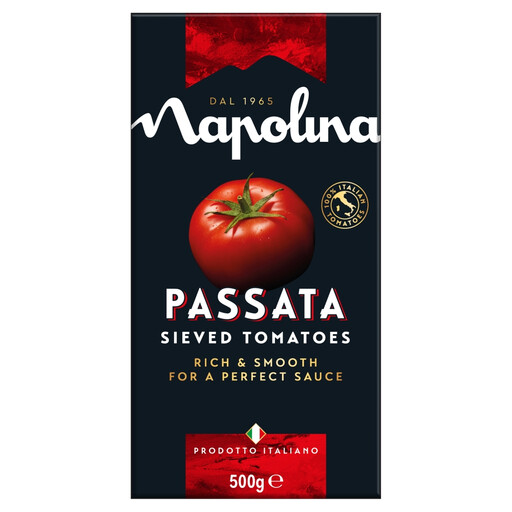 Image unavailable
Napolina Tomato Passata 500g
Use this tomato base when you have time to prepare and season the sauce yourself. Napolina declares 0.12g salt per 100g for the 500g passata; the salt in the finished meal will also depend on your portion and added ingredients.
View on Joybuy
Questions about lower-salt sauce
Does “reduced salt” mean a pasta sauce has little salt?
No. “Reduced salt” describes a comparison with a similar product, not an absolute amount in the sauce or your meal. Read the declared salt per 100g and check it against the portion you will serve.
Can I use “no added sugar” or “low fat” as a guide to salt?
No; those claims concern other characteristics. Tesco Groceries lists 0.64g salt per 100g for its No Added Sugar Bolognese, and ASDA Groceries lists 0.67g per 100g for Dolmio Low Fat Bolognese. Compare the salt entries directly.
Why compare salt per 100g as well as per serving?
Salt per 100g gives you a common basis for comparing similar sauces. A declared serving may not match what you put on each plate, so use the amount you actually serve to assess the sauce's contribution.
Can passata replace a ready-made pasta sauce?
Passata can serve as the tomato base if you are willing to prepare and season the sauce. Napolina describes its passata for this use and declares 0.12g salt per 100g for the 500g product; check the other ingredients you add when assessing the finished meal.


