Families comparing salt at dinner
For tuna pasta, jacket potatoes, sandwiches or salads, compare the tin’s salt declaration and the amount going into each serving. Sauces, cheese and other additions also contribute to the finished meal.


Choose tinned tuna for a family dinner by comparing the salt declaration on the exact product, ideally per 100g on a like-for-like label basis, then checking the portion each person will eat. The cited M&S spring-water tin declares 0.75g salt per 100g, while the John West, Princes and Tesco examples declare 0.80g, 0.85g and 0.90g respectively; their stated nutrition bases differ, so check the labels before treating those figures as a precise ranking. Spring-water packing and no-drain convenience do not, by themselves, establish a reduced-salt claim.
For tuna pasta, jacket potatoes, sandwiches or salads, compare the tin’s salt declaration and the amount going into each serving. Sauces, cheese and other additions also contribute to the finished meal.
Portion size matters when planning a family meal. NHS guidance gives maximum daily salt amounts of 3g for children aged 4–6 and 5g for those aged 7–10, rather than the 6g maximum for people aged 11 and over.
A no-drain format may be useful when dinner needs assembling quickly. Compare its salt label separately: the John West no-drain product listed by Asda includes salt in its ingredients and declares 0.80g salt per 100g.
Start with the nutrition panel, then work out how the pack and the rest of the recipe affect the serving you plan to put on the table.
| Priority | What to check | Your needs |
|---|---|---|
| Salt declaration | Compare salt per 100g and note whether the figure is for drained tuna or another stated basis. Check the serving amount too; a spring-water label alone does not establish a reduced-salt claim. | I want to know how much salt the tuna contributes to dinner, not choose by the words on the front of the tin. |
| Family portions | Check the tin or multipack size, the amount each person will eat and the labels of additions such as sauce or cheese. NHS maximum daily salt amounts vary by age: 3g at ages 4–6, 5g at ages 7–10 and 6g from age 11. | If children are eating with us, I need to plan their portions and consider the whole meal, not apply an adult figure to everyone. |
| Meal preparation | Choose a pack format that suits the recipe and check whether the specific product is no-drain. Follow its instructions for refrigerating and using tuna left after opening. | For a quick pasta dish or jacket-potato topping, fewer preparation steps matter to me, but they do not replace a salt check. |
| Ingredients and warnings | Read the fish-allergen declaration and any bone warning on the exact pack. If sourcing matters to you, check the stated certification or policy separately from the nutrition panel. | I need to know whether the tuna is suitable for everyone at the table and what to check before serving it. |
The cited spring-water products carry different salt declarations: M&S lists 0.75g per 100g, while Tesco lists 0.90g per 100g as sold or drained. Packing medium does not settle the comparison.
Read the exact tin’s nutrition panel and its stated measurement basis. Treat “reduced salt” as a product claim only if it appears on that product’s current labelling.
NHS guidance sets lower maximum daily salt amounts for children aged 4–10 than for adults. Tuna is also only one component of a dinner that may include bread, cheese or sauce.
Consider the serving and the whole recipe. The NHS maximums are 3g a day at ages 4–6, 5g at ages 7–10 and 6g from age 11.
No-drain describes preparation. Asda’s listing for John West No Drain Tuna Chunks with a Little Spring Water declares 0.80g salt per 100g and includes salt in the ingredients.
Choose the format for the preparation steps it saves, then compare its nutrition panel with the other tins you are considering.
Tuna contains fish, and Asda’s John West listing warns that some bones may remain. M&S instructs buyers to refrigerate its tuna and eat it within two days after opening.
Check the allergen and bone information before serving, particularly to children. Store leftovers according to the instructions on the product you bought.
These are references for particular products and pack formats, not salt or availability claims about every tuna product from each brand or retailer.
M&S lists a 160g Tuna Chunks in Spring Water tin that can be compared by its declared nutrition values.
The No Drain Tuna Chunks with a Little Spring Water 3 x 100g product offers a format that avoids a draining step.
Princes Tuna Chunks in Spring Water is listed in a 4 x 145g format for households planning several servings or meals.
Tesco lists its own-label Tuna Chunks in Spring Water as a 4 x 145g multipack.
Sainsbury's lists own-label Tuna Chunks in Spring Water in a 4 x 145g pack and describes pole-and-line catch for that product.
Asda lists branded spring-water tuna, including John West No Drain Tuna Chunks with a Little Spring Water.
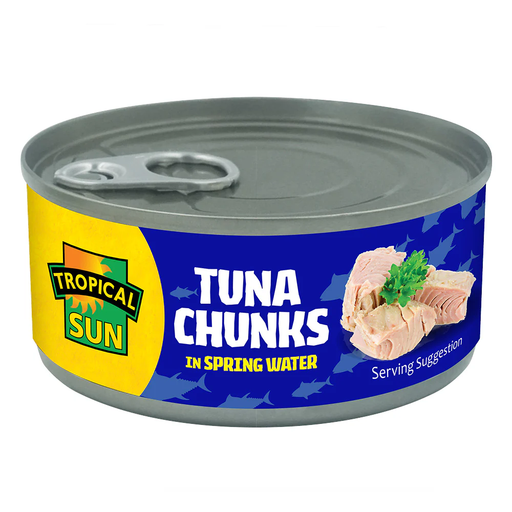
These spring-water tuna packs offer different tin counts and a no-drain option for family meals. Check each current product label for salt per 100g, its measurement basis and the serving you intend to use; the pack format alone does not determine salt content.
 No image available
A single 160g tin is an option when planning how much tuna to use in one family meal. Check the current salt panel and its per-serving information before comparing it with other tins; do not treat an approximate listing figure as an exact label value.
 No image available
The no-drain format is relevant when you want to skip draining tuna while preparing dinner. The pack contains 3 x 100g; check the current tin’s salt figure and its stated basis rather than using the preparation format as a nutrition guide.
 No image available
Four 125g tins let you plan tuna across more than one serving or meal. Compare the current pack’s salt declaration on its stated basis; do not assume this particular multipack has a no-drain format.
No image available
The six-pack format is relevant if you plan tuna for several family meals. Check the salt declaration per 100g drained on the current pack and work from the amount served, rather than assuming a multipack or spring-water label indicates lower salt.
Not automatically. The NHS suggests choosing tinned fish in water rather than brine when cutting down salt, but spring-water products still have different salt declarations. Compare the nutrition panel on the exact tin and look for a reduced-salt claim only if that particular product makes one.
The NHS gives maximum daily amounts of 3g for ages 4–6, 5g for ages 7–10 and 6g for ages 11 and over. Those amounts cover salt in the whole day’s food, including what is added during cooking or at the table.
Follow the instructions on the tin you bought. M&S directs buyers to refrigerate its Tuna Chunks in Spring Water and eat it within two days after opening; check the exact product’s instructions before saving leftovers for another meal.
No: tuna is fish. The cited John West and Princes product information identifies fish in the ingredients, and you should check the allergen information on the exact pack each time.
No. The tuna is one part of the meal; cheese, sauces, mayonnaise and other additions can contribute salt too. Check their labels and the amounts used alongside the tuna portion.