Parents planning shared meals
If tuna is going into regular adult meals that might later be adapted for a baby, compare the exact tin's salt declaration and plan the baby's portion separately.


For new-parent meals, choose tinned tuna by the salt declaration on the exact tin, not by spring-water or no-drain wording. Sainsbury's and M&S each declare 0.75g salt per 100g on the products considered here; John West declares 0.80g, Princes 0.85g and Tesco 0.90g on their respective products. Check that figures use the same drained or as-sold basis before comparing them, and consider baby-meal preparation or NHS tuna-frequency guidance where relevant.
If tuna is going into regular adult meals that might later be adapted for a baby, compare the exact tin's salt declaration and plan the baby's portion separately.
A no-drain or drained-and-ready format can remove a step from making sandwiches, pasta or salads. Its salt declaration still needs its own check.
Where someone is pregnant or trying for a baby, the NHS tuna-frequency limit matters alongside the choice of tin.
Start with the exact tin's salt declaration, then decide whether preparation time, pack size or family meal planning changes your choice.
| Concern | What to check | Who this matters to |
|---|---|---|
| Salt declaration | Read salt per 100g on the exact tin. Check whether it refers to tuna as sold or drained before comparing figures. | When tuna features regularly in family meals, I want the salt figure on the pack to guide my choice, not the name of the packing liquid; about 36% of consumers would put this first. |
| Quick preparation | Check whether the particular tin is no-drain or drained-and-ready, as well as its salt declaration. | For a quick sandwich or pasta meal, I would rather avoid draining a tin if the format suits the recipe; about 29% of consumers would prioritise easier preparation. |
| Pack size and leftovers | Compare tin and drained weights, then read the after-opening storage instructions. | If I stock the cupboard for several meals, I need tin sizes that fit what the household will use; about 21% of consumers would make pack and leftover planning their main concern. |
| Family fish planning | For a baby's portion, check the label and for bones; follow NHS tuna-frequency guidance if pregnant or trying for a baby. Check sourcing claims on the exact product if they matter to you. | Before sharing a meal or planning the week's fish, I want it to fit the people eating it; about 14% of consumers would put family guidance or sourcing first. |
The products considered here carry different salt declarations despite all being spring-water tuna. Sainsbury's and M&S each declare 0.75g per 100g on their cited tins, while Tesco declares 0.90g per 100g on its cited tin.
Compare the nutrition panels on the exact products, using the same as-sold or drained basis.
John West lists salt among the ingredients of its No Drain Tuna Chunks in Spring Water and declares 0.80g salt per 100g.
Choose a no-drain format for its preparation method if that helps, but check its ingredients and nutrition panel separately.
The NHS advises against adding salt to a baby's food or cooking water. M&S and Tesco also warn that their cited tuna products may contain bones.
Prepare the baby's portion without added salt, check the tin's label and inspect the fish carefully for bones.
A tin's salt declaration does not change NHS guidance for someone who is pregnant or trying for a baby.
In those circumstances, the NHS advises no more than 4 cans of tuna a week or 2 tuna steaks a week.
Its Tuna Drained & Ready Water 120g is a ready-to-use steak-format option.
Its Tuna Chunks in Spring Water 160g offers a chunks format.
The cited No Drain Tuna Chunks in Spring Water suits shoppers who want to skip draining.
Its spring-water range includes conventional chunks and a drained-and-ready steak product.
Its Tuna Chunks in Spring Water 400g is a larger-tin option for households planning more than one use.
These spring-water tuna chunks offer different tin and multipack formats for quick adult meals and cupboard planning. Check each exact pack's salt declaration and measurement basis if salt is your deciding factor.
 Image unavailable
For meals where skipping the draining step matters, this no-drain multipack contains three 100g tins. Check the exact pack's salt declaration and whether its per-100g figure is stated as sold or drained before making a comparison.
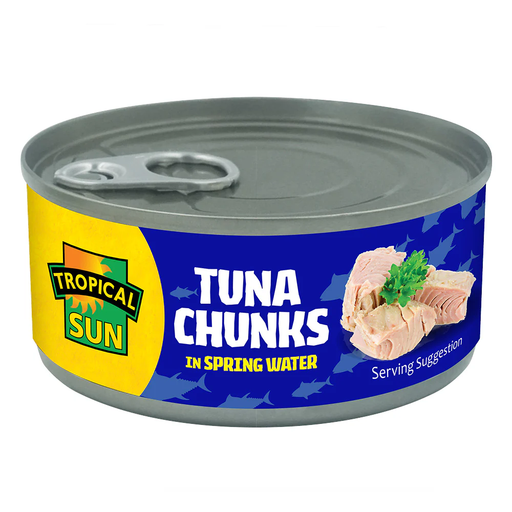 Image unavailable
For a single-tin spring-water option, this product is labelled as a 160g tin. If comparing it for salt, read the exact pack's per-100g declaration and check whether that figure refers to tuna as sold or drained.
 Image unavailable
For stocking separate tins for several meals, this pack contains four 125g tins. Check the exact variant's preparation instructions rather than assuming it is no-drain, and compare salt figures on the same stated basis.
No. Spring water describes the packing liquid, not a reduced-salt declaration. Sainsbury's and M&S each list 0.75g salt per 100g for the cited products, while Tesco lists 0.90g per 100g for its cited product. Check the exact tin and compare figures on the same as-sold or drained basis.
Do not serve an adult recipe unchanged without checking how it is prepared. The NHS advises against adding salt to a baby's food or cooking water; check the tuna's label, leave added salt out of the baby's portion and inspect the fish for bones.
Yes. The NHS advises people who are pregnant or trying for a baby to have no more than 4 cans of tuna a week or 2 tuna steaks a week because tuna contains higher levels of mercury than other fish. Choosing a different salt declaration does not change that frequency guidance.
Follow the instructions on the exact product. Tesco and M&S instruct shoppers to transfer unused contents from their cited tins to a non-metallic container, refrigerate them and consume them within 2 days.
No. The NHS states that fresh and canned tuna do not count as oily fish, so a tuna meal should not be counted as an oily-fish portion when planning fish meals.