Students packing for move-in day
A bar is easy to put in a bag while travelling or carrying boxes. Choose by the portion you expect to eat: a small bar and a larger protein bar are not the same-sized snack.


For a small snack to pack on move-in day, compare the calories in the whole bar you will eat, then check its sugars, protein, fibre and allergens. Among the portions compared here, Kellogg's lists 104 kcal for its 27 g Special K Red Berry Bar, while Tesco lists 116 kcal for a 30 g Graze Cocoa Vanilla Oat Boost; the protein and nut bars in the comparison have higher calorie totals per bar. Check the exact pack size when shopping, as a different-sized bar cannot be assumed to have the same nutrition values.
A bar is easy to put in a bag while travelling or carrying boxes. Choose by the portion you expect to eat: a small bar and a larger protein bar are not the same-sized snack.
If you are choosing between individually portioned bars, read the sugars, protein and fibre figures alongside kcal. A lower calorie total alone does not tell you how the other nutrition values compare.
Check the current pack before buying for yourself or someone in a shared flat. The products discussed here have different ingredient and allergen declarations, so a familiar brand name is not enough to establish suitability.
Start with the whole-bar portion for the snack you intend to pack. Then use the nutrition panel and ingredient list to decide whether that particular bar fits your other requirements.
| Priority | What to check | Your needs |
|---|---|---|
| Whole-bar calories | Read kcal and weight per individual bar, rather than comparing multipack totals. The comparison portions include a 27 g Kellogg's bar at 104 kcal and a 30 g Graze boost at 116 kcal, according to Kellogg's and Tesco respectively. | I want a small snack for the journey or while unpacking, so the amount in the bar I will actually eat matters most. |
| Sugars | Compare grams of sugars for the stated portion as well as kcal. Kellogg's lists 7.6 g sugars in its 27 g Special K Red Berry Bar; Tesco lists 2.7 g in a 30 g Graze Cocoa Vanilla Oat Boost. Food Standards Agency guidance also describes traffic-light labels as a way to compare sugar information where those labels appear. | The bar with fewer calories is not necessarily the one I would choose after checking its sugars. |
| Protein and fibre | Read both values per bar alongside its calories. Nature Valley lists 10.2 g protein and 4.5 g fibre in its 197 kcal, 40 g Chocolate & Coffee Protein bar. Those figures describe that bar, not every Nature Valley product. | If I am considering a larger bar between meals, I want to see what its protein and fibre figures are before accepting a higher calorie total. |
| Ingredients and allergens | Read the current ingredient list, highlighted allergens and any precautionary statement for the exact flavour and pack. Do not assume that a vegan or gluten-free description addresses other ingredients you need to avoid. | In a shared kitchen, I need to know whether a bar suits the person who will eat it before buying a multipack. |
A per-100 g figure compares equal weights, but it does not show the calories in a whole bar when portion sizes differ.
For the snack you plan to eat, compare kcal per complete bar first. Use the per-100 g column when you also want to compare products at the same weight.
Nature Valley lists 197 kcal per 40 g Chocolate & Coffee Protein bar, and Eat Natural lists 218 kcal per 40 g Peanuts, Almonds & Cocoa Protein bar. Protein content and dietary format answer different questions from the calorie total.
Choose for the attributes you need, then check the kcal figure for that exact bar rather than relying on its category.
The bars discussed here have different declarations covering ingredients such as gluten-containing cereals, milk, soya and peanuts, as well as possible cross-contact on some products.
Read the current pack for the exact product before purchasing or sharing it; do not rely on another flavour's label.
The smaller portions in this comparison contain fewer calories than the checked 40 g protein and nut bars, but their portion size is also different.
If you expect a long interval before eating again, compare the full nutrition panels and plan your next meal separately rather than choosing by the lowest kcal figure alone.
These figures describe particular UK-listed products, not every bar made by each brand. Match the flavour and portion size before using them to judge a pack you are buying.
Kellogg's lists its Special K Red Berry Bar at 104 kcal per 27 g serving.
Tesco lists a 30 g Graze Cocoa Vanilla Oat Boost at 116 kcal per boost.
Nature Valley lists crunchy and protein bar ranges; its Chocolate & Coffee Protein bar provides a specific protein-and-fibre comparison.
Eat Natural lists both a Coconut & Dark Chocolate vegan cereal bar and a Peanuts, Almonds & Cocoa Protein bar.
Nutracheck lists a 50 g Trek Protein Flapjack serving with 10 g protein.
These Joybuy listings cover cereal-bar multipacks and oat squares that could be packed for moving day. Check the nutrition and ingredient declarations for each exact pack before comparing it with the differently sized examples discussed above.
 No image available
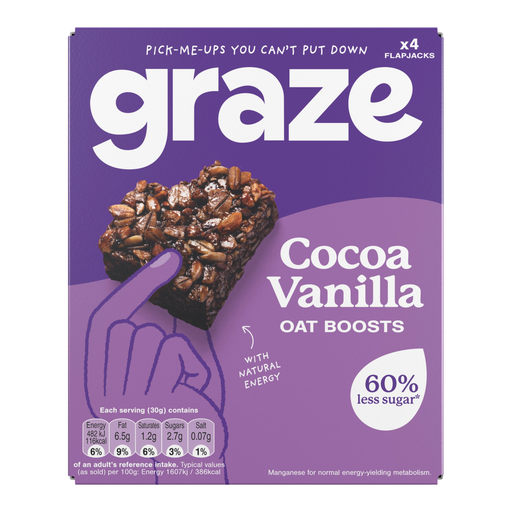
The 4 x 30g format gives you separate portions to pack. Check this product's own nutrition panel: its name is different from the Graze Cocoa Vanilla Oat Boost used in the comparison above.
 No image available
This orange-flavoured four-pack is an option to consider for move-in snacks. Use the declared per-bar calories and sugars, rather than the word “Light” in its name, to compare it with another bar.
 No image available
The six-bar pack offers 21.5 g portions for taking out during a move. Do not apply the nutrition figures for the 27 g Special K Red Berry Bar discussed above to these smaller bars; read this pack's per-bar declaration.
 No image available
This six-pack uses 21.5 g portions, a useful size to identify when comparing whole-bar figures. Check the dark chocolate variety's own nutrition panel and ingredients rather than using figures from Red Berry.
 No image available
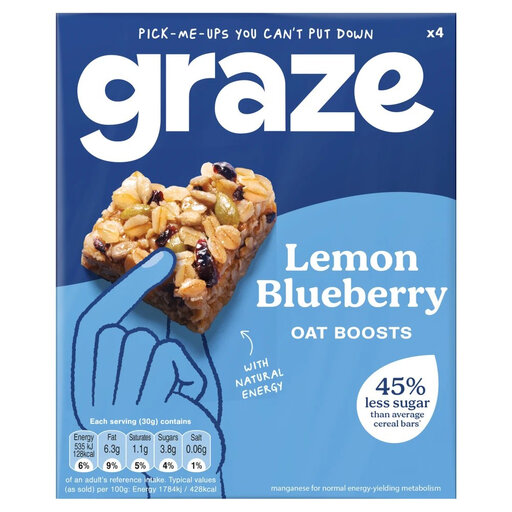
The 4 x 30g format provides separate oat-boost portions for packing. Read this lemon and blueberry variety's own kcal, sugars and ingredient declarations before comparing it with Cocoa Vanilla.
Compare kcal for one complete bar in the pack you intend to eat, then check its weight and other nutrition values. For example, Kellogg's lists 104 kcal for a 27 g Special K Red Berry Bar, while Tesco lists 116 kcal for a 30 g Graze Cocoa Vanilla Oat Boost; those figures belong to those stated portions.
Not on that figure alone. A smaller bar can serve as a small snack, but compare its portion size, protein and fibre with any larger bar you are considering, and plan separately for meals. Nature Valley, for example, lists 10.2 g protein, 4.5 g fibre and 197 kcal for its 40 g Chocolate & Coffee Protein bar.
Read the current pack's ingredients, highlighted allergens and any “may contain” statement for the exact flavour. The products discussed here differ in their declarations, so do not assume that another bar from the same brand has the same ingredients.
They are a quick starting point where present, but also read the portion size and full nutrition panel. Food Standards Agency guidance describes traffic-light labels as useful for comparing calories, fat, sugar and salt; the per-bar figure tells you the amount for the portion you will eat.