Tea-break snackers watching calories
If you plan to eat one bar with your morning tea, its kcal per bar and weight tell you more about that snack than a front-of-pack description alone.


For a lower-calorie morning tea break, compare energy per bar as well as bar size: ASDA lists Kellogg's Milk Chocolate Snack Bars at 78 kcal per 20g bar, while Tesco lists Graze Cocoa Vanilla Oat Boost at 116 kcal per 30g bar. A protein bar is a different choice rather than an automatic lower-calorie alternative: Nature Valley lists its Peanut & Chocolate Protein Bar at 195 kcal per 40g bar. Check the exact pack for sugars, allergens and the number of bars you plan to eat.
If you plan to eat one bar with your morning tea, its kcal per bar and weight tell you more about that snack than a front-of-pack description alone.
If protein or fibre matters more to you than choosing the lowest-kcal bar, compare those figures alongside energy per bar. A protein-bar label does not establish its calorie content.
If you avoid particular ingredients, check the exact flavour and current pack. Cereal bars can contain cereals, milk, soya or nuts, and may carry additional allergen warnings.
Start with the bar you would actually eat at your break, then compare its nutrition and ingredient information with your other requirements.
| Priority | What to check | Your needs |
|---|---|---|
| Energy and portion | Compare kcal per bar, weight in grams and how many bars you expect to eat. Use per-100g figures to compare different-sized products. | I want to know the energy in my whole tea-break snack, not just a figure for a serving smaller than the amount I would eat. |
| Sugars and saturated fat | Read both per-bar and per-100g values on the current nutrition label. Do not substitute a protein, fibre or wholegrain claim for those figures. | A bar's other claims are not enough for me; I want to compare its sugars and saturated fat too. |
| Protein and fibre | Compare the stated amounts per bar with kcal and bar weight. Check the exact flavour rather than assuming every bar in a range has the same values. | If I am choosing a protein or oat bar instead of a smaller cereal bar, I want to see what I get in that portion and how its energy compares. |
| Ingredients and allergens | Read the current ingredient list, allergen statement and any may-contain warning for the exact product. | I need the bar I buy to fit my ingredient or allergen exclusions, regardless of its calorie figure. |
A lower kcal figure per bar can partly reflect a smaller portion. The 20g Kellogg's bar listed by ASDA and the 40g Nature Valley protein bar described by Nature Valley are different-sized snacks.
Compare kcal per bar for the amount you intend to eat, then look at weight, protein and fibre if those details matter to your choice.
A claim on the front does not describe the full nutrition panel. In its 2025 survey of supermarket snack bars, Action on Sugar and Salt reported that 37% of products would be high in sugars and 55% high in saturated fat under voluntary traffic-light criteria. Those are proportions of surveyed products, not shoppers.
Check sugars and saturated fat per 100g and per bar alongside any protein or fibre information.
ASDA lists oats, soya, barley, milk and wheat in Kellogg's Milk Chocolate Snack Bars. Nature Valley says its Peanut & Chocolate Protein Bar contains peanuts, soy and milk and may contain tree nuts.
Read the current ingredients and allergen statement for the flavour and pack you are buying; do not rely on another bar in the range.
Alpen's November 2021 product list included cereal bars, but its current FAQ identifies several bar lines that are no longer made. An older listing cannot establish the nutrition or availability of a bar today.
Confirm the exact product and pack with a current retailer listing before comparing it with other bars.
These brand references describe particular ranges or products; the nutrition and allergen details of one bar should not be assumed to apply to every flavour.
Its portioned Milk Chocolate Snack Bars provide a small-bar comparison for a morning break.
Oat Boost flapjacks offer a 30g oat-bar option rather than the smallest bar in this comparison.
Its protein-bar range is worth comparing when protein and fibre are priorities rather than the lowest energy per bar.
TREK describes its range as plant-based, with protein bars and flapjacks for shoppers interested in those formats.
Its protein fruit-and-nut range is an option to examine if you prefer bars with nuts and seeds.
Alpen is a name some shoppers may know from cereal bars, but a historical bar listing is not a current product choice.
These options include portioned cereal and oat bars, plus a protein bar to compare when protein matters more than choosing the lowest-kcal item. Use each product's current pack to make the final nutrition and allergen comparison.
 No image available
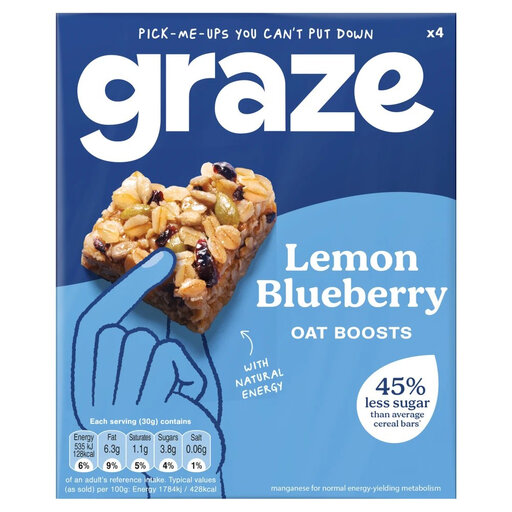
This 4 x 30g oat-bar pack is an option if you want to compare a portioned flapjack with smaller cereal bars for your break. Check energy per bar and the exact flavour's allergen statement before choosing it.
 No image available
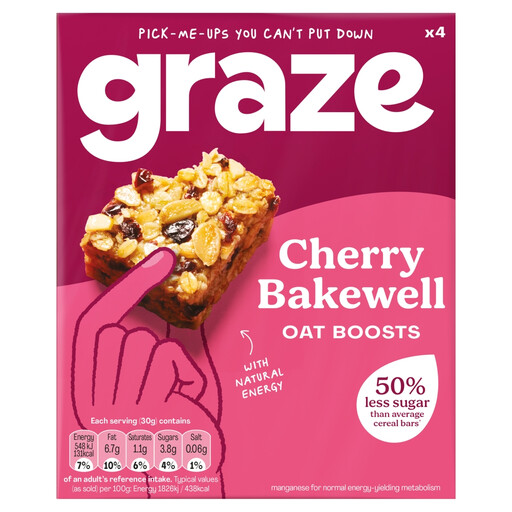
This Cherry Bakewell oat-bar pack contains four 30g portions. If you are comparing flavours, check this pack's own kcal, sugars and allergen information rather than applying figures from another Oat Boost.
 No image available
This four-pack is another cereal-bar option for a morning break. Use the current pack's per-bar nutrition figures when comparing it with oat or protein bars; the word “Light” in its name does not supply those figures.
 No image available
Consider this 4 x 40g protein-bar pack if protein and fibre matter to your choice, but compare its current kcal per bar with smaller cereal bars. Nature Valley says the Peanut & Chocolate bar contains peanuts, soy and milk and may contain tree nuts.
 No image available
This pack contains six 21.5g cereal bars, a size to consider if you plan to eat one bar at your tea break. Check the Red Berry bar's own energy, sugars and allergens; figures for the Milk Chocolate variant do not describe this one.
No. Compare kcal per bar, bar weight and the number of bars you would eat. The NHS explains that pre-packed-food nutrition information gives energy per 100g and may also give it per portion; your planned portion can differ from the one shown.
Check sugars, saturated fat, salt, protein and fibre on the current pack, using per-bar figures for your snack and per-100g figures to compare different-sized bars. Also read the ingredients and allergen statement.
No. Nature Valley lists approximately 10g protein and 4g fibre in its 40g Peanut & Chocolate Protein Bar, alongside 195 kcal. Compare the current pack with smaller cereal bars if limiting kcal per break is your priority.
Read the exact product's current ingredient list, allergen statement and any may-contain warning. For example, ASDA lists oats, soya, barley, milk and wheat in Kellogg's Milk Chocolate Snack Bars; Nature Valley lists peanuts, soy and milk in its Peanut & Chocolate Protein Bar and says it may contain tree nuts. Another flavour's details cannot establish suitability.