Hosts planning individual portions
Small packets make it straightforward to compare the labelled amount for one guest with a serving taken from a sharing bag.


For a defined individual portion, Walkers UK lists 96 kcal per 22g pack for its Oven Baked Sea Salt and Cheese & Onion flavours—the lowest per-pack figures among the individual packs compared here, not a judgement on every crisp available. If guests prefer conventional potato crisps, compare the calories in the actual pack or planned serving, then check salt, ingredients and allergy information for each flavour.
Small packets make it straightforward to compare the labelled amount for one guest with a serving taken from a sharing bag.
If guests prefer familiar, sliced-potato crisps, compare the calories in each bag rather than assuming a different cooking style determines the portion total.
Read the ingredients, allergy statement and any vegetarian, vegan or gluten-free declaration for the exact flavour you intend to serve.
Start with the amount each guest is likely to eat: a single packet and a serving from a sharing bag are not interchangeable portions.
| Priority | What to check | Your needs |
|---|---|---|
| Calories | Read kcal per packet or planned serving, then kcal per 100g when comparing different weights. Check calories even if a pack makes a lower-fat claim. | I want to compare the amount each guest might actually eat, not treat a smaller bag as proof that the crisps themselves contain fewer calories per 100g. |
| Portion size | Check the pack weight and number of stated servings. For a sharing bag, decide how much to put in each bowl. | Individual packets would make portions clearer; if I serve a large bag, I want to plan the serving size. |
| Salt and fat | Compare salt, saturates and total fat for the portion likely to be eaten. Figures for different pack sizes need the weights alongside them. | I am serving other savoury foods and want to compare more than the calorie figure on a crisp packet. |
| Ingredients and allergens | Read the current ingredients and allergy statement for each flavour. Use vegetarian, vegan or gluten-free declarations only where they apply to that product. | I need to offer guests an option that fits their requirements without assuming every flavour from one brand is alike. |
Seabrook Crisps lists 126 kcal for a 25g Canadian Ham bag and 505 kcal per 100g. Tesco lists 176 kcal for a larger, 35g REAL Sea Salt pack. The packet totals describe different amounts of food.
Use kcal per packet for the portion you plan to hand out, and kcal per 100g to compare products across pack sizes.
Tyrrells lists five 30g servings in its 150g Lightly Sea Salted bag, at 156 kcal per stated serving. That figure does not describe the whole bag.
Plan how much to put out at a time, or use individual packets if clearly defined portions matter to your party.
Salt amounts differ between products and pack sizes. Ingredients and allergy statements also need checking for the exact flavour, including any may-contain information.
Compare salt for the amount you expect to serve and read the current packet before offering it to a guest with an allergy.
These examples help distinguish pack formats and flavour-specific details; they do not establish the nutrition or suitability of every product from a brand.
Its Oven Baked and conventional packets offer two different kinds of individual portion to compare.
Canadian Ham is a conventional crisp option with a labelled 25g individual bag.
Lightly Sea Salted comes in both individual and sharing formats.
KETTLE describes its range as hand-cooked British crisps.
Pipers describes a range focused on distinctive flavourings, including Anglesey Sea Salt.
REAL offers hand-cooked crisps, including a Sea Salt individual pack.
These options include multipacks with individual portions and an 85g sharing bag. Compare the amount you plan to serve rather than treating every format as the same portion.
 No image available
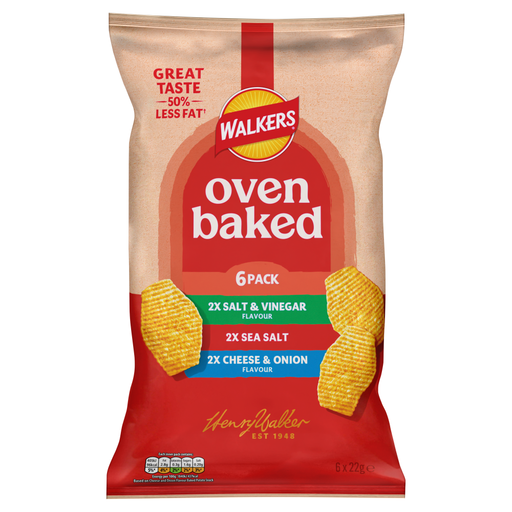
Six individual 22g packets provide a defined portion for guests. Check each flavour's packet for its nutrition, ingredients and allergy statement, particularly where milk or barley is relevant.
 No image available
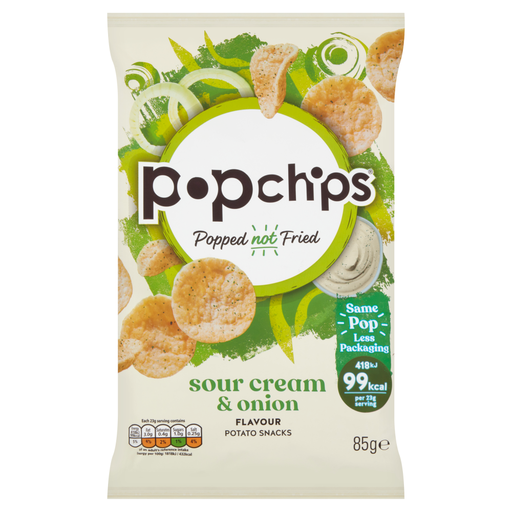
This 85g bag is a sharing format, so decide on a serving amount before comparing it with an individual packet. Check the pack's ingredients and allergy statement for guests with dietary requirements.
 No image available
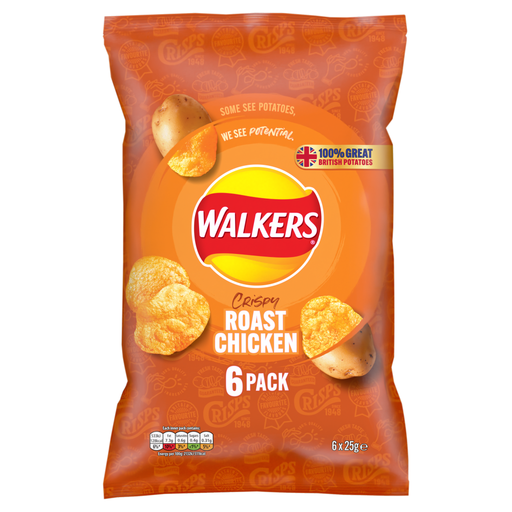
Six individual 25g packets suit a party where guests prefer conventional potato crisps and a defined bag size. Check the current packet for its calorie figure and may-contain allergy warnings.
 No image available
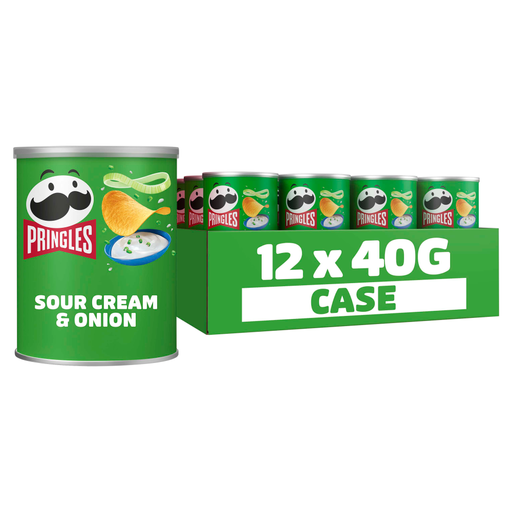
The twelve 40g cans offer separate portions, but each can is larger than the 22g and 25g packets above. Compare calories per can and check the ingredients for wheat and milk before serving guests with allergies.
Walkers UK lists 96 kcal per 22g packet for both Oven Baked Sea Salt and Oven Baked Cheese & Onion, the lowest packet totals among the individual products compared here. Check the flavour's ingredients and how many packets each guest might eat.
Use calories per packet when you plan to hand out one packet per guest, and per 100g to compare products sold in different weights. A smaller packet can have a lower total without the crisps having fewer calories per 100g.
Choose the amount you intend to serve from the sharing bag and use the label's serving information for that amount. Tyrrells, for example, lists five 30g servings in its 150g Lightly Sea Salted bag, rather than one serving for the whole bag.
Read the current packet for the exact flavour, including ingredients, allergy and may-contain statements and any stated dietary suitability. Walkers Oven Baked Cheese & Onion, for example, contains milk-derived ingredients; a declaration for another flavour or product line does not replace that check.
The Department for Education's school-food guidance concerns food and drink provided in state-funded schools in England, not food served at a private party. If you are buying for a school-food setting instead, assess that purchase under the applicable school requirements.