Parents comparing lunchbox portions
A packet’s calorie figure is useful only alongside its weight. Compare the amount your child will eat, particularly when choosing between a small raisin box and fruit portioned from a larger bag.


For a lower-calorie school-lunch option, start with plain dried fruit and compare both kcal per 100g and kcal in the amount you will pack: a small box can contain fewer calories simply because it contains less fruit. If you want the dried fruit to count as one 5 A Day portion, the NHS reference is 30g; it also advises serving dried fruit with a meal rather than as a between-meal snack. Check coated fruit separately, as its ingredients and nutrition values differ from those of plain fruit.
The useful choice depends on whether you are controlling the amount packed, aiming for a 5 A Day portion, or checking ingredients and school rules.
A packet’s calorie figure is useful only alongside its weight. Compare the amount your child will eat, particularly when choosing between a small raisin box and fruit portioned from a larger bag.
The NHS says 30g of dried fruit counts as one 5 A Day portion. Check the pack weight before treating an individual snack box as a full portion.
Ingredient and allergen declarations matter when considering products such as sulphite-containing apricots or coated raisins. Check the school’s packed-lunch and allergy policies before packing a particular product.
Decide how much fruit will go in the lunchbox, then compare labels on that basis. A per-100g figure helps compare products, while the packet or measured-portion figure describes what you are packing.
| Priority | What to check | Your needs |
|---|---|---|
| Calories per portion | Read kcal per 100g and kcal for the packet or measured amount. ASDA lists 182kcal per 100g and 61kcal per one-sixth pack for its Apricots 200g; Whitworths lists 47kcal for a 14g Sunny Raisins box. Those serving figures describe different amounts of fruit. | I want to know the calories in the amount going into the lunchbox, not choose by the smallest number on two differently sized packs. |
| Portion size | Check the net weight of an individual pack or measure a portion from a larger bag. The NHS says 30g of dried fruit counts as one 5 A Day portion; a 14g box falls below that reference. | A small fruit addition may suit this lunch, or I may want a full dried-fruit 5 A Day portion. The two goals call for different amounts. |
| Ingredients | Distinguish plain fruit from coated snacks and read the current allergen declaration. ASDA Apricots 200g declares sulphur dioxide/sulphites; Tesco lists milk and soya ingredients in its checked yoghurt-coated raisins. | I need a product whose ingredients are suitable for my child, rather than assuming every fruit-based snack has the same contents. |
| Lunch-time use | Plan to serve dried fruit as part of lunch. The NHS advises eating it at mealtimes, rather than between meals, to reduce tooth-decay risk. | The fruit is for lunch, not for repeated snacking throughout the school day. |
| School policy | Check the individual school’s packed-lunch and allergy policies, particularly before buying multipacks for regular use. | I want to know that the specific product can be packed under my child’s school rules. |
Whitworths gives 47kcal for a 14g Sunny Raisins box, but the NHS reference for one dried-fruit 5 A Day portion is 30g. The box’s lower packet total does not make it a full portion.
Choose the amount you intend to pack first, then compare calories for that amount.
Tesco’s checked 25g yoghurt-coated-raisin serving lists 118kcal, 5.3g fat and 4.4g saturates. Its ingredients include sugar, vegetable oil, milk ingredients and soya lecithin.
Check the nutrition panel and ingredients for the particular snack rather than using a plain-raisin figure for it.
ASDA Apricots 200g declares sulphur dioxide/sulphites, which matters if your child needs to avoid them.
Read the current pack’s ingredient and allergen declaration when buying or changing products.
The NHS advises eating dried fruit at mealtimes rather than between meals to reduce the risk of tooth decay.
Include it with the packed lunch instead of setting aside several small dried-fruit snacks for the day.
These product-label examples show why pack format and ingredients matter; a retailer’s range is not a substitute for checking the specific product you buy.
Whitworths lists Sunny Raisins in small boxes, including a 14g format.
ASDA Apricots 200g has nutrition values for both 100g and one-sixth of the pack.
Tesco’s checked listings include 30g plain Whitworths Sunny Raisins packs and a separate yoghurt-coated-raisin snack.
M&S Raisins 500g is a bulk-bag option with raisins and sunflower oil listed as ingredients.
These raisin, prune and apricot formats offer different ways to pack dried fruit for lunch. Compare the amount you intend to serve and check each current label before choosing.
 No image available
The 14g boxes offer a defined amount to put in a packed lunch. Each box is smaller than the NHS 30g reference for one dried-fruit 5 A Day portion; check the pack’s nutrition information for its calories.
 No image available
Individual wrapping may be convenient for packing prunes with lunch, but count or weigh the amount you pack before comparing its calories with another fruit portion. If a 5 A Day portion is the aim, compare that amount with the NHS 30g dried-fruit reference.
 No image available
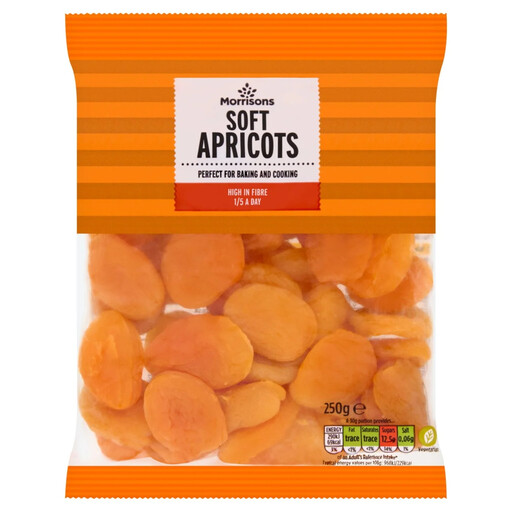
The 250g bag can be divided into lunch portions; measure the amount you pack and use this product’s label to calculate its calories. Check its current allergen declaration, particularly if sulphites need to be avoided.
No. Compare kcal for the amount you plan to pack as well as kcal per 100g. ASDA lists 61kcal per one-sixth pack of its Apricots 200g, while Tesco lists 118kcal per 25g serving of its checked yoghurt-coated raisins; these are different products and serving sizes.
The NHS says 30g of dried fruit counts as one 5 A Day portion. A smaller box can still be packed with lunch, but do not count it automatically as a full dried-fruit portion.
Serve it with lunch or another meal. The NHS advises eating dried fruit at mealtimes rather than between meals to reduce the risk of tooth decay.
Yes. ASDA Apricots 200g declares sulphur dioxide/sulphites, and Tesco’s checked yoghurt-coated raisins contain milk and soya ingredients. Read the current pack declaration for the product you intend to buy.
Check your child’s school packed-lunch and allergy policies. The Department for Education describes England’s school food standards as applying to food and drink provided to pupils by state-funded schools; that does not establish one rule for every lunch packed at home.