Hosts planning individual portions
If guests will pick up a whole wrapped bar, compare calories for that whole bar. The pack size matters too: a multipack may contain more portions than your buffet needs.


For a Boxing Day buffet, compare calories per whole bar before choosing by protein content or a low-sugar claim. Barebells UK lists 190 kcal and 20 g protein for its 55 g Cookies & Cream bar; PhD lists 250 kcal and 21 g protein for its 64 g Choc Brownie Smart Bar, so the choice depends on the portion and protein amount you want to offer. Keep each flavour’s wrapper available for ingredient and allergen checks.
A buffet bar needs to make sense as a complete portion, not just as a nutrition claim on the front of the pack.
If guests will pick up a whole wrapped bar, compare calories for that whole bar. The pack size matters too: a multipack may contain more portions than your buffet needs.
A higher protein figure does not, by itself, identify the lower-calorie serving. Read both figures alongside the bar’s weight before choosing between flavours or formats.
Keep flavours identifiable and their original wrappers available. Ingredients and “may contain” statements can differ between bars, including flavours from the same range.
Start with the serving a guest would actually take, then check what that portion contains and how it will be presented on the buffet.
| Priority | What to check | Your needs |
|---|---|---|
| Calories per bar | Read kcal for the complete bar and note its weight. Barebells UK lists 190 kcal per 55 g Cookies & Cream bar; PhD lists 250 kcal per 64 g Choc Brownie Smart Bar. Calories per 100 g can help compare different sizes, but do not replace the whole-bar figure. | I want guests to see what one complete buffet portion contains, rather than judging it by “low sugar” on the front of the pack. |
| Protein and portion size | Compare protein grams and kcal for the same stated serving. Barebells UK lists 20 g protein in its 55 g Cookies & Cream bar, while PhD lists 21 g in its 64 g Choc Brownie bar. | If protein is the reason for choosing a bar, I still want to know how large the bar is and how many calories come with it. |
| Ingredients and allergens | Check the ingredient list and “may contain” statement for each exact flavour. Keep its wrapper or an accurate copy of its pack information beside it; do not assume another flavour has the same ingredients. | Guests need to identify the bar they are taking without having to guess which wrapper belongs to a mixed display. |
| Serving warnings | Read any age or excessive-consumption warning on the exact pack. PhD’s Choc Brownie Smart Bar information carries a laxative-effect warning for excessive consumption; Grenade UK gives an under-14 warning for Soft Core Chocolate Peanut Butter. | At a help-yourself buffet, I want pack warnings to remain visible even if several bars are set out together. |
Sugar wording does not tell you the calories in a whole bar. Under the UK low-energy nutrition-claim threshold published on legislation.gov.uk, a solid food must contain no more than 40 kcal per 100 g to make that claim; calling a buffet option comparatively lower in calories is not the same claim.
Compare kcal per complete bar first, then protein, serving weight and ingredients. Avoid labelling a bar “low calorie” as a formal product claim on a buffet card unless the applicable claim conditions are met.
A mixed bowl makes it difficult to connect an individual bar with its ingredients and cross-contact statement. Barebells UK, for example, lists possible gluten-containing cereals, soy, peanuts and nuts for Cookies & Cream.
Leave bars wrapped and group each flavour with its own pack information. Check the exact product before describing it as suitable for a guest with an allergy.
A case size tells you how many bars you will receive, not whether that flavour fits the calories, ingredients or portions you have in mind.
Check the nutrition and allergen panel for the exact flavour, then choose a pack quantity that fits the number of guests likely to take one.
These are useful starting points for checking particular ranges and flavours, not a statement that every product from a brand has the same nutrition or ingredients.
Its UK Cookies & Cream page provides figures for a complete 55 g bar, making that flavour useful for a per-portion comparison.
The Smart Bar range includes a 64 g Choc Brownie serving for shoppers comparing protein with calories per bar.
Soft Core includes a 50 g Chocolate Peanut Butter bar; its smaller weight alone does not establish its calorie position against another flavour.
Its UK range includes bars alongside formats such as wafers and oatbakes, which may suit a buffet with different types of individually served snack.
Quest describes its protein bars as low sugar and providing 20 g protein on its own product-range page.
Tesco is a mixed-brand retail option rather than a protein-bar manufacturer.
These Grenade multipacks are options for offering individual protein bars at a Boxing Day buffet. Compare the exact flavour’s calories and pack information before deciding how many to put out.
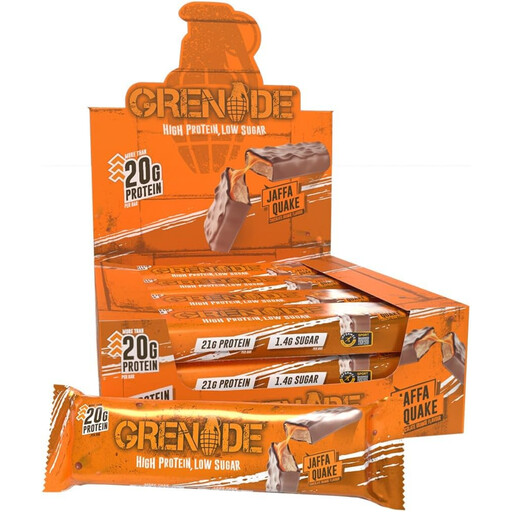 Image unavailable
The 60 g bar size gives guests a defined portion. Check calories, ingredients and any consumption warning for the Jaffa Quake flavour before adding it to a mixed buffet.
 Image unavailable
For a whole-bar calorie comparison, Joybuy lists 178 kcal and 15 g protein per 50 g Double Chocolate bar. Keep the exact pack available so guests can check its ingredients and warnings.
 Image unavailable
This pack contains 50 g bars for portion-by-portion serving. Compare the Golden Caramel pack’s kcal per bar and allergen statement with the other flavours before setting them out together.
 Image unavailable
These 50 g bars offer a Peanut Butter flavour. Check the exact pack’s peanut and other allergen statements, and keep that information with the bars on a shared buffet.
 Image unavailable
The four-bar pack is an option when you want fewer 60 g portions. Read the Oreo Flavour nutrition panel for calories per whole bar and retain its allergen information beside the buffet selection.
No. Check kcal for the whole bar separately from its sugar figure. Barebells UK lists 190 kcal for a 55 g Cookies & Cream bar, while PhD lists 250 kcal for a 64 g Choc Brownie Smart Bar. The UK low-energy nutrition-claim threshold published on legislation.gov.uk is no more than 40 kcal per 100 g for a solid food; a comparatively lower-calorie choice does not automatically meet it.
Keep each flavour in its wrapper, or place its exact pack information beside it. That lets guests check ingredients and “may contain” statements without trying to identify loose bars in a mixed bowl.
Keep the pack warnings visible if guests can take more than one. PhD’s Smart Bar information and Grenade UK’s Soft Core Chocolate Peanut Butter information warn that excessive consumption may cause laxative effects; check the warning on each flavour you serve.
Check the exact product rather than applying one range’s warning to every bar. Grenade UK states that its Soft Core Chocolate Peanut Butter bar is not suitable for children under 14; that statement does not establish the age guidance for other flavours or brands.