Revision snackers comparing portions
If you plan to eat one bar during a revision session, compare the calories for that whole bar. The NHS notes that a manufacturer’s stated portion may differ from the amount you actually eat.


For a revision-desk snack, start with the calories in the bar you would actually eat, then check its serving weight, total sugars and allergens. A small bar can have fewer calories per bar than a larger one without being lower in calories per 100 g; if fibre or protein matters more to you, compare those figures separately rather than treating a front-of-pack claim as proof of a lower-calorie choice.
The useful comparison depends on whether your priority is a smaller desk snack, a particular dietary requirement or the nutrient profile of a larger bar.
If you plan to eat one bar during a revision session, compare the calories for that whole bar. The NHS notes that a manufacturer’s stated portion may differ from the amount you actually eat.
Vegan or gluten-free wording may help narrow your options, but it does not answer every allergen question. Check the ingredients and any may-contain statement on the exact pack.
If fibre or protein is an important selection factor, compare the stated grams per bar alongside its calories and weight. A protein claim alone does not establish that a bar is lower in calories.
Start with the portion you intend to eat, then use per-100-g figures to compare bars of different sizes. Check dietary suitability before choosing between otherwise suitable options.
| Priority | What to check | Your needs |
|---|---|---|
| Calories and portion | Check kcal and weight for the whole bar you intend to eat. Use kcal per 100 g to compare bars on the same weight basis. | I want one desk snack and need to compare the amount I would eat, not just the smallest number printed on a pack. |
| Total sugars | Read total sugars per bar and per 100 g. If a traffic-light label is present, check what its sugar colour describes rather than relying on a single product claim. | A bar labelled “no added sugar” may still contain sugars. I want the total figure before deciding whether it suits my choice. |
| Fibre and protein | Compare the stated grams of each per bar, its serving weight and its kcal. Treat fibre and protein claims as separate from the calorie comparison. | If I am choosing a bar for its fibre or protein, I can weigh those figures against a potentially larger portion instead of assuming every protein bar is a lower-calorie snack. |
| Ingredients and allergens | Read the current ingredients, highlighted allergens and may-contain wording. Check vegan, gluten-free or dairy-free suitability for the exact variant. | My dietary requirements matter as much as the nutrition figures; a fruit-and-nut or oat-bar description is not enough to establish suitability. |
“Protein”, “high fibre” and “no added sugar” describe different attributes; none establishes that a bar is lower in calories or total sugars. In Action on Salt & Sugar’s November 2025 review of 458 snack bars from major UK retailers, 37% of the sampled bars were high in sugars under voluntary traffic-light thresholds. Among sampled bars carrying a high-fibre claim, 31% were also high in sugars. These are findings about sampled products, not shoppers’ preferences.
Compare kcal and total sugars for the bar you would eat, then use per-100-g figures when the bars differ in size.
A 19 g Alpen Light Chocolate & Fudge bar and a 40 g Nature Valley Protein Salted Caramel Nut bar have different labelled serving weights. Their per-bar calorie figures answer a portion question, not a like-for-like weight comparison.
Use per-bar kcal for your planned snack and per-100-g values to understand the difference at the same weight. If you expect to eat more than one small bar, compare the amount you would actually eat.
Named examples in these categories contain or may contain ingredients such as nuts, peanuts, milk, soya and cereals containing gluten. A vegan or gluten-free claim does not settle a separate nut-allergy question.
Read the exact current pack’s ingredients and may-contain statement rather than relying on the flavour name or product category.
A snack bar is one food choice; its packaging cannot tell you whether the amount you plan to eat or its nutrient profile fits your broader preferences.
Decide on the portion first, then compare the label for that product version rather than repeatedly selecting bars by a single claim.
These examples describe particular bars or ranges, not every product made by each brand. Check the current pack for the flavour and size you are considering.
Weetabix Cereals lists 65 kcal for one 19 g Alpen Light Chocolate & Fudge bar, making portion size central to this example.
Graze Cocoa Vanilla Oat Boosts provide an oat-bar example at a different serving size: Waitrose & Partners lists 116 kcal per 30 g bar.
Nakd describes its Blueberry Muffin bar as vegan, gluten-free and made without added sugar; the labelled serving is 35 g.
Nature Valley offers several bar ranges. Its Protein Salted Caramel Nut bar illustrates a protein-and-fibre choice rather than a small-bar calorie comparison.
Eat Natural’s Peanuts & Dark Chocolate Protein Bar is a nut-led example for comparing protein with portion calories.
Trek Cocoa Oat Protein Flap Jacks appear as a 3 × 50 g pack in a Joybuy product-discovery listing.
These Joybuy options span oat bars, a fruit-and-nut bar, a protein bar and a smaller cereal bar for revision snacks. Compare the portion and label for each exact variant; the examples do not all serve the same dietary requirements or calorie preference.
 No image available
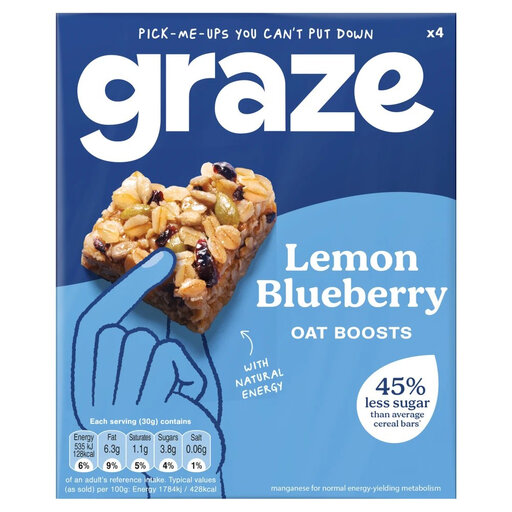
For a revision snack in an individual oat-bar format, compare the label for one 30 g bar with the amount you plan to eat. Check the current ingredients and allergen wording for this flavour.
 No image available
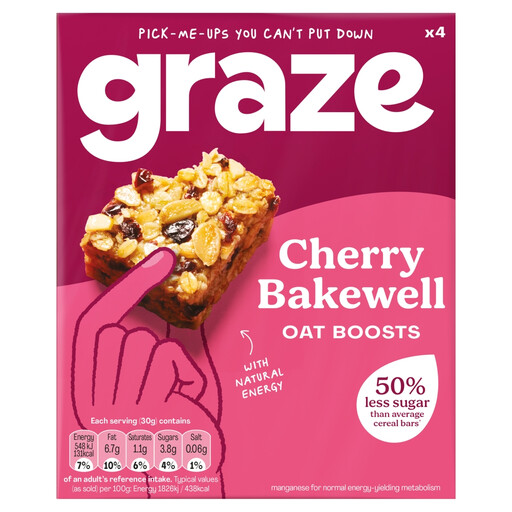
Another 30 g oat-bar option for comparing individual portions. Read this variant’s nutrition and ingredient label rather than applying figures or dietary claims from a different Graze flavour.
 No image available
For shoppers comparing a fruit-and-nut bar with oat bars, Nakd lists 131 kcal, 17 g total sugars and 3.3 g fibre per 35 g bar. Nakd describes it as vegan and gluten-free, but its ingredients include cashews and almonds; check the current pack’s may-contain wording too.
 No image available
This 50 g protein-bar format is worth comparing separately from smaller cereal bars if protein content is your priority. Check kcal, protein, total sugars and allergens on the exact pack before deciding whether one bar fits your intended snack.
 No image available
The stated 21.5 g bar is a smaller portion than the other Joybuy bars shown here. Compare its kcal for the amount you would eat, then check the per-100-g panel and current allergen information.
Start with kcal for the full bar—or the amount you expect to eat—then compare nutrition per 100 g on the same weight basis. The NHS notes that a manufacturer’s portion may differ from yours; sugars, saturated fat, salt, fibre and protein can also affect which label details matter to you.
No. Nakd describes its Blueberry Muffin bar as having no added sugar, while its UK nutrition panel lists 17 g total sugars and 131 kcal per 35 g bar. Read the total sugars and kcal figures rather than treating that claim as a substitute for the panel.
Read the current pack’s ingredients, highlighted allergens and may-contain statement for the exact flavour. Vegan or gluten-free wording answers particular dietary questions, but it does not establish suitability for every allergy; for example, Nakd Blueberry Muffin contains cashews and almonds.
No. Nature Valley lists around 10 g protein and 198 kcal per 40 g Salted Caramel Nut bar, while Eat Natural lists 7.8 g protein and 220 kcal per 40 g Peanuts & Dark Chocolate bar. Compare those per-bar figures with smaller bars if calories for your intended portion are the deciding factor.