Desk snackers watching portion size
If you want a portable mid-morning snack with a modest calorie total, compare the amount in the whole bar as well as the figures per 100g. A smaller bar can have fewer calories simply because it is smaller.


Start with the calories in the whole bar or portion you intend to eat, then use the per-100g figures to compare bars of different sizes. Tesco lists two 30g Graze Oat Boosts at 116 and 129 kcal each; fruit-and-nut or protein bars may offer different amounts of fibre and protein, so check sugars, saturated fat and allergens on the current pack too.
If you want a portable mid-morning snack with a modest calorie total, compare the amount in the whole bar as well as the figures per 100g. A smaller bar can have fewer calories simply because it is smaller.
If those nutrients matter to your choice, compare their amounts per bar alongside calories and sugars rather than relying on a front-of-pack claim.
Check the dietary statement and allergen information for the exact flavour and pack. Fruit, nuts, oats, milk and soya differ between products, even within a brand.
Choose the portion you would actually eat, compare bars by weight, then check the other label details that matter to you.
| Priority | What to check | Your needs |
|---|---|---|
| Portion and calories | Read kcal per whole bar or stated portion. Use kcal per 100g to compare different bar sizes on the same weight basis, as NHS food-label guidance advises. | I want to know the calories in the snack I will actually eat, without assuming a smaller bar has fewer calories per 100g. |
| Sugars and saturated fat | Compare both per bar and per 100g. Read total sugars even when the pack says ‘no added sugar’; check saturated fat separately. | A lower calorie total is useful to me, but I also want to see what the bar’s sugars and saturated fat figures mean for the portion I choose. |
| Fibre and protein | Compare grams of each per bar alongside calories, sugars and portion weight. A protein-led name does not tell you the calorie total. | If I am choosing a bar for its fibre or protein, I can weigh those amounts against the other nutrition figures rather than judging it by one claim. |
| Dietary suitability | Read the current ingredient list, allergen statement and any vegan or gluten-free declaration for the exact variant. Check any precautionary allergen wording relevant to you. | I need to rule out ingredients or allergen warnings that conflict with my requirements before comparing calories. |
In its 2025 review of 458 snack bars sold by 10 major UK retailers, Action on Salt & Sugar classified 37% as high in sugars and 55% as high in saturated fat under UK front-of-pack thresholds. Those are findings about the products reviewed, not about every bar.
Check calories, sugars and saturated fat on the nutrition label, then consider fibre and protein rather than treating a single claim as a summary of the bar.
A 30g bar and a 50g flapjack are different-sized portions. Their calorie totals tell you about those portions, not which has fewer calories for the same weight.
Use the per-bar figure for what you plan to eat and the per-100g figure for a like-for-like comparison.
Tesco lists Nakd Peanut Delight as having no added sugar and 12g total sugars per 35g bar. The two statements describe different things.
Read ‘of which sugars’ per bar and per 100g, as well as the ingredient list.
Bars in this category can contain peanuts, other nuts, milk or soya, and dietary labels do not replace the allergen statement for a particular product.
If you have an allergy or a dietary restriction, check the current pack and its precautionary warnings before comparing nutrition.
These examples show how particular ranges differ; a brand name alone does not establish the nutrition or suitability of every flavour.
The 30g Oat Boost flapjacks are examples of individually portioned oat bars.
Its Protein + Fibre and Salted Caramel Nut bars offer protein-focused alternatives to the small oat-bar examples.
Fruit-and-nut bars offer another route for shoppers checking vegan or gluten-free labels.
Its Original Oat Protein Flapjack is a larger, protein-focused bar.
The Dark Chocolate & Peanut Protein Bar is a nut-led option to assess by its full nutrition panel.
Alpen has appeared in cereal-bar ranges, but an older product list is not a reliable way to choose a current bar.
These options cover individually portioned oat and fruit-and-nut bars alongside protein bars. Compare the current pack details for each flavour and pack size before choosing a mid-morning snack.
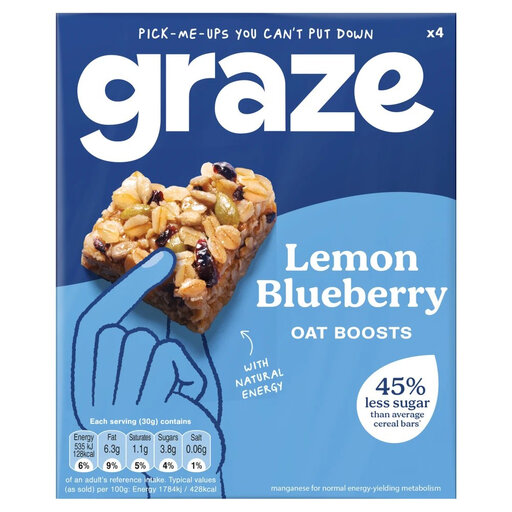 No image available
An individually portioned oat-bar option for a mid-morning snack. Compare the nutrition figures for one 30g bar with those of larger bars, and check the current allergen statement.
 No image available
A fruit-and-nut option in individual 35g bars. Compare total sugars as well as calories, and read the ingredient and allergen statements for this flavour.
 No image available
If you are considering a peanut-and-fruit bar, check that the pack is Peanut Delight before using its nutrition information. Tesco lists 155 kcal and 12g total sugars per 35g Peanut Delight bar; it contains peanuts.
 No image available
A protein-bar option for comparing nutrition per 40g bar with smaller oat or fruit-and-nut bars. Nature Valley UK identifies peanut, soya, almond and milk ingredients for its Salted Caramel Nut bar; check the current pack.
 No image available
A 50g protein-bar option if you want to compare a larger individual bar with smaller mid-morning portions. Read its current nutrition panel and allergen statement before deciding whether it meets your needs.
Use kcal for the whole bar or portion you intend to eat, then compare kcal per 100g for an equal-weight comparison. As NHS food-label guidance explains, nutrition information is given per 100g and may also be given per portion; a smaller bar can have fewer total calories without having fewer calories per 100g.
No. Read total sugars on the nutrition label: Tesco lists Nakd Peanut Delight as having no added sugar but containing 12g sugars per 35g bar. NHS food-label guidance defines more than 22.5g sugars per 100g of food as high and 5g or less per 100g as low.
No. Compare the stated portion and nutrition figures rather than the protein claim alone. Nature Valley UK lists 167 kcal per 36g Protein + Fibre Chocolate & Orange bar, while Myprotein UK lists 217 kcal per 50g Trek Original Oat Protein Flapjack; those are different-sized products with different nutrition profiles.
Yes. Tesco lists Nakd Peanut Delight as vegan and gluten-free, but it contains peanuts and may contain soya and other nuts. Check the exact product’s current ingredient list and allergen warning against your requirements.
Yes. Use the current pack to confirm the flavour, portion size, nutrition figures and allergen information, particularly if a specific ingredient or dietary declaration determines whether you can eat it.