What should you check?
Start with the claim on the pack, compare figures on the same basis, then check the portion and school-specific restrictions before choosing a bar.
| Priority | What to check | Your needs |
|---|
| Fat claim |
Read the claim for the finished bar, not an ingredient description. The British Nutrition Foundation explains that “reduced fat” compares a product with a similar one and means at least 30% less fat; Business Companion gives “low fat” a separate limit of 3g fat per 100g for solid foods. |
I’m specifically looking for a reduced-fat bar, rather than assuming that “less sugar” or “fat-reduced cocoa” means the same thing. |
| Total fat |
Compare total fat per 100g across bars, then read the amount per bar. Kellogg’s UK declares 6.3g per 100g for Special K Red Berry; Tesco lists 22g for Graze Cocoa Vanilla Oat Boosts, and Nature Valley UK lists 25.7g for Protein Fibre Coconut & Almond. |
If I’m choosing between bars of different sizes, I want a like-for-like comparison and the figure for the portion going into the lunchbox. |
| Allergens |
Read the exact wrapper for ingredients and precautionary allergen statements. Check the child’s requirements and the school’s current policy; do not assume that every bar has the same gluten or nut status. |
The bar needs to fit both my child’s dietary requirements and the school’s approach to packed lunches. |
| Sugars and fibre |
Read the amounts for the portion as well as per 100g. Tesco lists 2.7g sugars per 30g Graze Cocoa Vanilla Oat Boost bar, but also lists 22g fat per 100g; its lower-sugar wording is not a reduced-fat claim. |
I want to consider sugars and fibre without letting one front-of-pack claim decide the whole choice. |
| Lunch portion |
Check the weight and nutrition of the individual bar, then consider what else is being packed. A bar’s nutrition panel describes that snack, not the entire lunch. |
For a school day, I’m choosing a snack component rather than treating a cereal bar as the lunch itself. |
Cereal bars on Joybuy
These individually packaged cereal-bar options are relevant to the school packed-lunch question. Compare their exact pack sizes and current labels rather than treating their names or their inclusion here as a reduced-fat claim.
 No image available
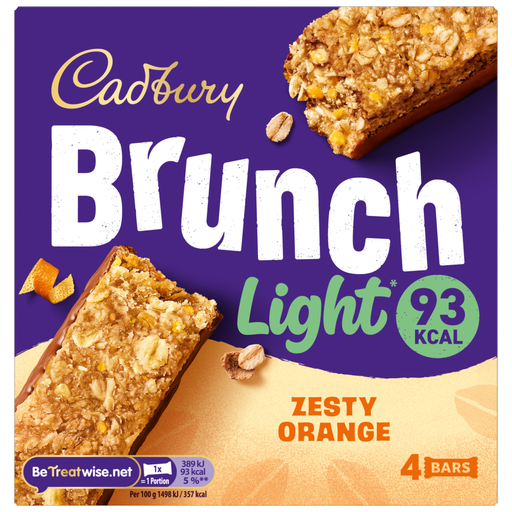
Cadbury Brunch Light Orange Cereal Bar, 4pk, 104g
The four-pack format is one option for packing individual bars. “Light” in the name is not, by itself, a reduced-fat claim; check the current nutrition panel and any peanut or nut precautionary statement against the school’s policy.
View on Joybuy
 No image available
Special K Red Berry Cereal Bar, 6 x 21.5g
This pack states six 21.5g bars. Kellogg’s published fat figures for a 27g Special K Red Berry bar should not be applied to this differently sized listing; check this pack’s own nutrition and allergen statement before putting a bar in a school lunch.
View on Joybuy
 No image available
Special K Dark Chocolate Snack, 6 x 21.5g
This dark-chocolate variant also states six 21.5g bars. Check its own fat and sugars figures, allergen statement and the school’s rules rather than carrying figures across from the Red Berry variant.
View on Joybuy
Frequently asked questions
Are “reduced fat” and “low fat” the same on a cereal-bar pack?
No. The British Nutrition Foundation describes “reduced fat” as at least 30% less fat than a similar product, while Business Companion gives “low fat” a limit of no more than 3g fat per 100g for solid foods. Read the exact claim and nutrition panel; neither lower-sugar wording nor an ingredient called fat-reduced cocoa answers the fat question.
Does the lowest-fat bar in the three-product comparison qualify as reduced fat?
A lower figure in this comparison does not establish a reduced-fat claim. Kellogg’s UK lists 6.3g fat per 100g for its Special K Red Berry product, compared with Tesco’s 22g for Graze Cocoa Vanilla Oat Boosts and Nature Valley UK’s 25.7g for Protein Fibre Coconut & Almond. The comparison is only of declared fat per 100g for those exact products; check any reduced-fat claim and its comparator on the pack.
What allergen checks matter for a school lunchbox bar?
Read the current wrapper of the exact bar for ingredients and precautionary statements, including cereals containing gluten, peanuts, tree nuts, milk and soya where relevant. Also check the school’s policy: England’s Department for Education says food brought from home should be considered in schools’ approaches to allergy safety.
Does a gluten-free bar necessarily fit a school’s nut policy?
No. Nature Valley describes its Protein Peanut & Chocolate bar as gluten-free, but the Joybuy listing says it contains peanuts, soya and milk and may contain nuts. Check the exact wrapper, the child’s requirements and the school’s policy separately.


