Shoppers prioritising less fat
If you want dried fruit for the afternoon but are comparing fat content, the distinction between fruit-only packs and fruit-and-nut mixes matters more than the word “fruit” on the front of a pack.


If fat is your main criterion, compare fruit-only packs before fruit-and-nut mixes. The cited Tesco Groceries and Ocado/M&S fruit-only examples list 0.5–1.2 g fat per 100 g, while the cited Whitworths and M&S nut mixes list 23.6–29.5 g per 100 g. That does not settle whether dried fruit suits a between-meal snack: the NHS advises eating it at mealtimes to reduce tooth-decay risk.
If you want dried fruit for the afternoon but are comparing fat content, the distinction between fruit-only packs and fruit-and-nut mixes matters more than the word “fruit” on the front of a pack.
A portable pack can still call for a look at its serving size, sugars, ingredients and allergen statements, particularly when switching between plain fruit and a flavoured blend.
Age and eating occasion matter as well as the nutrition panel. The Department for Education advises against offering raisins as a snack to children under 12 months; the NHS advises having dried fruit at mealtimes rather than between meals.
Start with fat per 100 g for the exact pack, then decide whether its ingredients, portion and intended eating time fit your plans.
| Priority | What to check | Your needs |
|---|---|---|
| Fat content | Compare fat per 100 g on the exact pack. Check whether a fruit blend contains nuts rather than assuming all dried-fruit products have similar values. | I want fruit without choosing a nut mix by mistake. Ocado/M&S lists 0.5 g fat per 100 g for M&S Orchard Fruits Medley, but 29.5 g for M&S Fruit & Nuts. |
| Sugars and portion | Read sugars per 100 g and per serving, and check the pack size. The NHS counts 30 g of dried fruit as one 5 A Day portion. | A small pack or a measured amount may be easier for me to plan than eating from a larger bag. Tesco Groceries lists 18.8 g sugars per 30 g of Tesco Seedless Raisins. |
| Eating time | Consider whether the fruit will be eaten with a meal or between meals. The NHS advises mealtimes for dried fruit to reduce tooth-decay risk. | If my afternoon snack is separate from a meal, lower fat alone does not address the NHS dental advice. |
| Ingredients and allergens | Check for juice-infused or sweetened fruit, sulphites, declared nuts and may-contain statements on the exact pack. | I need the ingredient and allergen information to fit the person eating it. The Food Standards Agency identifies sulphites as an ingredient used in some dried fruit. |
Nuts change the comparison: Whitworths lists 23.6 g fat per 100 g for its 1DERS fruit-and-nut mix, while Ocado/M&S lists 29.5 g for M&S Fruit & Nuts.
If fat is the deciding factor, compare the per-100-g figures and ingredient lists before choosing a mix for its texture.
The NHS counts 30 g of dried fruit as one 5 A Day portion but advises eating dried fruit at mealtimes, not as a between-meal snack, to reduce tooth-decay risk.
Consider when you intend to eat it, rather than making the decision from its fat figure alone.
Ocado/M&S declares sulphites for M&S Orchard Fruits Medley and nuts for M&S Fruit & Nuts. The Food Standards Agency notes a higher risk of reaction to sulphur dioxide for people with asthma.
Read the ingredients and allergen statement on the particular pack, including any may-contain wording.
A fruit blend can contain other ingredients: Ocado/M&S lists apple-juice-infused cranberries and blueberries in M&S Super Fruit Medley.
Compare the nutrition panel and full ingredient list, then check what the stated serving size represents.
These product examples show why it helps to compare individual packs rather than judge fat content by brand alone.
Tesco Seedless Raisins are a fruit-only example for comparing a larger pack with smaller snack formats.
Its snacking raisins and 1DERS fruit-and-nut mix illustrate two different ingredient profiles.
The cited M&S medley and nut mix give shoppers distinct fat and allergen labels to compare.
These raisin, sultana and prune packs offer different pack sizes and formats to consider when choosing dried fruit for the afternoon. Check each pack’s nutrition and ingredients alongside the NHS advice on eating dried fruit at mealtimes.
 No image available
The 12 x 14g format offers individually sized packs to consider for an afternoon eating occasion. The NHS advises having dried fruit at mealtimes rather than between meals; the 12+ months age marking does not change that advice.
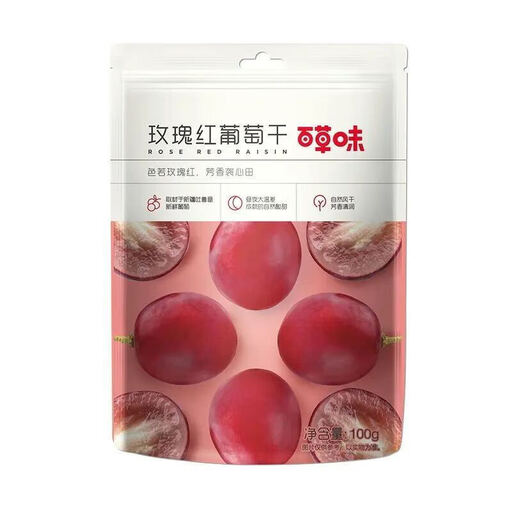 No image available
This 100g raisin pack is an option if you want to choose your own amount. Check its fat and sugars per 100 g on the pack, and consider the NHS advice on eating dried fruit at mealtimes.
 No image available
These pitted prunes come in a 500g pack and are described as individually wrapped. Check the sugars declaration rather than relying on the product title’s “sugar-free” wording, and consider whether dried fruit fits your intended eating time.
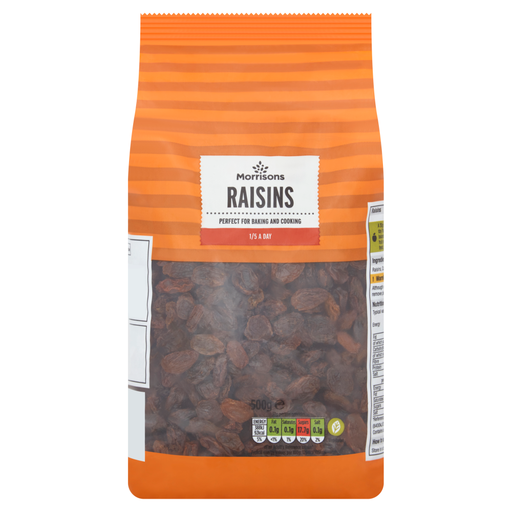 No image available
The 500g bag lets you take an amount for a planned eating occasion rather than buying individual packs. Compare its nutrition panel and ingredients with other raisins, and bear in mind the NHS mealtime advice.
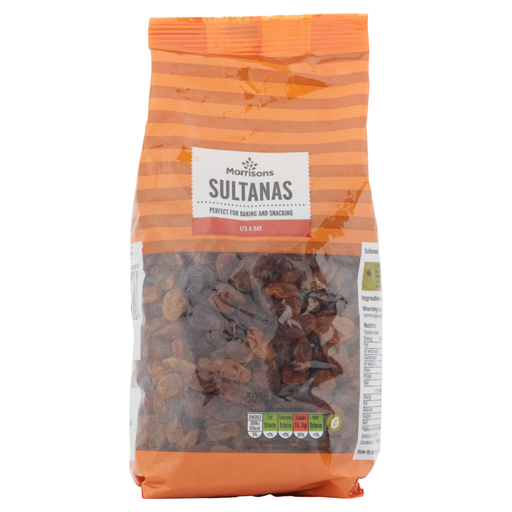 No image available
This 500g sultana bag is another larger-pack option if you plan to take out a portion. Read its own fat, sugars and ingredient information rather than assuming it matches the Morrisons raisin pack.
No. Compare fat per 100 g on the exact product: Ocado/M&S lists 0.5 g for M&S Orchard Fruits Medley but 29.5 g for M&S Fruit & Nuts. Ingredients, particularly nuts, can change the comparison.
The NHS advises eating dried fruit at mealtimes rather than as a between-meal snack to reduce tooth-decay risk. It counts 30 g as one 5 A Day portion, but that portion figure does not remove the advice about timing.
Check sugars per 100 g and per serving, the full ingredient list and allergen statements. The Food Standards Agency identifies sulphites as an ingredient used in some dried fruit and notes a higher risk of reaction to sulphur dioxide for people with asthma.
The Department for Education advises not offering raisins as a snack to children under 12 months, although they can be chopped as part of a meal. Its early-years food-safety guidance also says children must never be left alone while eating.