Parents feeding selective young eaters
Topping familiarity matters alongside the nutrition label. For children who reject unfamiliar foods, the NHS advises offering variety repeatedly, serving small portions and not forcing them to eat.


Start with frozen pizzas whose toppings the eater is willing to try, then compare their fat per 100g. Check saturates, salt, the likely portion and allergens too: a familiar Margherita may be easier to serve, but neither plain toppings nor a thin crust establish that it has less fat.
Topping familiarity matters alongside the nutrition label. For children who reject unfamiliar foods, the NHS advises offering variety repeatedly, serving small portions and not forcing them to eat.
If frozen pizza remains on the menu, compare fat per 100g among acceptable options, then check saturates, salt and the portion likely to be served. A lower figure in that comparison does not by itself establish an on-pack reduced-fat claim.
When gluten-free suitability is needed, check the product’s dietary and allergen information first. A free-from label serves a different purpose from a comparison of fat or saturated fat.
Compare pizzas with acceptable toppings on the same per-100g basis before looking at the portion to be served. The Food Standards Agency and Ipsos interviewed 611 UK adults between 16 September and 23 November 2024 for their Making Food Better Tracker Survey; its label-use figure concerns food shopping generally, not frozen pizza.
| Priority | What to check | Your needs |
|---|---|---|
| Nutrition label | Compare fat, saturates and salt per 100g on the exact pizzas under consideration. Read traffic-light information alongside the nutrition panel. | I want to compare pizzas that could work for this meal, rather than judge them by the box. In the Food Standards Agency and Ipsos 2024 survey, 49% of the 611 UK adults interviewed actively used traffic-light labelling when shopping for food. |
| Portion | Check the pack’s serving weight and nutrition per serving. Use per-100g values for comparison before considering how much pizza will be served. | A half-pizza figure only helps me plan the meal if I also know how large that half is. |
| Toppings | Read the topping description and ingredients. Compare a familiar cheese-and-tomato pizza with mixed-topping options only if both are realistic choices for the eater. | Chicken, spinach or mushrooms may change whether this particular pizza is accepted, even if its fat figure looks useful. |
| Claims and crust | Check fat values rather than treating “thin crust” as a nutrition claim. If a pack says “reduced fat”, read what comparison it states. | I do not want the crust description or a reduced-fat claim to replace a check of the whole label. |
| Dietary suitability | Check ingredients, allergens and any required gluten-free statement on the current pack. Compare nutrition separately from dietary suitability. | If gluten-free suitability matters in my household, I need to establish that first; I cannot use a free-from label to judge fat content. |
Dr. Oetker UK describes Ristorante Mozzarella as thin and crispy, yet lists 12g fat per 100g. Crust style alone cannot tell you how its fat content compares with another pizza.
Check fat and saturates per 100g for the exact products you are choosing between, then consider the portion.
A half-pizza serving can represent a different weight from one product to another. ASDA Groceries, for example, lists both per-100g values and half-pizza values for its Saporito Stonebaked Margherita.
Use per-100g figures for a like-for-like label comparison, then read the serving figures for the meal you intend to make.
Sainsbury’s Free From Margherita is listed as suitable for coeliacs, but that suitability does not describe its fat content: the listing gives 9.2g fat and 5.1g saturates per 100g.
Check dietary suitability and allergens for their intended purpose, and assess fat, saturates and salt separately.
A pizza is a less workable meal choice if its toppings are rejected. The NHS advises offering children variety over time, with small portions and without forcing them to eat.
Keep accepted toppings in mind when choosing the main pizza, and offer unfamiliar foods gradually rather than making one pizza carry the whole change.
The Ristorante line includes pizzas with different topping combinations, including Pollo with chicken, spinach and sweetcorn.
Saporito Stonebaked Margherita is a frozen, simple-topping option for shoppers considering a familiar pizza style.
Free From Margherita is a frozen gluten-free pizza listed as suitable for coeliacs.
Goodfella’s lists frozen pizzas in stonebaked thin-crust, takeaway, deep-pan, pizza-pocket and gluten-free formats.
Chicago Town’s Ultimate Chicago Thin Sausage ’n’ Pepperoni is a frozen pizza with meat toppings.
These pizzas offer Margherita, ham-and-mushroom and pepperoni toppings to consider against what the eater accepts. For any option you might serve, check the current pack’s nutrition and allergen information.
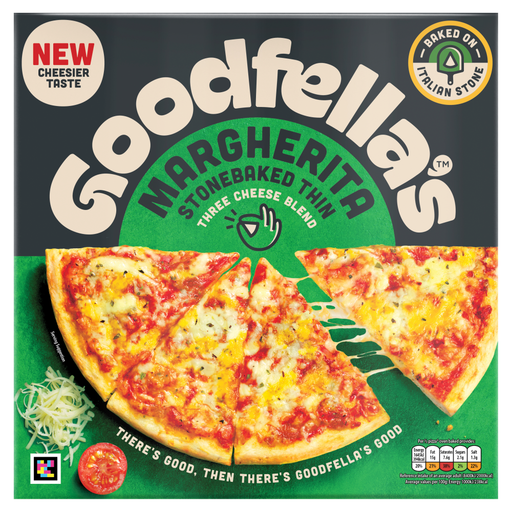 No image available
A tomato-and-cheese option to consider if those toppings are accepted. Compare its fat, saturates and salt per 100g with other suitable pizzas; the thin crust does not establish a reduced-fat claim.
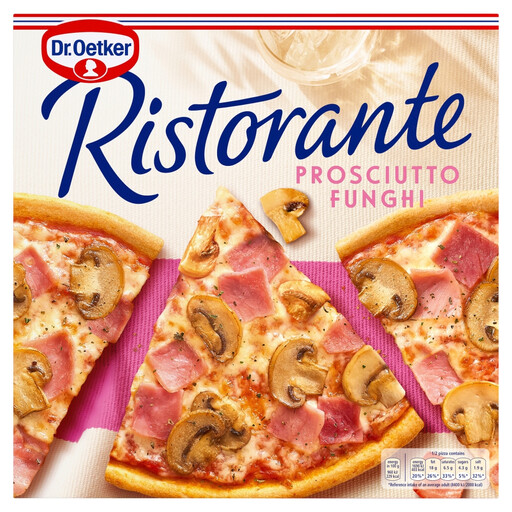 No image available
Consider its ham-and-mushroom toppings only if they are acceptable to the eater. Its listed nutrition includes fat, saturates and salt per 100g for comparison; check the current pack before interpreting any fat claim.
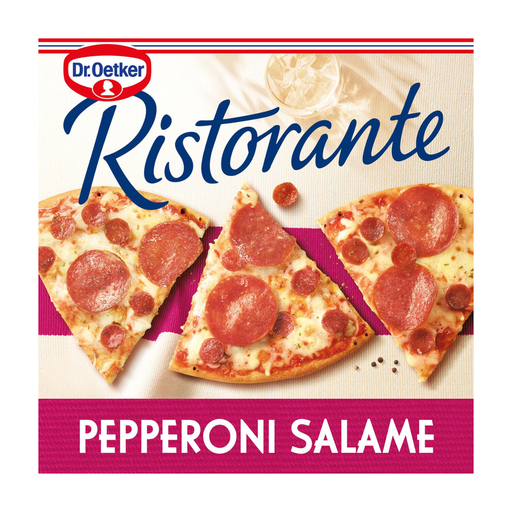 No image available
Pepperoni is the relevant topping to check against the eater’s preferences. Use the listed fat, saturates and salt per 100g to compare it with other pizzas they would eat, rather than judging it by its thin-and-crispy base.
No. Compare the exact pizzas’ declared fat per 100g: Dr. Oetker UK lists its thin-and-crispy Ristorante Mozzarella at 12g per 100g and Ristorante Pollo at 7.8g per 100g. Check saturates and the serving too.
Only if its toppings make it a realistic meal choice. Compare fat among pizzas the eater is willing to try; for children, the NHS advises offering variety gradually, giving small portions and not forcing them to eat a rejected food.
No. Read what comparison the pack states, then check its fat and saturates per 100g, salt and serving information. A thin crust or gluten-free statement describes a different attribute.
A gluten-free label does not establish that. Sainsbury’s lists its Free From Margherita at 9.2g fat and 5.1g saturates per 100g; check gluten-free suitability for the dietary requirement, then compare nutrition separately.
Follow the directions for the exact product. Chicago Town instructs buyers of its Ultimate Chicago Thin Sausage ’n’ Pepperoni to keep it frozen until baking, cook it at 200°C in a fan oven for 14–15 minutes, ensure it is thoroughly cooked and let it stand for two minutes before serving. Other pizzas may have different instructions.