Unsalted peanuts can address salt without reducing fat: Sainsbury's lists KP Unsalted at 51g fat per 100g, the same figure KP gives for Original Salted. If reducing fat is essential, compare the particular product's UK nutrition information per 100g and per intended serving rather than relying on words such as “unsalted” or “dry roasted”. The NHS advises against whole nuts for children under 5; check the school's or club's allergy policy before packing any nut snack.
Who is choosing the snack?
Families comparing salted and unsalted peanuts
For an older child or a shared snack at home, unsalted peanuts may suit a salt-focused choice. Check fat separately: Sainsbury's and KP each declare 51g fat per 100g for the KP unsalted and Original Salted varieties respectively.
Parents of children under 5
Texture comes before a comparison of fat or salt. The NHS says not to give whole nuts or peanuts to children under 5 and advises chopping or flaking nuts and seeds when preparing them for young children.
Families packing snacks for a school club
A nut snack used at home may not be permitted at a particular school or club. Check that setting's current allergy policy before packing it, regardless of whether the product is salted, unsalted or labelled reduced fat.
What should you check first?
Check the child's age and where the snack will be eaten, then compare fat, salt and the amount likely to be served.
| Priority |
What to check |
Your needs |
| Fat and pack claims |
Compare fat per 100g on the nutrition panel, then fat per intended serving. For a product labelled reduced fat, check what the claim compares it with; neither “unsalted” nor “dry roasted” establishes fat reduction. |
I want to compare the fat figures, not assume a pack description settles the question. In the Food Standards Agency and Ipsos Northern Ireland's 2024 survey of 611 adults in Northern Ireland, conducted from 16 September to 23 November, 35% named back-of-pack nutrition claims as their primary source of nutritional information and about 49% said they actively used traffic-light labelling when shopping for food. Those figures describe general food shopping, not nut-snack purchases. |
| Salt |
Compare salt per 100g separately from fat. Sainsbury's lists KP Unsalted at below 0.5g salt per 100g; KP lists Original Salted at 1.3g. Both declare 51g fat per 100g. |
If I'm choosing unsalted peanuts to avoid added salt, I still need to check whether the fat figure meets a separate lower-fat requirement. |
| Age, allergens and setting |
Check the nut and may-contain declarations, the snack's form and the school's or club's policy. The NHS says not to give whole nuts or peanuts to children under 5. |
Before I serve or pack nuts, I need a form appropriate for the child and confirmation that nuts are permitted where the snack will be eaten. |
| Serving size |
Read the stated serving size as well as the per-100g figures. Sainsbury's lists 15g fat for a 30g serving of KP Unsalted; Tesco lists 11.6g fat for a 25g serving of its Dry Roasted Peanuts. Those servings are different sizes. |
With a sharing bag, I want to decide how much to serve rather than mistake portioning for a change to the product's fat content. |
Common buying mistakes
-
Treating “unsalted” as “reduced fat”
Sainsbury's lists KP Unsalted at 51g fat per 100g, the same figure KP gives for Original Salted. Their salt figures differ, but the declared fat figures do not.
Compare fat per 100g and per intended serving, then check salt as a separate decision.
-
Choosing a sharing bag without deciding the serving
Per-serving figures refer to the quantity stated on the label. For example, Sainsbury's gives figures for 30g of KP Unsalted, while Tesco gives them for 25g of its Dry Roasted Peanuts.
Decide how much to serve and use the corresponding label figures. Dividing a bag into portions does not make its contents a reduced-fat product.
-
Offering whole peanuts to a child under 5
Whole nuts and peanuts present a choking risk for children under 5, according to the NHS.
Do not give whole nuts or peanuts to a child under 5. If considering another nut format, check the child's allergy suitability and prepare it in an age-appropriate form.
-
Assuming a snack suitable at home is allowed at a club
A school or club's allergy arrangements affect whether a family can send in a nut snack.
Ask the named school or club about its current policy before packing nuts. If nuts are not permitted, choose a non-nut snack.
Brand and retailer references
These labelled products provide comparison points for fat, salt and format; a brand name alone does not establish that a snack is reduced fat.
KP
KP salted and unsalted roasted peanuts show why salt and fat need separate comparisons.
- Sainsbury's lists KP Roasted Peanuts, Unsalted at 51g fat and below 0.5g salt per 100g.
- KP lists Original Salted at the same 51g fat per 100g, with 1.3g salt per 100g. Neither figure makes the unsalted variety a lower-fat alternative to Original Salted.
Tesco
Tesco Dry Roasted Peanuts offer another labelled whole-peanut product for comparison.
- Tesco declares 46.4g fat and 0.99g salt per 100g, with 11.6g fat per stated 25g serving.
- Tesco says this product may contain other nuts and warns that small children can choke on nuts. “Dry roasted” should not be read as a reduced-fat claim.
Planters
Planters' US Unsalted Dry Roasted Peanuts are a whole-peanut product, not a demonstrated reduced-fat choice for this UK after-school decision.
- Planters lists peanuts as the ingredient on its US product page.
- That US page gives 14g fat per serving. Use the particular UK pack's serving size, per-100g nutrition and allergen declaration for a UK comparison.
A Joybuy peanut option
This unsalted whole-peanut option is relevant when salt, rather than fat reduction, is the deciding factor for an after-school snack. Check the child's age and the eating setting before choosing it.
 No image available
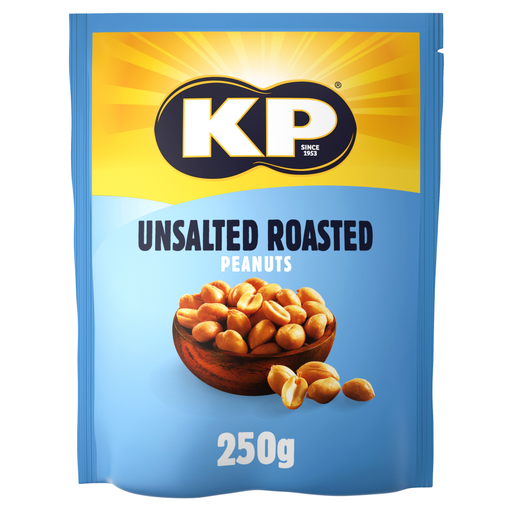
KP Snacks Unsalted Roasted Peanuts 250g
For an older child when peanuts are suitable and permitted, this unsalted snack addresses a salt preference rather than a reduced-fat requirement. Sainsbury's lists the matching KP Unsalted 250g product at 51g fat and below 0.5g salt per 100g. Do not give whole peanuts to children under 5, and check the school's or club's allergy policy before packing them.
View on Joybuy
Questions about after-school nut snacks
Are unsalted peanuts lower in fat than salted peanuts?
Not in the KP products compared here: Sainsbury's lists KP Unsalted at 51g fat per 100g, the same figure KP gives for Original Salted. Their declared salt differs—below 0.5g versus 1.3g per 100g—so compare fat and salt separately.
Can a child under 5 have whole peanuts after school?
No. The NHS says not to give whole nuts or peanuts to children under 5 because of choking risk. For a nut snack in another form, check allergy suitability and follow age-appropriate preparation guidance.
Can I send nuts to an after-school club?
Check the particular school or club's current allergy policy before sending them. The Department for Education's school-food standards concern food provided to pupils by state-funded schools in England; they do not establish blanket permission for a family's packed nut snack.
What should I compare if reducing fat is essential?
Compare fat per 100g, fat in the portion you intend to serve and the basis of any reduced-fat claim on the particular product's UK pack. A peanut powder or spread is a different format from ready-to-eat whole nuts, so also check its preparation instructions, ingredients and allergens rather than assuming the same serving figures apply.


