Shoppers comparing total fat
If reducing total fat matters more than avoiding preparation, compare plain kernels cooked as directed with ready-to-eat popcorn. Check the cooking method before using a prepared nutrition figure to plan your snack.


If reducing total fat is your main aim and you can prepare popcorn, start by comparing plain kernels cooked as directed: ASDA lists 4.5g fat per 100g for its prepared kernels, while the checked ready-to-eat and microwave options list higher figures on their own stated bases. For a snack you can take straight to work, a portioned ready-to-eat bag avoids cooking, but compare fat per 100g as well as per bag. Added oil and toppings change the result for kernels, and wording such as “lightly salted” or “reduced saturated fat” does not establish a low total-fat content.
If reducing total fat matters more than avoiding preparation, compare plain kernels cooked as directed with ready-to-eat popcorn. Check the cooking method before using a prepared nutrition figure to plan your snack.
A ready-to-eat multipack gives you a defined portion without cooking. The per-bag figure tells you what that portion contains; the per-100g figure helps you compare products of different sizes.
If salt, sugars or allergens affect your choice, read the full nutrition panel and the current pack information. Unpopped kernels also matter when popcorn is intended for a young child.
Choose a format that fits your break, then compare total fat on the same per-100g basis while keeping each product’s preparation instructions in view.
| Priority | What to check | Your needs |
|---|---|---|
| Total fat | Compare total fat per 100g, then the amount in your likely portion. Check whether a front-of-pack claim concerns total fat or saturated fat: the British Nutrition Foundation describes “reduced fat” as at least 30% less fat than a similar product, not an absolute low-fat level. | I’m choosing popcorn with total fat in mind, so a “skinny” or reduced-saturated-fat description alone will not settle the choice. |
| Portion | Check the bag weight against the stated serving. Sainsbury’s lists 1.7g fat in each 10g bag of Propercorn Lightly Sea Salted 6x10g, alongside 17.4g fat per 100g. | A small bag suits my break when I want a defined amount without weighing popcorn from a larger pack. |
| Preparation | Distinguish ready-to-eat popcorn from microwave popcorn and hob-cooked kernels. Compare prepared figures only with their stated cooking methods; added oil or toppings can change the finished snack. | If I have time and a hob, kernels are an option. At a desk, I may need a ready-to-eat bag or access to a microwave. |
| Salt and sugars | Read both values per 100g, particularly for flavoured popcorn. ASDA Groceries lists 25g sugars and 2.0g salt per 100g for ASDA Sweet & Salted Popcorn. | Fat is my starting point, but I also want to see what the flavouring contributes before choosing a bag. |
| Pack warnings | Check current ingredients, allergen statements and unpopped-kernel warnings. ASDA Groceries says its popcorn kernels may contain nuts and peanuts; Sainsbury’s warns that its Simply Salty Butterfly Popcorn is unsuitable for babies and small children because of unpopped kernels. | If I’m buying for someone with an allergy or for a young child, I need the warning on the actual pack, not just a nutrition comparison. |
Metcalfe’s Salted Caramel compares its saturated fat with average salted-caramel-style popcorn, while the Tesco Groceries nutrition panel lists 21.4g total fat per 100g. Those are different measures.
Read which nutrient the claim names, then compare total fat per 100g and in the amount you expect to eat.
ASDA and Sainsbury’s give prepared figures for their kernels, and their supplied hob methods use oil. Changing the oil or adding toppings means the declared prepared figure may no longer describe your finished popcorn.
Keep each product’s preparation basis beside its fat figure when comparing it with a ready-to-eat bag.
Hob preparation also needs time and suitable equipment during your break.
Flavoured products differ in sugars and salt, while allergen statements and unpopped-kernel warnings vary by product. ASDA Groceries lists 25g sugars and 2.0g salt per 100g for its Sweet & Salted Popcorn.
Check the current pack’s full nutrition panel, ingredients and warnings, especially when buying for someone with an allergy or a young child.
These product-line examples show why preparation and flavour matter more to this decision than a brand name on its own.
ASDA Groceries lists both kernels for hob preparation and ready-to-eat sweet-and-salted popcorn.
Sainsbury’s lists popping corn and ready-to-eat salted popcorn with different preparation requirements.
Propercorn offers portioned ready-to-eat popcorn as well as microwave and flavoured products.
Its Salted Caramel product illustrates the difference between a saturated-fat comparison and total-fat content.
Tesco Groceries provides product-level claim wording and nutrition information for the listed Metcalfe’s Salted Caramel popcorn.
These Propercorn ready-to-eat options suit an elevenses break without cooking. Compare the 10g multipack with the 70g bag by both pack size and fat per 100g; neither represents the hob-prepared kernel route.
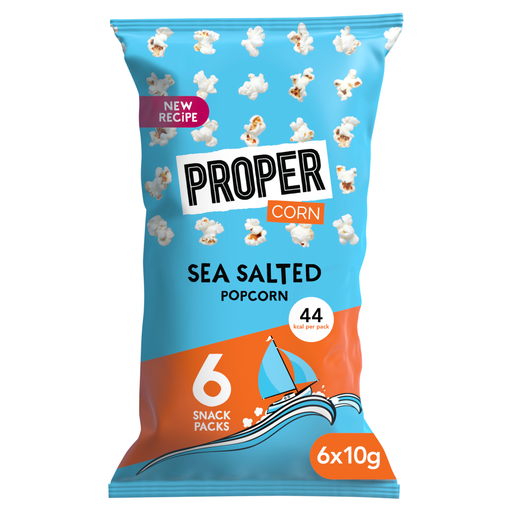 No image available
The ready-to-eat 10g bags provide a defined portion for a break away from a kitchen. The product lists 1.7g fat per bag and 17.4g per 100g. Allergen information differs between the supplied product listings, so check the statement on the pack if an allergy affects your choice.
 No image available
This ready-to-eat 70g bag avoids preparation but does not define a 10g portion as the multipack does. Joybuy lists 16.9g fat per 100g; check how much you intend to eat, the current allergen statement and availability before ordering.
No. The British Nutrition Foundation describes “reduced fat” as at least 30% less fat than a similar product: it is a relative claim, not an absolute low-fat level. Check total fat per 100g and in the portion you plan to eat, and do not confuse a reduced-saturated-fat claim with reduced total fat.
ASDA Groceries lists 4.5g fat per 100g for its Popcorn Kernels prepared as directed, the lowest declared figure among the checked options. The kernels require cooking and the supplied method uses oil, so the figure should not be treated as the value for any preparation or topping.
No. A small bag defines the amount you take, while the per-100g figure describes the product on a common comparison basis. Sainsbury’s lists 1.7g fat in a 10g bag of Propercorn Lightly Sea Salted 6x10g and 17.4g fat per 100g.
Read the current pack’s ingredients, precautionary allergen statement and kernel warning. ASDA Groceries says its popcorn kernels may contain nuts and peanuts. Sainsbury’s says its Simply Salty Butterfly Popcorn is unsuitable for babies and small children because unpopped kernels present a choking hazard.
Follow the instructions for the particular pack and stay present while it pops. Sainsbury’s listing for Propercorn Microwavable Salted Popcorn says to stop when the pops slow to two to three seconds apart.