Plain kernels are the stronger choice if lower fat is your priority and you can prepare them with little added oil or butter: a Tesco Groceries listing gives Island Sun kernels 4.3g total fat per 100g, compared with 20g to 23.8g per 100g for three checked ready-to-eat bags. Bags avoid preparation, but compare their per-100g labels rather than small-pack figures; a ‘light’ microwave claim also needs checking against the product’s own saturated-fat and salt values.
Who each format suits
The practical divide is between preparing kernels yourself and choosing a pack you can open without cooking.
Students who can prepare popcorn
Plain kernels give you control over added oil, butter and salt. Tesco Groceries lists Island Sun kernels at 4.3g total fat and 0.6g saturates per 100g before preparation, below the values listed for the checked ready-to-eat bags. You still need suitable equipment and time to pop them.
Students who need a portable snack
A ready-to-eat bag or multipack needs no cooking and can be carried between classes. Check fat, saturates, sugars and salt per 100g: a small pack’s calorie figure cannot, by itself, establish how it compares with another popcorn.
Students with microwave-only access
Microwave popcorn offers a preparation route without a hob, but ‘light’ describes a comparison made on the pack, not the whole nutrition panel. Tesco Groceries lists Golden Fluff Light microwave popcorn at 6g saturates per 100g; the NHS classifies more than 5g per 100g as high.
What to check before choosing
Start with what you can prepare, then compare nutrition on the same per-100g basis. Keep the finished popcorn in mind when adding ingredients to plain kernels.
Plain kernels
Choose when: You have equipment and time to pop them and want control over what you add.
Bear in mind: Added oil, butter or seasoning changes the finished popcorn; the kernel label describes the kernels as sold.
Ready-to-eat bags
Choose when: You need popcorn you can carry and eat without preparation.
Bear in mind: Flavour and pack size vary, so compare the full nutrition panels rather than relying on a name or serving figure.
Microwave popcorn
Choose when: A microwave is your practical way to prepare popcorn.
Bear in mind: A relative ‘light’ claim does not tell you the saturated-fat or salt content without the nutrition panel.
| Priority |
What to check |
Your needs |
| Fat and saturates |
Compare total fat and saturates per 100g across packs. The NHS calls 1.5g saturates or less per 100g low and more than 5g high; check added fat when preparing kernels. |
I want to compare products on the same basis, not assume ‘skinny’ or ‘light’ means lower fat. In the Food Standards Agency and Ipsos Northern Ireland’s 2024 survey of 611 people, 49% said they actively used traffic-light labels when shopping for food. |
| Sugars and salt |
Read both values per 100g alongside fat; recipes differ between sweet, salted and microwave products. Check the ingredients if you plan to add a coating or seasoning. |
A lower-fat figure alone would not tell me what else is in a flavoured bag. |
| Preparation |
Confirm that you have the equipment the format requires. For microwave popcorn, follow its pack instructions and any supervision warning. |
If I only have a microwave, kernels that need another preparation method may not fit my routine; on a day without cooking time, a ready-to-eat bag may be simpler. |
| Serving size |
Use per-100g values to compare products, then check the amount in the pack or serving you expect to eat. Do not treat calories for differently sized servings as a like-for-like fat comparison. |
I want to know what is in the portion I will actually use, especially when comparing a small multipack bag with a larger sharing bag. |
| Pack suitability |
Check the current allergen statement and preparation instructions. Confirm that the product is available before relying on a particular pack for a meal plan. |
I need a pack I can use with my cooking setup and any ingredient restrictions, rather than choosing by its front label alone. |
Common buying mistakes
-
Taking small-pack calories as proof of lower fat
Pack size changes the calorie figure. Tesco Groceries lists PROPER Sweet & Salty at 65kcal per 14g pack but 20g total fat per 100g; its figures answer different questions.
Compare fat and saturates per 100g first, then use the per-pack information to understand your serving.
-
Reading ‘light’ as ‘low in saturated fat’
Golden Fluff Light says it has less fat and sodium than its natural-flavour comparator, according to its Tesco Groceries listing. The same listing gives 6g saturates per 100g, above the NHS high threshold of 5g per 100g.
Check what the front-of-pack claim compares, then read the product’s own saturated-fat and salt values.
-
Choosing kernels without planning how to prepare them
The values on a plain-kernel pack do not include any oil, butter or seasoning you add. Kernels also need a preparation method you can use.
Check your equipment, the pack instructions and the allergen statement before building them into your dinner plan.
Brand and product references
These examples show why the exact product and flavour matter more than a brand name when comparing popcorn labels.
Tesco
Tesco Groceries lists both a plain-kernel product and its own ready-to-eat sweet popcorn, allowing a comparison between two different formats.
- The Island Sun kernels listing gives 4.3g fat and 0.6g saturates per 100g before preparation.
- Tesco Sweet Popcorn is a different product: its listing gives 23.4g fat and 1.8g saturates per 100g. Check the label of the pack you choose.
Propercorn
The checked PROPER Sweet & Salty 12 x 14g product is a ready-to-eat multipack.
- Individual 14g packs provide a stated serving size without preparation.
- Tesco Groceries lists this particular multipack at 20g fat, 1.7g saturates, 11g sugars and 0.66g salt per 100g; do not transfer those values to other Propercorn variants.
Metcalfe's
The checked Skinny Sweet 'N Salt product is a ready-to-eat sweet-and-salty popcorn, not a basis for judging every product with ‘skinny’ in its name.
- The Tesco Groceries listing provides per-100g values for a direct label comparison.
- That listing gives 23.8g fat, 1.4g saturates, 18.1g sugars and 1.3g salt per 100g. Read all four values rather than the product name alone.
Ready-to-eat options on Joybuy
These Propercorn bags and multipacks represent the no-preparation route. If lower fat is the main aim, compare each pack’s per-100g label with plain kernels and consider what you would add when preparing them.
 No image available
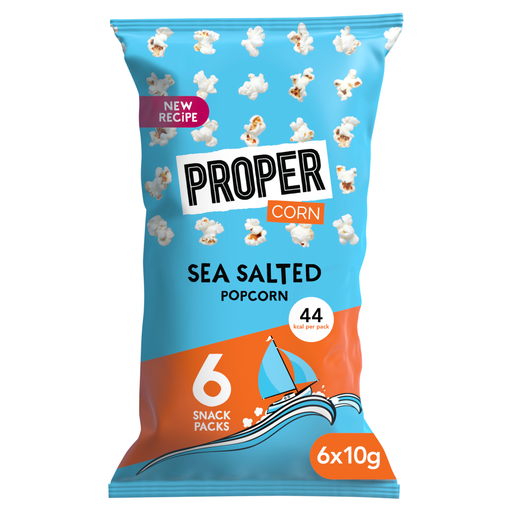
Propercorn Lightly Sea Salted Popcorn 6 x 10g
Six ready-to-eat 10g packs suit carrying individual portions. For a lower-fat comparison, check total fat and saturates per 100g on the current pack, along with its salt value.
View on Joybuy
 No image available
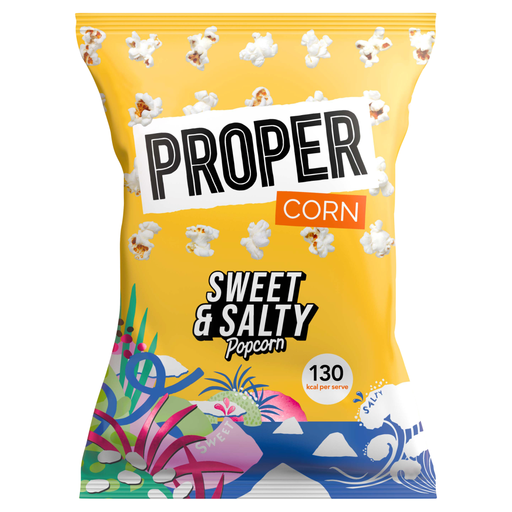
Propercorn Sweet & Salty 90g
This ready-to-eat 90g bag avoids preparation. Compare its fat, saturates, sugars and salt per 100g with other flavours rather than judging it by bag size.
View on Joybuy
 No image available
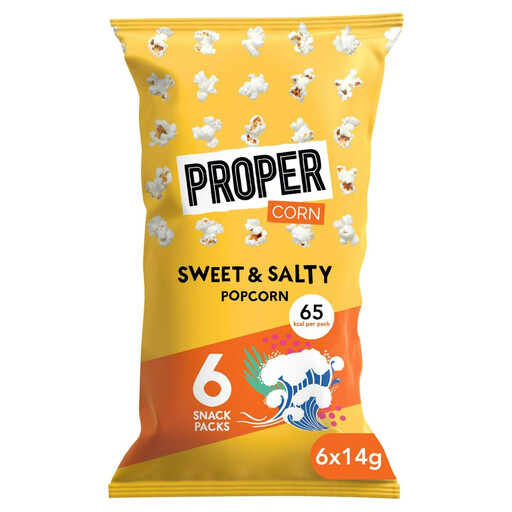
Propercorn Sweet & Salty 6 x 14g
The six-pack format provides separate ready-to-eat 14g bags. Check the nutrition values per 100g before comparing them with a larger bag or plain kernels.
View on Joybuy
 No image available
Propercorn Lightly Sea Salted 70g
This is a ready-to-eat sea-salted 70g bag rather than the six-pack version. Check its own per-100g fat, saturates and salt values; do not assume the two pack formats have identical labels.
View on Joybuy
 No image available
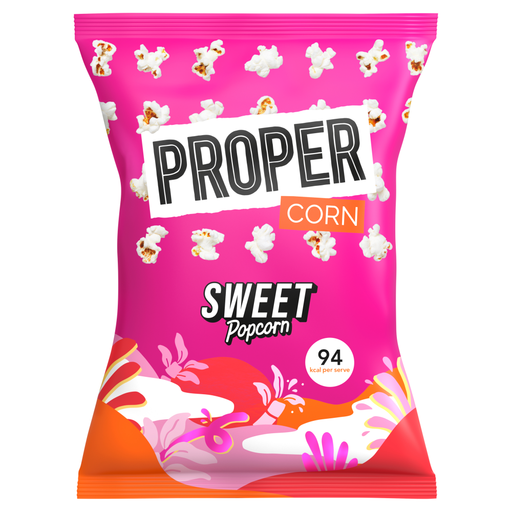
Propercorn Sweet 90g
This ready-to-eat sweet 90g bag needs no cooking. Read its sugars as well as its fat and saturates per 100g when comparing it with salted popcorn or plain kernels.
View on Joybuy
Frequently asked questions
What does ‘low in saturated fat’ mean on a per-100g comparison?
The NHS describes 1.5g saturates or less per 100g as low and more than 5g per 100g as high. Compare the same per-100g measure across products: Tesco Groceries lists Island Sun kernels at 0.6g saturates per 100g before preparation and Golden Fluff Light microwave popcorn at 6g per 100g.
Does ‘light’ or ‘skinny’ mean a popcorn has less fat?
Not necessarily compared with the other popcorn you are considering. Golden Fluff Light’s claim compares it with its natural-flavour product, while Tesco Groceries lists the Light version itself at 12g fat per 100g; the checked Metcalfe's Skinny Sweet 'N Salt lists 23.8g fat per 100g. Read the claim’s comparator and each pack’s nutrition panel.
How do plain kernels fit a lower-fat popcorn choice?
Plain kernels let you decide how much oil, butter or seasoning to add. The checked Island Sun kernels list 4.3g fat per 100g before preparation, so that figure does not describe popcorn after additions. You also need a suitable way to pop them; popcorn alone should not be assumed to make a complete dinner.
What should I check before preparing or eating popcorn?
Read the current pack’s allergen information and preparation instructions, and take care with unpopped kernels. The Golden Fluff microwave-popcorn label specifically warns against leaving the microwave unattended while popping.


