People tracking fat intake
If fat grams matter to your food plan, compare the figure per 100g before looking at the amount in one bar. Check the protein per bar separately so a lower-fat choice still fits the role you want the snack to play.


Compare fat per 100g first, then check fat and protein per bar for the snack you will actually pack. Among the named flavours with documented figures, Myprotein Lean Layered White Chocolate & Raspberry has 8.6g fat per 100g and 15g protein per 40g bar, according to Myprotein UK; it is lower in fat than the other flavours compared here, but it does not meet the UK low-fat claim threshold of 3g fat per 100g for solid foods listed by legislation.gov.uk. Check the exact flavour’s allergens, warnings and storage directions before buying a multipack.
If fat grams matter to your food plan, compare the figure per 100g before looking at the amount in one bar. Check the protein per bar separately so a lower-fat choice still fits the role you want the snack to play.
Individually portioned bars are convenient to carry between training, work and travel. Read the exact pack’s storage directions and allergen statement before leaving bars in your bag or buying several at once.
A low sugar figure does not answer the lower-fat question. Compare both lines of the nutrition panel: the documented PhD Smart Choc Brownie bar, for example, lists 1.2g sugar and 9.2g fat per 64g bar, according to PhD.
Start with comparable fat figures, then use the per-bar values and pack information to decide what works as a snack you can carry.
| Priority | What to check | Your needs |
|---|---|---|
| Fat content | Compare the exact flavours’ fat per 100g, then fat per bar. For solid foods, legislation.gov.uk lists no more than 3g fat per 100g as the UK low-fat claim threshold; a bar can be lower in fat than another without meeting it. | I’m trying to keep track of the fat in each snack, not choose by a word such as “lean” alone. Myprotein UK lists 8.6g per 100g and 3.4g per 40g bar for Lean Layered White Chocolate & Raspberry. |
| Protein and portion | Read protein per bar alongside bar weight; use per-100g figures when serving sizes differ. Myprotein UK lists 15g protein in a 40g Lean Layered bar and 18g in a 45g Lean Protein Cookie Dough bar. | For a between-meal snack, I want to know what one whole bar provides, rather than comparing protein numbers without their serving sizes. |
| Sugar and flavour | Check sugar and fat on the same flavour’s panel. PhD lists 1.2g sugar and 9.2g fat per 64g Smart Choc Brownie bar; Barebells UK lists 6.4g fat per 55g Cookies & Cream bar. | I may prefer a particular flavour or a lower sugar figure, but neither tells me whether that bar meets my lower-fat aim. |
| Ingredients and warnings | Read the current ingredient and allergen statements for the exact flavour, including “may contain” wording. Check any warning about excessive consumption of sweeteners or polyols. | Before buying a case, I need to know whether its ingredients and warnings work for me; another flavour in the range may have a different label. |
| Storage | Follow the pack’s temperature and storage directions. Barebells UK specifies room-temperature storage for Cookies & Cream; Grenade UK gives a cool, dry 15°C–22°C range for its Chocolate Fudge bar. | If a bar will spend hours in my gym bag, I need somewhere to keep it that follows its own storage instructions. |
A comparison with another bar does not establish a low-fat claim. Legislation.gov.uk lists a limit of 3g fat per 100g for a low-fat claim on solid foods; the named flavours compared here have documented figures above that limit.
Use fat per 100g for the comparison and fat per bar for your portion. If a pack gives a percentage reduction, check which product or average it uses as the comparator.
Protein, sugar and fat are separate figures. PhD lists 1.2g sugar but 9.2g fat in a 64g Smart Choc Brownie bar, so its sugar figure cannot stand in for a fat comparison.
Decide which figure matters for this snack, then compare the nutrition panels for the exact flavours and serving sizes you might buy.
The documented bars include declared allergens, precautionary “may contain” statements and warnings that excessive consumption may have laxative effects. A different flavour’s ingredient list is not a substitute for the one on your pack.
Read the current label for the exact flavour before buying a case, particularly if an ingredient or precautionary allergen statement affects your choice.
A multipack may be impractical to use if its label identifies an ingredient you need to avoid.
Storage directions differ by product. Grenade UK instructs shoppers to keep its Chocolate Fudge bar in a cool, dry place at 15°C–22°C, away from direct sunlight and changes in heat.
Check the instructions on your chosen bar and avoid leaving it in direct sun or a hot car.
Myprotein UK lists Lean Layered and Lean Protein bars with nutrition figures that can be compared by flavour.
Barebells UK lists original and vegan protein-bar flavours with different ingredients and nutrition panels.
PhD’s Smart Bar range includes the documented Choc Brownie flavour.
Grenade UK provides product information for its protein-bar flavours, including Chocolate Chip Salted Caramel.
Tesco Groceries listed several Grenade protein-bar flavours in its snack-bar assortment.
These Grenade multipacks contain individually sized bars that can be packed for a gym-bag snack. Compare each exact flavour’s fat panel before treating it as a lower-fat choice; a protein or low-sugar description does not settle that question.
 No image available
A multipack of individually sized bars for taking one as a gym-bag snack. Check the Double Chocolate nutrition panel for fat per 100g and per bar, along with its ingredients and warnings, before choosing it for a lower-fat plan.
 No image available
Four individually sized bars offer a smaller multipack for gym-bag snacks. The product name describes protein and sugar, not fat: read the Oreo Flavour fat figures and allergen statement separately.
 No image available
This pack provides 50g bars that can be taken out one at a time for a gym bag. Compare the Golden Caramel fat panel with other exact flavours, and read its ingredients and warnings before buying twelve.
 No image available
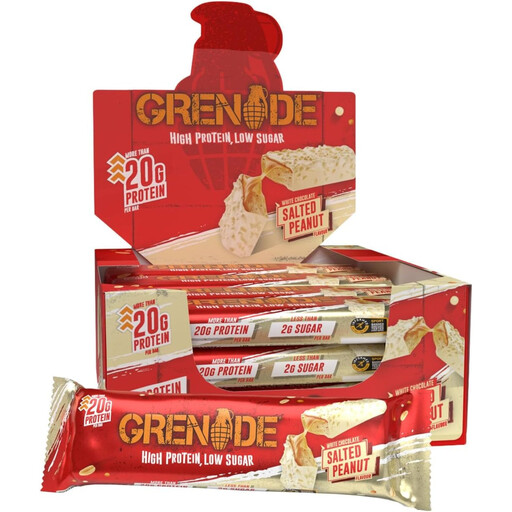
A twelve-bar pack for portioning out gym-bag snacks. If fat reduction is your priority, check this flavour’s fat per 100g and per 60g bar; read its allergen statement carefully before choosing a peanut-flavoured product.
 No image available
These individually sized bars can be packed one at a time. Check the Peanut Butter flavour’s fat figures against your other options, and read its current ingredient and allergen information before buying the multipack.
No. Legislation.gov.uk lists no more than 3g fat per 100g as the UK low-fat claim threshold for solid foods. A bar can have less fat than a named comparator and still exceed that threshold; check its fat per 100g and the basis of any comparison.
Compare fat per 100g to put the bars on the same basis, then check fat and protein per bar for the portion you will eat. Bar weights differ: Myprotein UK lists a 40g Lean Layered bar, while PhD lists a 64g Smart Choc Brownie bar.
Yes. PhD lists 1.2g sugar and 9.2g fat in its 64g Smart Choc Brownie bar; Barebells UK lists 6.4g fat in its 55g Cookies & Cream bar. Check sugar and fat separately, using the per-100g figures for a direct fat comparison.
Follow the storage instructions for the exact bar. Barebells UK specifies room-temperature storage for Cookies & Cream, while Grenade UK instructs shoppers to keep its Chocolate Fudge bar cool and dry at 15°C–22°C, away from direct sunlight and changes in heat.
Read the exact flavour’s current nutrition panel, ingredients, allergen and precautionary “may contain” statements, storage directions and any excessive-consumption warning. Formulations can differ between flavours; Myprotein UK explicitly notes that Lean Protein Bar nutrition values may vary by flavour.