Parents and carers packing lunches
When a packaged snack is convenient, compare its portion and nutrition label with the rest of the lunch. Check the exact pack’s allergen information before sharing it with a child.


For a school-holiday lunch, treat a protein bar as a snack rather than the whole meal; NHS Healthier Families recommends fruit and vegetables as snack choices. If you choose a bar, compare fat per 100g as well as the amount in one bar, then check saturated fat, sugars, salt and allergens on the exact pack. A high-protein or low-sugar description does not establish that a bar is low in fat.
When a packaged snack is convenient, compare its portion and nutrition label with the rest of the lunch. Check the exact pack’s allergen information before sharing it with a child.
Compare fat per 100g across different bar sizes, then look at the protein, sugars and amount in the bar you would actually eat. Low sugar alone does not tell you how much fat it contains.
A vegan description or a familiar brand name cannot replace a check of the exact flavour’s ingredients and allergen statements.
Decide whether a packaged bar is needed for this lunch, then compare labels on the same per-100g basis before judging the portion you will pack.
| Priority | What to check | When it matters to me |
|---|---|---|
| Total fat | Compare fat per 100g across bars, then fat in the whole bar. Check saturated fat separately. NHS label guidance defines low fat for solid food as 3g or less per 100g. | I’m trying to choose a bar with less fat without mistaking a smaller portion or a low-sugar claim for a low-fat product. |
| The whole lunch | Check the bar’s portion size, energy, sugars and salt alongside the other food being packed. NHS Healthier Families recommends fruit and vegetables as snack choices. | A bar would be one convenient snack in the lunch, not a substitute for everything else in it. |
| Allergens | Read the exact flavour’s ingredients, emphasised allergens and any precautionary statement. The Food Standards Agency explains that precautionary allergen labelling signals possible unintended allergen presence. | If I’m sharing lunch with someone who must avoid an ingredient, another flavour’s label is not enough to make the choice. |
| Protein and sugars | Compare protein and sugars per bar, but keep the per-100g fat comparison alongside them. Check whether the pack carries a warning about excessive consumption. | I may want protein in a portable snack, but that does not make the bar a complete lunch or answer the lower-fat question. |
| Plant-based choice | Check the exact product’s vegan description, ingredients and allergen statement, then compare its fat per 100g with other bars. | Avoiding animal-derived ingredients may decide which bars I consider; I still need to assess fat and any allergens separately. |
Tesco lists 13g fat per 100g for Grenade Chocolate Chip Cookie Dough 35g; PhD lists 14g for Smart Bar Choc Brownie, and Barebells lists 15g for Salty Peanut. None meets the NHS low-fat benchmark of 3g or less per 100g for solid food.
Read total and saturated fat on the nutrition panel rather than relying on the claims on the front.
The reviewed Grenade, Barebells and PhD bars weigh 35g, 55g and 64g respectively. Their per-bar figures therefore describe different-sized portions.
Use fat per 100g for a like-for-like label comparison, then check what the bar you plan to pack contains.
The reviewed bars have different ingredient and allergen declarations. The Food Standards Agency says a precautionary allergen statement communicates a risk of unintended presence.
Check the ingredients and any precautionary statement on the exact pack, particularly when sharing food.
A protein bar is a packaged snack, not the rest of the lunch. NHS Healthier Families identifies fruit and vegetables as snack choices and advises aiming for no more than two packaged snacks a day for children.
Decide what role the bar has in the lunch before choosing one for convenience.
These examples help illustrate why the exact product label matters; a brand name does not establish that every bar in its range has the same nutrition or ingredients.
Tesco lists a 35g Chocolate Chip Cookie Dough protein bar.
PhD lists Choc Brownie within its Smart Bar range.
Salty Peanut and Vegan Fudge Brownie are distinct options with different labels.
Quest’s US product page describes its Chocolate Peanut Butter Protein Bar.
Tesco lists Myprotein Crispy Wafer Vanilla 40.4g and Chocolate Flavour 41.9g products among its protein snacks.
Tesco is a retailer reference for named single bars and protein snacks, rather than a protein-bar formulation.
These portable bars and flapjacks may be considered as packaged lunch snacks. If keeping fat lower is the main aim, compare each exact pack’s nutrition panel before choosing; inclusion here is not a low-fat claim.
 No image available
The four-pack offers individual 40g bars for a packed snack. Its stated fat content is a poor fit when reducing fat is the priority; check the exact pack’s nutrition and allergen labels before sharing it.
 No image available
This four-pack also contains individual 40g bars. Its stated fat content is a poor match for a lower-fat lunch, so compare its per-100g panel and check the allergen declaration on the pack.
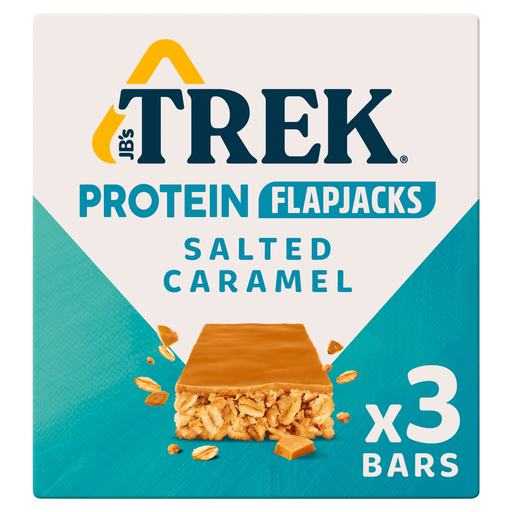 No image available
The three-pack contains individual 50g flapjacks for a packed snack. It may suit a plant-based selection, but its stated fat content works against a lower-fat aim; confirm the exact pack’s ingredients and allergen statement.
No. A comparison between two bars does not establish that either is low in fat. NHS food-label guidance gives 3g fat or less per 100g as the low-fat benchmark for solid food, so check the exact bar’s per-100g figure.
Start with total fat, saturated fat, sugars and salt per 100g so different bar sizes are comparable. Then read the figures for the whole bar you intend to pack; NHS guidance notes that labels may also show nutrition per portion.
Treat it as a snack component, not a complete lunch. NHS Healthier Families recommends fruit and vegetables as snack choices; consider what other foods will be included rather than using the protein claim to stand in for the meal.
Yes. Read the ingredients and allergen information on the exact pack. The Food Standards Agency explains that a precautionary statement such as “may contain” communicates possible unintended allergen presence, which matters when food is being shared.
PhD’s Smart Bar information warns that excessive consumption may cause laxative effects. Follow the guidance on the product you buy rather than assuming that several bars can be eaten as though they were one serving.