Party guests keeping fat lower
A sweet protein snack can suit the occasion, but the fat figure matters more than the protein claim if low fat is your firm requirement. Compare fat per 100g first, then look at the amount in the bar you would eat.


For a strict low-fat choice, start with fat per 100g, not a high-protein or low-sugar message: the nutrition-claims annex published on legislation.gov.uk sets a limit of 3g fat per 100g for a solid food described as low fat. If you simply prefer a bar with less fat, compare the same figures across similar bars rather than treating “reduced fat” as another name for low fat. For a party, check each flavour’s saturated fat, ingredients and allergen label before serving it.
A sweet protein snack can suit the occasion, but the fat figure matters more than the protein claim if low fat is your firm requirement. Compare fat per 100g first, then look at the amount in the bar you would eat.
If protein is the main reason for picking a bar, check its protein per serving alongside fat and saturated fat. A high-protein or low-sugar description does not establish that a bar is low fat.
Assorted flavours need separate ingredient and allergen checks. Keep the wrappers with the bars so guests can read the declarations for the exact flavour offered.
Choose this approach: Use it when low fat is a firm requirement, and check for no more than 3g fat per 100g on the solid bar’s nutrition label.
Trade-off: A bar can meet your protein or sugar preference while exceeding that fat limit.
Choose this approach: If you do not require a low-fat claim, compare fat and saturated fat per 100g across similar bars, then check the amount per bar.
Trade-off: The bar with less fat in a comparison may still be above the low-fat limit.
| Priority | What to check | Your needs |
|---|---|---|
| Fat and saturated fat | Read fat per 100g and per bar. The nutrition-claims annex on legislation.gov.uk gives 3g fat per 100g as the low-fat limit for solids. Compare saturated fat on the same per-100g basis. | If low fat is a firm requirement, I need the bar’s fat figure to meet that limit. If it is a preference, I want comparable figures before choosing a flavour. |
| Protein and serving size | Check protein per bar and the bar’s weight. Read energy per bar too if it matters to your selection; neither protein nor energy alone determines whether a bar is low fat. | I want a convenient protein snack for the party, but I do not want the protein figure to obscure what else is in one bar. |
| Ingredients and allergens | Read the ingredient and allergen declaration for each exact flavour, including any precautionary allergen wording. Keep its wrapper available when serving. | When I offer guests a choice of flavours, they need to be able to check the bar they are actually taking. |
| Sweeteners and warnings | Look for sugar alcohols, also called polyols, and read any excessive-consumption warning on the wrapper. Myprotein and PhD publish such warnings for the bar examples discussed here. | For a late-night gathering, I would rather check the sweeteners and serving warnings before putting out a multipack. |
Myprotein lists 10g fat per 100g for its Lean Protein Bar, while PhD lists 14g per 100g for the Choc Brownie Smart Bar. Both exceed the 3g-per-100g low-fat limit for solids set out on legislation.gov.uk.
If low fat is essential, check fat per 100g before comparing protein, sugar or flavours. Otherwise, compare fat and saturated fat across similar bars without calling the result low fat.
The nutrition-claims annex published on legislation.gov.uk describes a reduced-nutrient claim as a comparison requiring at least a 30% reduction against a similar product. The low-fat condition instead specifies an amount per 100g.
Check what a reduced-fat bar is being compared with, then read its actual fat per 100g and per bar.
Ingredients and allergen declarations can differ between flavours. Some bars also contain sugar alcohols, and Myprotein and PhD publish excessive-consumption warnings for the examples covered here.
Keep each wrapper beside its flavour and let guests check the ingredients, allergens and serving warnings before taking a bar.
Tesco advises that food products can be reformulated, changing their ingredients, nutrition information and allergens.
Use the current pack label for the final fat comparison and for checks before serving.
These brand examples show why it pays to compare the exact bar and flavour; a brand’s protein or sugar positioning does not settle its fat content.
Its Lean Protein Bar provides a labelled example for comparing fat and protein.
Its Smart Bar range has flavour-specific nutrition information, so compare the flavour you intend to serve.
Grenade presents its protein-bar range around protein, sugar and flavour choices.
Barebells has original, soft and plant-based bar ranges; exact-flavour checks matter when sharing them.
Quest describes its OG Protein Bars as protein-focused snacks.
Tesco is a retailer whose protein-bar listings provide a starting point for comparing different products.
These Grenade packs offer different flavours and bar sizes for a party selection. If keeping fat lower is the deciding factor, compare the current fat and saturated-fat figures on each pack before choosing; the flavour or protein-bar description alone cannot answer that question.
 No image available
The 12 × 50g pack gives guests a Double Chocolate option. Check the current wrapper for fat per 100g, saturated fat, ingredients and allergens before serving.
 No image available
This 12 × 50g pack adds a Golden Caramel flavour to a party selection. Compare its labelled fat per 100g with other bars, and leave the wrapper available for ingredient checks.
 No image available
The Peanut Butter flavour offers another choice in a 12 × 50g pack. Check this exact bar’s allergen declaration before putting it out for guests, as well as its fat and saturated-fat figures.
 No image available
This 4 × 60g pack is a smaller multipack option for an Oreo-flavoured party snack. Compare fat per 100g rather than assuming a larger bar has the same amount of fat per serving as a 50g bar.
 No image available
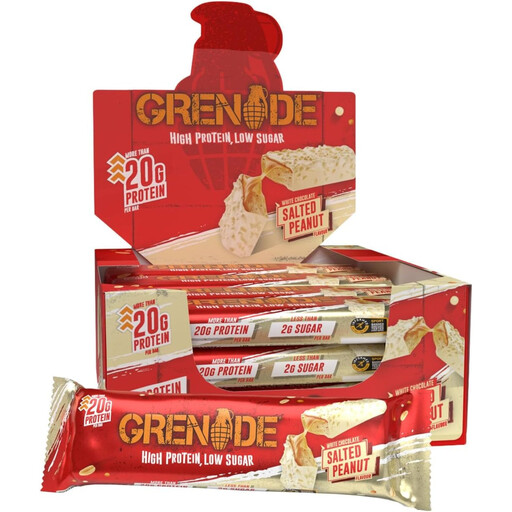
The 12 × 60g pack provides a White Chocolate Salted Peanut flavour for sharing. Keep its wrapper with the bars so guests can check allergens, and read both the per-100g and per-bar fat figures.
They describe different conditions in the nutrition-claims annex published on legislation.gov.uk: for a solid food, the low-fat limit is 3g fat per 100g, while a reduced-nutrient claim calls for at least a 30% reduction compared with a similar product. A reduced-fat comparison therefore does not, by itself, tell you that a bar meets the low-fat limit.
No. Myprotein lists 10g fat per 100g for its Lean Protein Bar, and PhD lists 14g per 100g for its Choc Brownie Smart Bar. Each exceeds the 3g-per-100g low-fat limit for solids published on legislation.gov.uk, regardless of its protein or sugar positioning.
Use both: fat per 100g lets you compare differently sized bars and check against the low-fat limit for solids; fat per bar shows the amount in the serving you plan to put out or eat.
Check the label of every exact flavour before serving it and keep the wrappers available to guests. Barebells, for example, says some of its flavours contain nuts or may contain traces, and that its bars contain lactose or may contain traces; a brand name alone is not an adequate ingredient check.
Check the ingredients and the warning on the particular bar: Quest says its protein bars contain sugar alcohols and that tolerance varies, while Myprotein and PhD publish laxative-effect warnings for the examples discussed here. Follow the current wrapper’s guidance when choosing bars for a party.