Shoppers comparing fat content
If you want to cut back on fat, a claim on the front of the wrapper is only a starting point. Compare total fat and saturates per 100g, then look at what one bar contains.


For a budget shop focused on reducing fat, compare total fat and saturates per 100g before checking protein per bar and pack size. The NHS explains that “reduced fat” is a comparison with a similar product, not a promise that the bar is low fat. A low-sugar or high-protein label cannot answer the fat question on its own.
If you want to cut back on fat, a claim on the front of the wrapper is only a starting point. Compare total fat and saturates per 100g, then look at what one bar contains.
A portable bar may be useful when you want to know the protein amount in a single serving. Read that figure alongside the fat and saturates for the same bar.
If particular allergens or sweeteners matter to you, read the statement for the exact flavour. Ingredients and warnings can be more decisive than the protein figure.
Start with figures that let you compare different bar sizes, then check the serving you would actually eat.
| Priority | What to check | Your needs |
|---|---|---|
| Total fat | Compare fat per 100g, then fat per bar. The NHS describes 3g fat or less per 100g as low fat for solid foods; “reduced fat” instead compares a product with a similar one. | I want to compare bars of different sizes without mistaking a smaller portion for a lower-fat product. |
| Saturates | Read saturates per 100g and per bar alongside total fat. The NHS identifies more than 5g saturates per 100g as high. | If I am also watching saturates, a total-fat figure alone will not answer my question. |
| Protein per bar | Use the protein figure for the actual bar size. Read its fat and saturates on the same per-bar basis; low-sugar wording does not establish low fat. | A stated protein amount is useful to me, but I want to see what else comes in that serving. |
| Pack and ingredients | Check the number and size of bars, then read the exact flavour’s ingredients, allergen statement and any sweetener warning. | I may prefer a multipack, but each bar still needs to meet my nutrition and ingredient requirements. |
The NHS explains that a reduced-fat claim means at least 30% less fat than a similar product. The resulting product can still contain more than the NHS low-fat guide of 3g fat per 100g for solid foods.
Check the current per-100g nutrition panel. If the comparison itself matters to you, check which similar product the claim refers to.
Those figures do not tell you the total fat or saturates. Barebells UK lists 20g protein, 8.2g fat and 3.6g saturates in its 55g Salty Peanut bar.
Compare protein, fat and saturates for the same serving, as well as the per-100g figures when looking across brands.
Barebells UK says its Salty Peanut bar contains milk, peanuts and soya, may contain gluten and nuts, and carries an excessive-consumption warning relating to laxative effects.
Read the current pack’s ingredients, allergen statement and warnings rather than assuming another flavour has the same formulation.
These examples describe particular bars or product lines, not every bar made by each brand.
Myprotein UK describes its Lean Layered Protein Bar as having less fat than its original Layered Bar and states 15g protein.
Barebells UK lists 20g protein, 8.2g fat and 3.6g saturates per 55g Salty Peanut bar.
PhD describes its Smart Bar range as high in protein and low in sugar.
Grenade UK presents its protein-bar range as high in protein and low in sugar, with several bar lines.
These PhD and Grenade bars are multipack options for comparing serving size, flavour and the exact nutrition label. Do not treat their protein or low-sugar wording as a reduced-fat claim.
 No image available
This 12-bar pack suits a comparison based on what each 64g bar contains. If fat is your priority, check the Chocolate Peanut Butter flavour’s fat and saturates per 100g and per bar, along with its allergen statement.
 No image available
With 12 bars of 50g, this pack calls for a per-100g comparison as well as a look at one bar’s serving figures. Check the Double Chocolate label for protein, total fat, saturates and allergens.
 No image available
The four-bar format may suit a shop where you want fewer bars at once. For the Oreo flavour, compare protein and fat per 60g bar, then use the per-100g fat and saturates figures when comparing it with other sizes.
 No image available
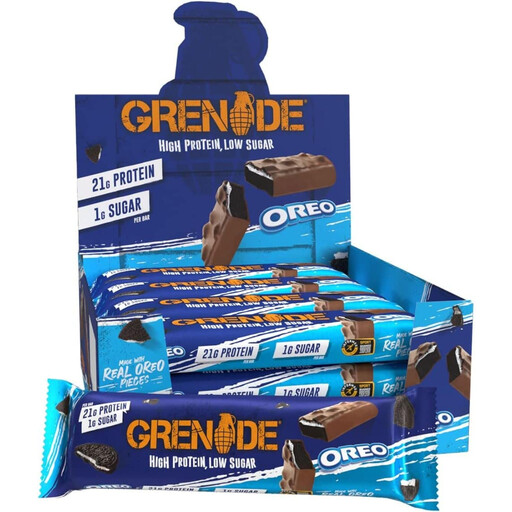
This Oreo-flavour listing contains 12 bars of 60g rather than four. Check the current nutrition and ingredient label for this pack; a larger bar count does not change what you need to assess in each serving.
 No image available
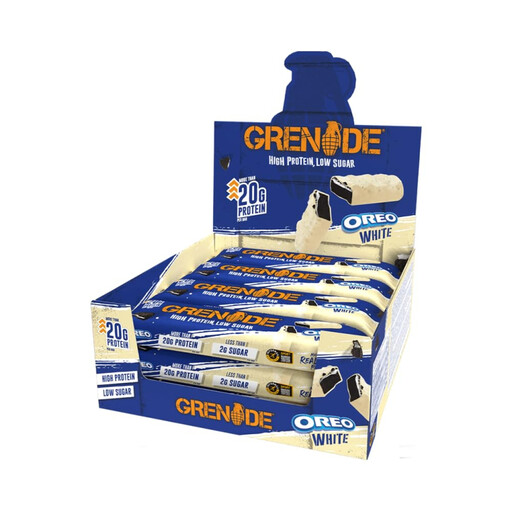
White Oreo is a distinct flavour in a 12 x 60g pack. Read its own nutrition panel for fat, saturates and protein, and check its ingredients rather than relying on another Oreo variant’s label.
No. The NHS explains that “reduced fat” means at least 30% less fat than a similar product, while its low-fat guide for solid foods is 3g fat or less per 100g. Read the bar’s nutrition panel to see where it falls.
Compare total fat and saturates per 100g to account for different bar sizes, then check both figures per bar. The NHS describes more than 17.5g fat or more than 5g saturates per 100g as high.
Yes. Sugar and fat are separate figures: Barebells UK lists 8.2g fat and 3.6g saturates in a 55g Salty Peanut bar. Check both nutrients for the particular bar you are considering.
Read the current ingredients, allergen statement and warnings for the exact flavour. Barebells UK says its Salty Peanut bar contains milk, peanuts and soya, may contain gluten and nuts, and warns that excessive consumption may have laxative effects.