Cyclists comparing fat figures
If you want a rice-cake snack with less fat, compare the exact varieties rather than assuming plain and flavoured cakes have similar nutrition panels.


For a lower-fat rice-cake snack, compare fat per 100 g, but choose what to carry using carbohydrate per cake and the number you can realistically eat. British Cycling gives 1 g of carbohydrate per kg of bodyweight per hour as a general event-day rule; a lower fat figure alone does not tell you how much a snack contributes to a longer ride. Flavoured cakes can differ considerably from plain ones in carbohydrate per piece, sugars, salt and ingredients.
If you want a rice-cake snack with less fat, compare the exact varieties rather than assuming plain and flavoured cakes have similar nutrition panels.
Carbohydrate per cake helps you work out how many pieces you would need to carry and eat alongside your other food and drink.
Check the current pack for ingredients, free-from statements and precautionary allergen wording. Rice as a main ingredient does not establish suitability for a particular requirement.
Start with the per-100-g panel to compare products on the same basis, then use the per-cake figures to plan what you would actually take on a ride.
| Priority | What to check | Your needs |
|---|---|---|
| Carbohydrate for the ride | Check carbohydrate per cake and the number of cakes you can carry and eat. British Cycling gives 1 g per kg of bodyweight per hour as a general event-day carbohydrate rule, not a rice-cake serving size. | For a longer ride, I want to know what each cake contributes to my wider food and drink plan. Kallo lists 5.6 g carbohydrate per cake, Sainsbury’s 5.9 g and Asda 6.1 g; Tesco lists 11 g per 13 g Snack a Jacks Caramel Jumbo cake. |
| Fat comparison | Compare fat per 100 g, then check the serving size. Marks & Spencer lists 2.5 g per 100 g for its Lightly Salted cakes; Asda lists 2.9 g for Slightly Salted, while Ocado lists 5.8 g for Snack a Jacks Salt & Vinegar Jumbo. | If reducing fat is my priority, I would compare the exact varieties rather than judge them by flavour, appearance or calories per cake. |
| Flavour, sugars and salt | Read sugars and salt per 100 g as well as the ingredient list. Tesco lists 19 g sugars per 100 g for Snack a Jacks Caramel Jumbo; Ocado lists 1.3 g salt per 100 g for Salt & Vinegar Jumbo. | A flavour I am willing to eat matters on the move, but I also want to know how that particular cake differs from a plain or lightly salted one. |
| Dietary suitability | Check the current pack’s free-from claims, ingredients and allergen warnings. Tesco describes its Free From Wholegrain Rice Cakes as wheat and gluten free but says they may contain sesame, soya and milk. | For an allergy or dietary restriction, I need the wording for the exact product, not an assumption based on rice being its main ingredient. |
A small serving can obscure differences on a like-for-like basis. Ocado lists 5.8 g fat and 1.3 g salt per 100 g for Snack a Jacks Salt & Vinegar Jumbo, compared with 2.5–2.9 g fat per 100 g across the cited plain and lightly salted examples from Marks & Spencer, Sainsbury’s, Kallo and Asda.
Compare the per-100-g panels first, then check the per-cake serving you intend to eat.
The cited Kallo, Sainsbury’s and Asda plain or lightly salted cakes provide 5.6 g, 5.9 g and 6.1 g carbohydrate per cake respectively. Several cakes may be needed to make a substantial contribution to a longer ride’s food intake.
Work out the contribution of the exact cake alongside your other food and drink, and try a planned quantity in training before relying on it at an event.
Free-from statements and allergen warnings differ by product. Sainsbury’s says its Lightly Salted Wholegrain Rice Cakes are not suitable for customers with a milk allergy because of manufacturing methods.
Read the current pack for the exact variety, including precautionary wording.
The cited Snack a Jacks Caramel Jumbo listing gives 1.7 g fat and 19 g sugars per 100 g, while the Salt & Vinegar Jumbo listing gives 5.8 g fat and 1.3 g salt per 100 g. Their profiles differ despite sharing a brand and format.
Choose a flavour you would eat, then compare its own panel with the plain or lightly salted alternative you are considering.
These figures describe the named varieties, not every product from each brand. Check the current pack before buying, particularly where ingredients or allergens matter.
Organic Lightly Salted Rice Cakes are a plain wholegrain option with a stated per-cake energy value.
Lightly Salted Rice Cakes provide another wholegrain option for a per-100-g comparison.
Lightly Salted Wholegrain Rice Cakes have a stated carbohydrate figure per cake.
Slightly Salted Rice Cakes are a brown-rice-and-sea-salt variety with per-cake carbohydrate stated.
The cited Caramel Jumbo and Salt & Vinegar Jumbo cakes show why flavoured varieties need separate label checks.
Free From Wholegrain Rice Cakes have an explicit wheat- and gluten-free description.
These options include a lightly salted wholegrain rice cake, a flavoured rice cake and lightly salted rice crackers. Compare the exact pack when carbohydrate per piece, fat or allergens will affect what you take on a ride.
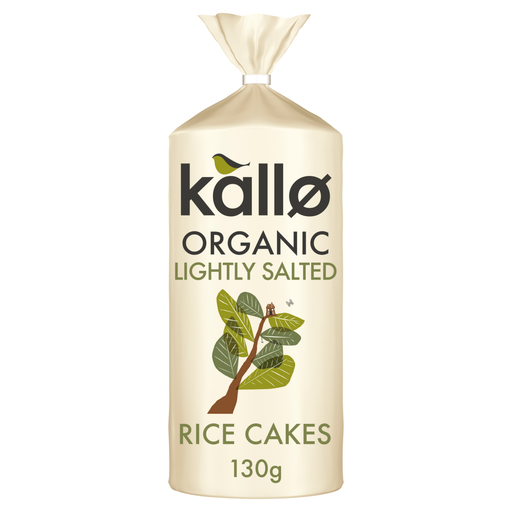 No image available
For a plainly flavoured cake you can count into a ride-food plan, Kallo lists 5.6 g carbohydrate per cake and 2.7 g fat per 100 g. Check the current pack’s allergen wording if you have a dietary restriction.
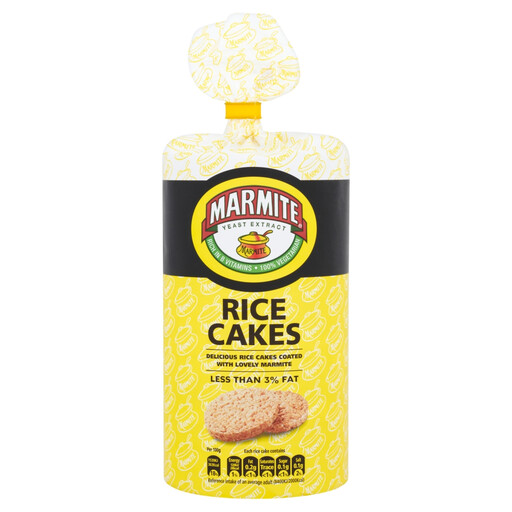 No image available
A flavoured rice-cake option if you would rather take a savoury snack. Check carbohydrate per cake and the current ingredients and allergen information before including it in a ride-food plan.
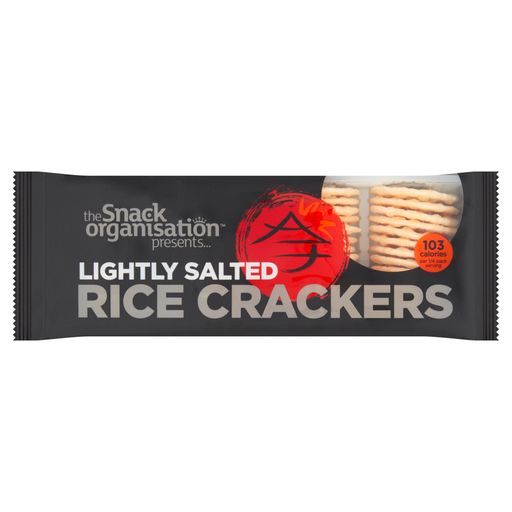 No image available
A lightly salted rice-cracker option rather than the plain wholegrain rice cakes compared above. Check its per-100-g fat figure and the portion’s carbohydrate contribution before deciding how many crackers to pack.
Not on its own: carbohydrate per cake and the amount you can carry and eat also matter. British Cycling gives 1 g of carbohydrate per kg of bodyweight per hour as a general event-day rule; the cited plain or lightly salted Kallo, Sainsbury’s and Asda cakes each provide around 5.6–6.1 g carbohydrate per cake.
Use fat per 100 g on the exact product, then check the serving you would eat. Marks & Spencer, Sainsbury’s and Asda list 2.5–2.9 g per 100 g for their cited lightly or slightly salted cakes; Ocado lists 5.8 g per 100 g for Snack a Jacks Salt & Vinegar Jumbo.
Yes, if its portion and ingredients work for your plan, but compare it with plain cakes rather than treating them as equivalent. Tesco lists 11 g carbohydrate per 13 g Snack a Jacks Caramel Jumbo cake and 19 g sugars per 100 g; try unfamiliar ride food in training before depending on it at an event.
No; suitability depends on the exact product and its current labelling. Tesco describes its Free From Wholegrain Rice Cakes as wheat and gluten free but says they may contain milk, while Sainsbury’s states that its Lightly Salted Wholegrain Rice Cakes are not suitable for customers with a milk allergy because of manufacturing methods.