Hosts planning a toppings table
Plain or lightly salted cakes give guests a base they can top themselves. Compare the cakes’ fat per 100 g, then consider the toppings and dips as separate foods.


For a party table with a choice of toppings, start with plain or lightly salted rice cakes and compare fat per 100 g; assess toppings separately. The legislation.gov.uk annex to Regulation (EC) No 1924/2006 sets a low-fat claim condition of no more than 3 g fat per 100 g for solid foods, and Department of Health and Social Care guidance identifies the regulation as part of the Great Britain framework from 1 January 2021. Flavoured cakes can also fit that figure, but do not assume they do: check the exact pack’s nutrition and allergen information before serving.
Plain or lightly salted cakes give guests a base they can top themselves. Compare the cakes’ fat per 100 g, then consider the toppings and dips as separate foods.
Read the exact pack before offering cakes to a guest with an allergy. Kallo lists possible milk, sesame and soya cross-contact for its Organic Lightly Salted cakes; Sainsbury’s says its plain cakes are not suitable for customers with a milk allergy because of manufacturing methods.
A flavoured cake saves topping preparation, but calories per cake do not establish its fat content per 100 g. Joybuy lists Snack A Jacks Salt & Vinegar at 43 kcal per cake and 5.8 g fat per 100 g.
Choose when: guests will add their own sweet or savoury toppings.
Bear in mind: the cake’s nutrition does not describe the finished topped snack.
Choose when: you want cakes to serve without preparing toppings.
Bear in mind: fat per 100 g varies by product, so check it rather than relying on the flavour or per-cake calories.
| Priority | What to check | Your needs |
|---|---|---|
| Fat content | Compare total fat per 100 g on the exact packs. For a low-fat claim on a solid food in Great Britain, the legislation.gov.uk annex to Regulation (EC) No 1924/2006 sets a limit of 3 g per 100 g; Department of Health and Social Care guidance identifies the Great Britain framework from 1 January 2021. | I want to compare plain and flavoured cakes on the same basis, rather than judging them by calories per cake. |
| Toppings and flavour | Decide whether guests will add toppings or take ready-flavoured cakes. Check toppings, dips and coatings separately from the rice-cake base. | A build-your-own table gives guests a choice; for a bowl of ready-to-serve snacks, I would check the flavoured product’s own label. |
| Allergens | Read the ingredients and precautionary statements on each current pack. Check the packaging for every variety you plan to serve. | Guests with allergies need information about the particular cakes on the table, not an assumption that all plain varieties have the same warnings. |
| Serving size | Keep per-cake calories and fat per 100 g distinct. Check the stated serving size when planning how many cakes and toppings to put out. | I want to plan portions without mistaking a light-looking individual cake for a low-fat product. |
Joybuy lists Snack A Jacks Salt & Vinegar at 43 kcal per cake but 5.8 g fat per 100 g. Those figures describe different measures; the latter exceeds the 3 g per 100 g condition for a low-fat claim on solid food in the legislation.gov.uk annex to Regulation (EC) No 1924/2006.
Compare fat per 100 g first if that is your buying priority, then use the per-cake information to plan servings.
Kallo says its Organic Lightly Salted cakes may contain milk, sesame and soya. Sainsbury’s says its plain rice cakes are not suitable for customers with a milk allergy because of manufacturing methods.
Read each current pack, keep the packaging available for guests and choose a suitable alternative where an allergy requires one.
The cake’s declared nutrition does not include toppings or dips added at the party.
If you are choosing cakes by their fat content, consider the portions and labels of anything served with them separately.
Ingredients, nutrition and allergen statements can change, so a saved listing may not describe the pack you buy.
Check the physical label and best-before date before setting out the cakes.
These figures describe the named products, not every rice cake made or sold by each brand. Check the current pack when buying for guests.
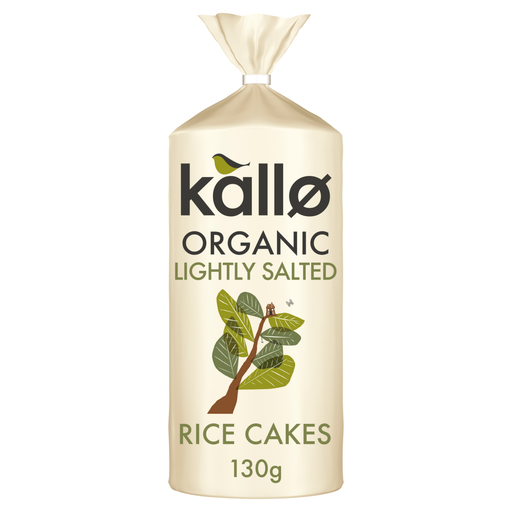
Organic Lightly Salted Wholegrain Rice Cakes offer a lightly salted base for toppings.
Its plain 135 g rice cakes are an option for a toppings-based table.
Slightly Salted Rice Cakes 130 g provide another base to compare by fat per 100 g.
Lightly Salted Rice Cakes 112 g are a plainly flavoured option for guests adding their own toppings.
Salt & Vinegar is a ready-flavoured alternative to a plain toppings base.
These options include a lightly salted cake for a toppings table and two ready-flavoured cakes. Check each pack’s nutrition and allergen information against your guest list.
 No image available
A lightly salted base for a table where guests choose their own toppings. Kallo declares 2.7 g fat per 100 g for its Organic Lightly Salted rice cakes and says they may contain milk, sesame and soya; check the current pack before serving guests with allergies.
 No image available
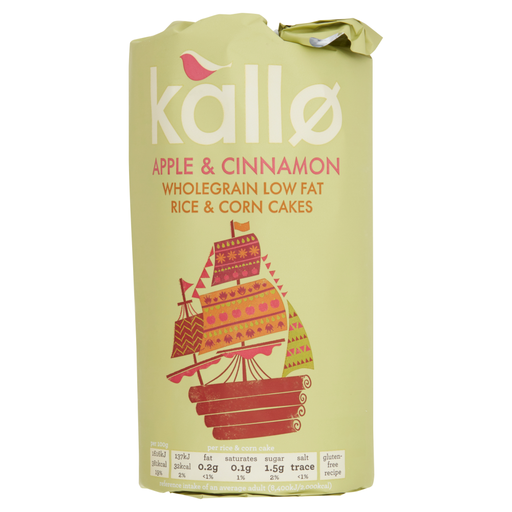
An apple-and-cinnamon-flavoured option when you want to serve cakes without adding toppings. Its flavour gives guests a different choice from a plain base; check the exact pack’s fat per 100 g and allergen statement before serving.
 No image available
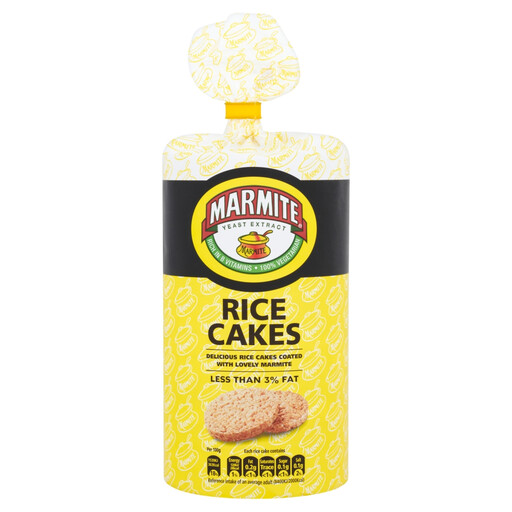
A ready-flavoured savoury option rather than a neutral base for mixed toppings. Check the exact pack’s fat per 100 g and ingredients, particularly when planning for guests with dietary exclusions.
No: a fat figure on one pack does not, by itself, establish a comparative “reduced fat” claim. For solid foods, the legislation.gov.uk annex to Regulation (EC) No 1924/2006 sets the low-fat claim condition at no more than 3 g fat per 100 g; Department of Health and Social Care guidance identifies the Great Britain framework from 1 January 2021. Read the precise claim and fat declaration on the pack rather than treating the two terms as interchangeable.
The named plain or lightly salted products declare: Sainsbury’s plain rice cakes, 2.4 g; M&S Lightly Salted, 2.5 g; Kallo Organic Lightly Salted, 2.7 g; and ASDA Slightly Salted, 2.9 g fat per 100 g, according to their respective product information. The legislation.gov.uk annex to Regulation (EC) No 1924/2006 sets 3 g per 100 g as the low-fat claim condition for solids. Toppings and dips need to be assessed separately.
No. Kallo says its Organic Lightly Salted cakes may contain milk, sesame and soya, while Sainsbury’s says its plain cakes are not suitable for customers with a milk allergy because of manufacturing methods. Check every current pack and keep its allergen information available when serving.
Follow the storage instructions on the pack you buy. Keep opened cakes cool and dry, and reseal the pack or use an airtight container; check any product-specific instruction about how soon to use them.
No conclusion follows from the flavour alone. Joybuy lists Snack A Jacks Salt & Vinegar at 5.8 g fat per 100 g, while the named plain and lightly salted examples declare 2.4–2.9 g per 100 g. Compare the exact flavoured and plain packs you are considering rather than applying that difference to every product.