Students stocking a shared kitchen
Rice cakes can be kept as a cupboard snack or used as a base for toppings. Compare the nutrition panels before choosing a pack: a small serving does not, by itself, make one product lower in fat than another.


For a lower-fat rice cake, compare total fat per 100g: the NHS defines low fat as 3g or less per 100g. Plain or lightly salted products can meet that guide, but check salt and allergens separately; flavoured and chocolate-coated rice cakes should not be assumed to have the same nutrition values.
Rice cakes can be kept as a cupboard snack or used as a base for toppings. Compare the nutrition panels before choosing a pack: a small serving does not, by itself, make one product lower in fat than another.
If low fat is the deciding factor, use the per-100g figure. The NHS guide is 3g fat or less per 100g, and rice cakes with different flavours or coatings can fall on different sides of it.
Read salt and allergen information as well as fat. Kallo’s product pages for its Organic Unsalted, Organic Lightly Salted and Lightly Salted rice cakes each carry a may-contain warning for milk, sesame and soya.
Start with comparable per-100g figures, then use the serving information and pack instructions to decide what works in your cupboard and daily routine.
| Priority | What to check | Your needs |
|---|---|---|
| Total fat | Compare fat per 100g, not just per cake. The NHS defines low fat as 3g or less per 100g; check the figure for the exact flavour and coating. | I want a lower-fat cupboard snack without assuming that every product labelled rice cakes meets that description. |
| Salt | Compare salt per 100g separately from fat. The NHS defines low salt as 0.3g or less per 100g; an unsalted and a seasoned product need not have similar figures. | If salt matters to me, I will check the nutrition panel even when a rice cake meets the low-fat guide. |
| Allergens | Read the current ingredients and may-contain statement for the exact pack. Kallo lists milk, sesame and soya in precautionary advice for its Organic Unsalted, Organic Lightly Salted and Lightly Salted products. | In a shared kitchen, I need to check whether a product suits the people who will eat it rather than relying on its rice base or vegan-recipe wording. |
| Serving size | Use per-100g figures to compare products, then check per-cake or per-pack values for the amount you plan to eat. Include any toppings in your own snack choice. | A portioned pack may be convenient between lectures, while plain cakes leave me free to choose toppings. |
| Storage | Follow the pack instructions after opening. Tesco and M&S specify cool, dry storage and an airtight container for their listed rice cakes. | I want a pack size I can use while keeping opened cakes properly stored in a shared cupboard. |
Snack a Jacks gives figures for some multipacks per 23g pack, while the plain rice cakes listed by Kallo and M&S give per-100g figures. Those quantities do not make a like-for-like comparison.
Compare the same nutrient per 100g first, then look at the per-pack figure for the serving you expect to eat.
M&S lists 22.7g fat per 100g for its Milk Chocolate Mini Rice Cakes; Tesco lists 5.7g fat and 1.45g salt per 100g for its Salt & Vinegar Rice Cakes. These are distinct products from the plain and lightly salted examples.
Check the nutrition panel for the flavour you are buying rather than applying figures from a plain rice cake.
Kallo’s Organic Unsalted, Organic Lightly Salted and Lightly Salted product pages warn that the cakes may contain milk, sesame and soya.
Check the current pack’s ingredients and precautionary allergen statement for the exact product before eating or sharing it.
Tesco and M&S instruct shoppers to keep their listed rice cakes in an airtight container after opening.
Choose a pack size that suits your use and follow its storage instructions in the shared kitchen.
These figures describe the named products, not every rice cake made by each brand; check the pack for the version you buy.
Its named wholegrain plain and lightly salted rice cakes offer several options for comparing fat and salt.
Its Lightly Salted Rice Cakes and Milk Chocolate Mini Rice Cakes illustrate why the exact product matters.
Its listed lightly salted and Salt & Vinegar rice cakes provide a comparison between plain and seasoned products.
Its flavoured multipacks are portioned for carrying between accommodation and lectures.
These options cover a lightly salted cake for a plain snack or toppings and a Marmite-flavoured cake for eating as it is. Check the current pack when salt or allergens affect your choice.
 No image available
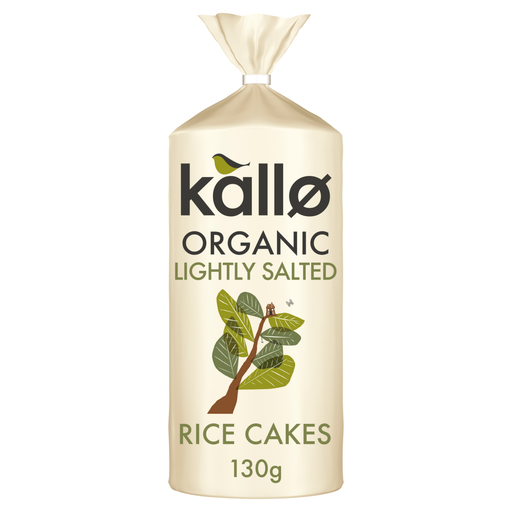
A lightly salted wholegrain cake to eat plain or use with toppings. Kallo lists 2.7g fat per 100g for Organic Lightly Salted, within the NHS low-fat guide of 3g or less per 100g. Check the current pack for salt and allergens; Kallo’s product information warns that it may contain milk, sesame and soya.
 No image available
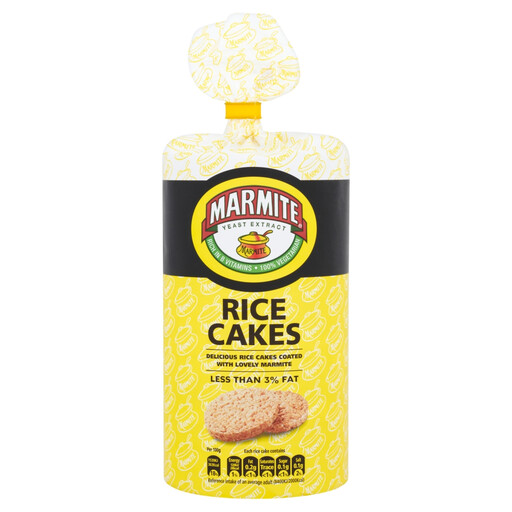
A Marmite-flavoured option if you want a rice cake without adding a topping. If fat or salt determines your choice, compare the current pack’s per-100g figures with other products. Check its ingredients and allergen information before eating or sharing it.
Compare total fat per 100g: the NHS defines low fat as 3g or less per 100g. A per-cake or per-pack figure helps with your intended serving, but differing portion sizes make it less useful for comparing products.
Not necessarily. Tesco lists 5.7g fat per 100g for its Salt & Vinegar Rice Cakes, while M&S lists 22.7g per 100g for its Milk Chocolate Mini Rice Cakes. Check the exact flavour or coating against the NHS guide of 3g fat or less per 100g rather than relying on the rice-cake category.
Do not assume so. Kallo’s Organic Unsalted, Organic Lightly Salted and Lightly Salted product pages warn that the cakes may contain milk, sesame and soya. Check the current pack’s ingredients and precautionary allergen statement for the specific allergy.
Follow the instructions on the pack you buy. Tesco and M&S direct shoppers to keep their listed rice cakes in a cool, dry place and use an airtight container after opening.