What should you compare?
Start with the fat figure for a like-for-like comparison, then check whether the flavour, salt and toppings work for the lunch you have in mind.
| Priority |
What to check |
Your needs |
| Fat content |
Compare fat per 100g, then check the amount per cake for your intended portion. Department of Health and Social Care guidance gives no more than 3g fat per 100g as the threshold for a 'low fat' claim on solid food. Kallo lists 2.7g per 100g for Organic Lightly Salted; Sainsbury's lists 2.4g per 100g for its cited plain rice cakes. |
I want to compare the cakes on the same basis, rather than assume that 'reduced fat' wording tells me how two packs differ. |
| Lunch ingredients |
Decide what topping or accompaniment you will use, and check its portion and label too. Royal United Hospitals Bath NHS Foundation Trust includes rice or oat cakes among starchy meal options and recommends including protein at meals. |
If these are my lunch, I want something to eat with them, such as a protein topping and fruit or vegetables, rather than relying on the cakes alone. |
| Salt and flavour |
Read salt per cake on the exact flavour and compare per 100g where available. Snack a Jacks lists 0.13g salt per Black Pepper & Sea Salt Jumbo cake and 0.26g per Salt & Vinegar Jumbo cake; Sainsbury's lists less than 0.01g per cake for its cited plain product. |
A savoury flavour might suit my lunch, but I also want to see how its salt figure compares with a plain cake. |
| Allergens |
Check the current ingredients and precautionary statements for the exact pack. Kallo says its Organic Lightly Salted cakes may contain milk, sesame and soya; Sainsbury's says its cited rice cakes are not suitable for customers with a milk allergy because of manufacturing methods. |
I need the allergen statement for the product I am buying, not an assumption based on the words 'rice cake' or 'vegan recipe'. |
Brand and retailer references
These product-line examples show why the exact variety matters; they are not a comparison of everything each brand or retailer sells.
Kallo
Kallo Organic Lightly Salted is a wholegrain rice cake to consider as a lightly salted topping base.
- Kallo lists 2.7g fat per 100g and 0.2g per cake for this product.
- Its allergen advice says it may contain milk, sesame and soya.
Snack a Jacks
The Jumbo range offers flavoured rice cakes for shoppers who prefer a savoury cake without adding a topping.
- Snack a Jacks lists 0.3g fat and 0.13g salt per Black Pepper & Sea Salt Jumbo cake.
- Its Salt & Vinegar Jumbo lists 0.6g fat and 0.26g salt per cake, so the Black Pepper & Sea Salt values do not describe every flavour.
Sainsbury's
The cited 135g plain rice cakes provide another topping-base example.
- Sainsbury's lists 2.4g fat per 100g and less than 0.01g salt per cake for this product.
- Its product information says the cakes are not suitable for customers with a milk allergy because of manufacturing methods.
Tesco
Tesco's cited rice-cakes listing includes a Tesco lightly salted product alongside Kallo and Snack a Jacks varieties.
- The listing gives shoppers plain and flavoured names to compare.
- Use the individual product information or pack for nutrition and allergens; a category listing does not give those details for every variety.
Joybuy rice cake options
These options cover a lightly salted cake for toppings and a pre-flavoured cake. Check each pack's nutrition and allergen information against the lunch you plan to make.
 No image available
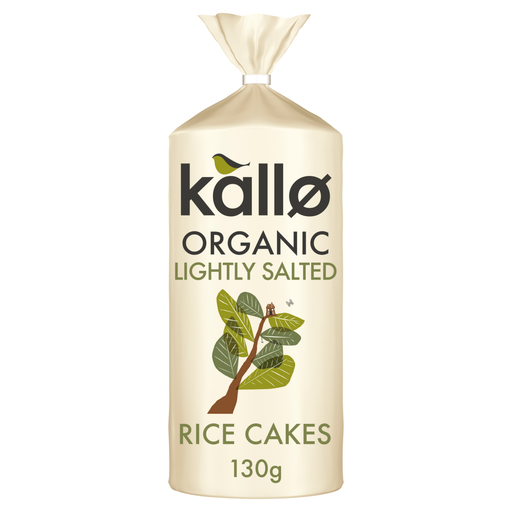
Kallo Organic Lightly Salted Rice Cakes 130g
A lightly salted option if you want to choose your own lunch topping. Kallo lists 2.7g fat per 100g for its Organic Lightly Salted rice cakes. Its allergen advice says the product may contain milk, sesame and soya; check the current pack before buying.
View on Joybuy
 No image available
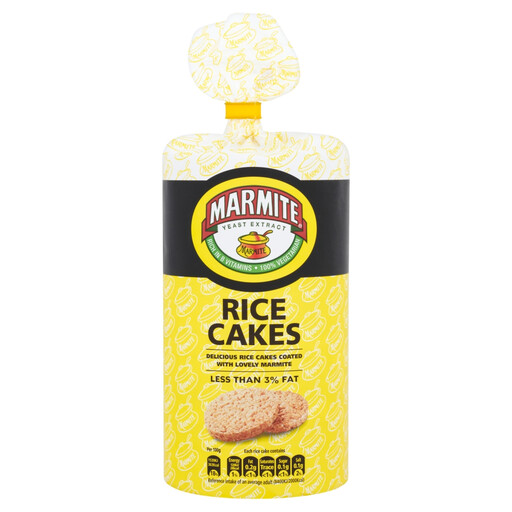
Marmite Rice Cakes 110g
A pre-flavoured option if you would rather eat the cakes without choosing a topping. Compare fat and salt per 100g with a plain alternative, and check the current pack's gluten and other allergen statements before buying.
View on Joybuy
Questions about rice cakes for lunch
What does 'low fat' mean on a rice-cake pack?
For solid food, Department of Health and Social Care guidance gives no more than 3g fat per 100g as the threshold for a 'low fat' claim. That figure describes fat in the product, not its salt content or the nutrition of a finished lunch.
Are rice cakes enough for a work-from-home lunch on their own?
Treat them as a starchy part of lunch rather than the whole meal. Royal United Hospitals Bath NHS Foundation Trust includes rice or oat cakes among starchy options in its guidance on meals for work and recommends including protein at meals.
What can I serve with rice cakes at lunch?
Consider a protein topping or accompaniment, such as eggs, beans or cheese, with fruit or vegetables alongside. Check the topping's portion and label too: the nutrition of the finished lunch depends on more than the rice cakes.
Does a vegan-recipe rice cake suit someone with a milk allergy?
Not necessarily. Kallo says its Organic Lightly Salted product may contain milk, and Sainsbury's says its cited vegan-recipe rice cakes are not suitable for customers with a milk allergy because of manufacturing methods. Read the current allergen statement for the exact product.
Do flavoured rice cakes have the same fat and salt as plain ones?
Do not assume they do. Snack a Jacks lists 0.3g fat and 0.13g salt per Black Pepper & Sea Salt Jumbo cake, compared with 0.6g fat and 0.26g salt per Salt & Vinegar Jumbo cake. Compare the exact flavour and the same quantity basis when choosing between packs.


