What to check before buying
Start with the format the school can accommodate, then compare salt on the stated serving basis and check the current ingredients and allergen information.
| Priority |
What to check |
Your needs and respondent share |
| Declared salt |
Compare salt per declared serving, and note whether the figure is for dry oats or a prepared pot. Plain sachets and pots should not be treated as like-for-like without checking the label basis. |
I want to compare the portion I am actually packing, rather than assume that all original oats have the same salt content. In a Food Standards Agency and Ipsos survey of 611 Northern Ireland adult food shoppers conducted from September to November 2024, 49% said they actively used traffic-light labelling while shopping, including to assess salt; this was not a survey of school packed lunches. |
| Preparation at school |
Confirm whether a bowl, milk or water, a microwave or boiling water, and suitable supervision are available. Check the manufacturer's stated method and any standing time. |
I need a format that can be made safely during the school day. A sachet may need a bowl, liquid and microwave, while a pot needs a permitted hot-water arrangement. |
| Allergen suitability |
Read the current ingredients and cross-contact wording for the exact pack. Check milk, wheat, barley, soya, peanut and nut information where relevant, as wording differs between products. |
I need the product to fit the pupil's medical plan and the school's allergy arrangements. For schools in England, the Department for Education says schools must publish an allergy safety policy setting out arrangements to reduce contact with known allergens. |
Joybuy product options
Joybuy options for instant-oat sachets that may suit a secondary-school routine where microwave preparation has been confirmed.
 Image unavailable
Quaker Oat So Simple Big Bowl Original 6 Pack 231g
Individually packed original-oat sachets for a school routine with a permitted microwave. The listing states a 2½-minute microwave method; check the current pack label for the salt declaration and allergen information, and confirm that a bowl and liquid are available.
View on Joybuy
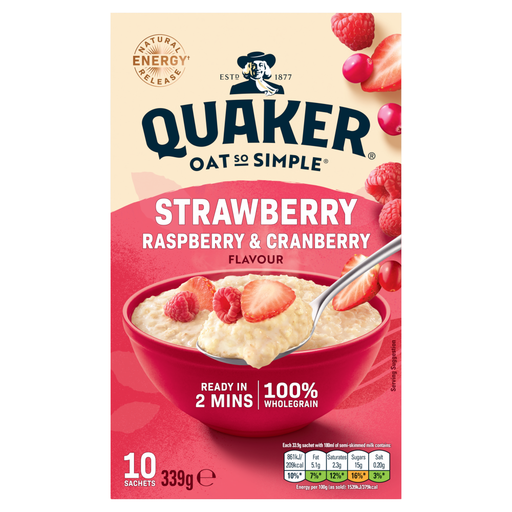 Image unavailable
Quaker Oat So Simple Strawberry, Raspberry & Cranberry 10 Sachets 339g
A flavoured sachet option for a permitted microwave routine. The listing gives a two-minute microwave method and requires milk and a bowl; it contains sugar and flavouring, so it is not a plain-oat option. Check the current allergen label and the school's preparation rules before packing.
View on Joybuy
Frequently asked questions
Are instant oats suitable for a secondary-school packed lunch?
They can be suitable only when the pupil has a confirmed way to prepare them safely. Sachets need a bowl, liquid and heating, while the verified pots need boiling water and standing time, so neither is equivalent to a ready-to-eat cold lunch item.
Which verified option has the lowest declared salt?
Among the verified plain sachets, Quaker Oat So Simple Original declares 0g salt per dry 27g sachet. Sainsbury's Original declares less than 0.01g per 27g sachet, and Flahavan's Natural Quick Oats declares less than 0.01g per 35g serving prepared with water; compare the current labels on like-for-like serving and preparation bases.
Does a plain oat product automatically suit a pupil avoiding gluten or other allergens?
No. Quaker Original may contain wheat, barley and soya; Sainsbury's Original has manufacturing-method cautions covering peanuts, nuts, milk, wheat and barley; and M&S Traditional Porridge Pot is stated as not suitable for coeliacs or people with wheat, peanut or nut allergy. Use the exact pack label and the pupil's medical advice rather than relying on the product name.
What school-policy check is needed in England?
The Department for Education says schools in England must publish an allergy safety policy setting out arrangements to reduce exposure to known allergens. Ask the individual school about packed lunches, food sharing, heating and allergy procedures before sending instant oats.
Can a porridge pot be reheated later?
Not for the verified Tesco and Sainsbury's hot-water pots: both product pages say not to reheat. Prepare immediately before eating only if the school permits the preparation method.


