Who is this for?

Parents considering salt across dinner

If you are making one meal for the family, the sauce label is only part of the decision. Cheese, stock, meat and seasoning also affect the finished dish, so compare the sauce while planning what else will go into it.

Households cooking on a busy weeknight

A ready sauce saves preparation, but its stated serving size may not match the amount your household uses. Check both the portions in the pack and the salt in the portion you intend to serve.

Cooks making sauce from cupboard tomatoes

Passata or tinned tomatoes let you choose the herbs, vegetables and other flavourings yourself. Allow time to prepare the sauce, and check the salt in anything you add.

What matters when choosing?

For a family dinner, decide whether controlling additions to the whole meal or shortening preparation is your main priority. Whichever route you take, compare the current pack’s salt declaration with the amount of sauce you will use.

Concern What to check Who this matters to
Salt in the whole meal Check sauce salt per 100g and per serving, then consider stock, cheese, processed meat and added seasoning. If you are adjusting the entire family dinner rather than just the sauce, you need room to choose its other ingredients. About 50% of consumers put whole-meal salt control first.
Preparation and portions Compare the stated number of servings, serving weight and salt in the amount you will actually use. When a weeknight dinner needs to be quick, a ready sauce can simplify preparation without settling the salt question. Quick preparation is the primary need for about 30% of consumers.
Flavour and texture Choose a texture the family will eat; compare smooth passata or sauce with tinned tomatoes, and check any flavourings added. If smooth sauce is more likely to work for your family, texture may determine which lower-salt approach you can use. About 20% of consumers place flavour and texture first.

Checks before you buy

  • Do not use other claims as a shortcut for salt

    “Low fat” and a sauce’s vegetable content describe different things from its salt figure. Sainsbury’s lists 0.75g salt per 112g serving for Dolmio Smooth Tomato Bolognese 675g.

    Read the salt line on the current pack even when another description catches your eye.

  • Compare both per 100g and per serving

    Sainsbury’s lists 0.82g salt per 100g and 0.62g per half-pot for its 150g Tomato & Basil stir-in sauce. Its 440g Stamford Street Co. jar lists 0.65g per 100g and 0.72g per quarter-jar serving. The serving figures describe different amounts of sauce.

    Use per 100g to compare products, then check how much each person will actually have.

  • Count ingredients added after the sauce

    Changing the sauce does not account for stock, cheese, processed meat or seasoning added during cooking or at the table. The NHS suggests herbs, spices, garlic, chilli or lemon as ways to add flavour instead of salt.

    Plan the complete recipe before deciding what the sauce contributes to dinner.

  • Check the exact pack, not an older listing

    Recipes and pack information can change, while different sizes or variants can have different serving instructions.

    Confirm the nutrition and ingredient label for the sauce or tomato base you are buying.

Brands to consider

Dolmio

Ready-to-use sauces include the Smooth Tomato Bolognese 675g jar, which Sainsbury’s describes as serving six.

  • The stated servings offer a starting point for planning a family meal.
  • Sainsbury’s lists 0.75g salt per 112g serving for this jar; its smooth texture or other product claims do not replace a salt check.

Napolina

Passata and tinned plum tomatoes are ingredients for making a sauce, rather than finished seasoned jar sauces.

  • Napolina lists 0.12g salt per 100g for its passata and 0.13g per 100g for its plum tomatoes.
  • You need to prepare and flavour the sauce; other ingredients determine the finished meal’s salt.

Sainsbury’s

Its cited own-label products include a 440g jar and a 150g stir-in pot, offering different formats for different portion plans.

  • The two formats let you assess pack size alongside your intended serving.
  • Sainsbury’s lists 0.65g salt per 100g for the cited jar and 0.82g per 100g for the cited pot. A smaller pack is not necessarily lower in salt per 100g.

M&S

Marks & Spencer lists its own-label Tomato & Basil Pasta Sauce alongside a separate Daylesford Tomato & Basil Sauce; they should be assessed as individual products, not as one brand range.

  • Marks & Spencer lists 0.60g salt per 100g for the cited own-label sauce and 0.45g per 100g for the cited Daylesford product.
  • The cited M&S own-label sauce is marked unsuitable for people with milk or egg allergy. Check the exact pack’s allergen information.

Joybuy tomato-base selection

For cooks making a family pasta sauce from a tomato base, this passata is a starting ingredient to season and prepare yourself.
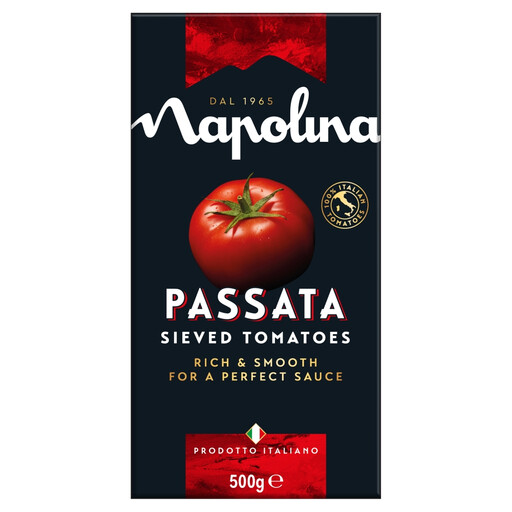
Napolina Tomato Passata 500g

Napolina Tomato Passata 500g

A 500g tomato base for a family sauce when you want to choose the added flavourings yourself. It needs recipe preparation rather than simply heating a finished sauce; check the current carton and account for salt in the other ingredients.

View on Joybuy

Questions about salt and pasta sauce

Should I compare salt per 100g or per serving?

Use both: per 100g helps compare different products, while per serving shows the sauce’s contribution if you use that stated amount. Check how much sauce your family will actually eat and consider the other ingredients in the meal.

Is passata always lower in salt than ready-made pasta sauce?

Not automatically. Napolina lists 0.12g salt per 100g for its cited passata and 0.13g per 100g for its cited plum tomatoes, but you still need to check the exact product and anything added while cooking.

Does a reduced-salt claim settle a prescribed salt limit?

No. A comparative claim does not describe the salt in your serving or the complete meal, and it cannot determine whether a product meets an individual prescribed limit. Check the current label against the limits supplied by your clinician.

How long can I keep sauce after opening?

Follow the storage instructions on the exact pack. For example, Marks & Spencer’s listing for the cited Daylesford Tomato & Basil Sauce says to use it within five days of opening; that instruction should not be applied to another sauce.

Do tomato pasta sauces still need an allergen check?

Yes. Marks & Spencer marks its cited Tomato & Basil Pasta Sauce as unsuitable for people with milk or egg allergy. Check the current label for the exact product you plan to serve.