Buying priorities
Start with the salt figure and ingredients on the dry product, then choose a format that fits the time, texture and allergy requirements of the meal.
Plain rolled oats
Choose when: You want a simple oat base for a savoury or sweet family meal and can allow around 4 to 5 minutes for cooking.
Consider: Toppings and seasonings determine much of the finished dish's flavour and salt content.
Quick or instant oats
Choose when: A fast meal matters more than a traditional rolled-oat texture.
Consider: Ingredient and allergen profiles vary by product, so check the precise sachet, pot or pack.
Smooth fortified oats
Choose when: A smooth texture and added micronutrients are more useful to the household than a single-ingredient oat product.
Consider: Compare nutrition figures on the same dry or prepared basis, especially where milk is used.
| Priority |
What to check |
Your needs |
| Salt in the finished meal |
Compare salt per 100g on dry products. Check whether any serving figure is prepared with water or milk. Keep stock, sauces, cheese and table salt separate from the oat choice. |
I want the whole meal, not only the oat pack, to stay lower in salt. |
| Cooking time |
Check the stated cooking method and time. Rolled oats may suit pan cooking, while quick oats can suit a faster meal. |
A family meal needs to fit the time available without assuming every fast format has the same ingredients. |
| Allergens |
Read the exact ingredient list, allergen declaration and any cross-contact warning. Check each replacement product separately. |
I need to avoid a product that is unsuitable for someone in the household with a relevant allergy or coeliac disease. |
| Texture and ingredients |
Choose wholegrain rolled oats for a simple base, or check whether a smooth cereal includes oat flour, added vitamins or minerals. Compare products on the same preparation basis. |
I am deciding between a plain wholegrain texture and a smoother cereal with additional ingredients. |
Joybuy porridge oat options
These Joybuy options are plain porridge oats for households building a lower-salt family meal from a simple oat base.
 No image available
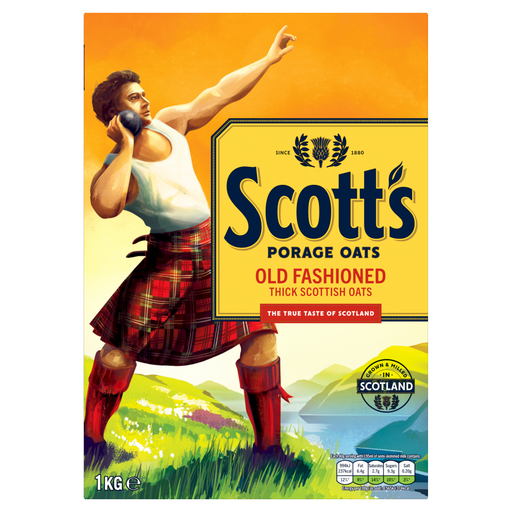
Scotts Porage Oats Old Fashioned Porridge Oats 1kg
A plain rolled-oat option for savoury or sweet family portions when you want control over added salt.
100% rolled oats; 0g salt per 100g. The stated methods use water or milk, with a 4–5 minute hob method or a 2–3 minute microwave method.
May contain wheat and barley; check suitability for anyone with a relevant allergy or coeliac disease. The finished dish depends on the liquid, toppings and seasonings used.
Joybuy
 No image available
Flahavan's Organic Porridge Oats 2kg (2 x 1kg)
A larger plain-oat format for households that use oats regularly and want separate bags for storage or replenishment.
100% organic wholegrain oat flakes; salt listed as less than 0.01g per 100g. The pack contains 2 x 1kg bags.
Contains oats (gluten). Check the current pack for cooking method, preparation time and suitability where gluten avoidance or coeliac disease is relevant.
Joybuy
 No image available
Flahavan's Organic Porridge Oats 1kg
A single-ingredient wholegrain oat choice for meals where flavourings, sugar and mixed cereal ingredients are not wanted.
100% organic wholegrain oat flakes; salt listed as less than 0.01g per 100g. The pack size is 1kg.
Contains oats (gluten). Check the current pack for cooking instructions, preparation time and suitability where gluten avoidance or coeliac disease is relevant.
Joybuy
Frequently asked questions
Are porridge oats naturally a high-salt food?
The examined plain oat products have very small labelled salt figures: Waitrose Essential and Scottish Porridge Oats list 0.0g per 100g, Quaker Traditional Rolled Oats lists 0g, and Mornflake Organic Porridge Oats lists 0.01g. The finished meal can contain more salt when milk, stock, cheese, sauces or table salt are added.
How much salt should children have in the UK?
NHS guidance gives maximum daily amounts of 2g for ages 1 to 3, 3g for ages 4 to 6 and 5g for ages 7 to 10; adults should have no more than 6g a day. These totals include salt already in food as well as salt added during cooking.
Should I add salt when cooking oats for a lower-salt family meal?
No, added salt is optional. For savoury oats, use herbs, spices, garlic, chilli or lemon for flavour instead, and check the salt contribution from stock, sauces and cheese.
Do ‘no added salt’ and ‘0g salt’ mean the same thing?
Not necessarily. Ready Brek Original Smooth Porridge Oats is labelled no added salt but lists 0.03g salt per 100g, while the examined Waitrose plain rolled oats list 0.0g per 100g. Check the nutrition panel on the exact pack and compare dry products with dry products.
Can a lower-salt oat meal still be unsuitable for someone with an allergy?
Yes. Check the exact pack and its allergen information. Mornflake Original Superfast Oats states that it is unsuitable for nut, milk, wheat and barley allergy sufferers because of manufacturing methods, while Jordans Organic Porridge advises people with nut allergy not to eat it.


