Who this suits

Families reducing salt at breakfast

For parents choosing a school-morning breakfast who want to limit salt from the oats themselves and avoid adding salt while cooking. The NHS gives maximum daily salt amounts of 3g for ages 4–6, 5g for ages 7–10 and 6g for ages 11 and older.

Time-pressed school-morning households

For families weighing two-minute sachet preparation against the greater freedom to choose portions and toppings with loose oats.

Families checking allergens carefully

For households that need to read each pack declaration before serving oats or sending an oat-based item to school, particularly where wheat, barley, soya, milk or nuts may matter.

Buying priorities

Plain loose oats or oatmeal

Choose this when: You want a plain breakfast base and control over what is added to the bowl.

Consider: Verified loose-oat examples take around four to five minutes on the hob, and added salt changes the finished meal.

Plain original microwave sachets

Choose this when: A predictable portion and minimal preparation are important on a busy morning.

Consider: Check the exact allergen statement, as a plain-looking sachet is not automatically suitable for every dietary requirement.

Gluten-free-labelled oats

Choose this when: The intended eater specifically needs food labelled gluten-free.

Consider: Oats remain relevant for oat allergy, so a gluten-free label does not replace an allergen check.

Priority What to check Your needs
Salt declaration Compare salt per 100g or per comparable serving prepared with water. Check whether the stated value includes milk, and do not add salt during cooking if reducing salt is the aim. I want the oats themselves to add little or no declared salt before milk, toppings or seasoning are added.
Morning preparation Check the stated method and time. The referenced Quaker Original sachets are described as ready in two minutes, while verified Waitrose loose oats have four- to five-minute hob instructions. I need breakfast to fit the time available before school, while still choosing a format I can prepare consistently.
Allergen suitability Read ingredients and precautionary allergen wording on the current pack. For a gluten-free requirement, choose a product explicitly labelled gluten-free; UK rules limit that label to foods containing no more than 20 mg/kg gluten. I need to check for oats themselves and any statements about wheat, barley, soya, milk or nuts before serving.
Portion and additions Check whether the product is loose or portioned, and whether it is plain or flavoured. A single-ingredient oat product leaves the household to choose portion size and additions. I want either flexible portions and toppings or a fixed sachet that is simple to prepare on a rushed morning.

Common pitfalls

  • Treating all porridge oats as gluten-free or allergy-safe

    Plain oats can carry statements about wheat, barley, soya, milk or nuts, and an ordinary oat product is not necessarily labelled gluten-free.

    For a gluten-free requirement, choose only an explicitly gluten-free-labelled product and check the current pack. For allergies, read both ingredients and precautionary allergen wording on every repeat purchase.

  • Comparing salt values prepared with different liquids

    A value shown for porridge made with milk includes nutrients from the milk, so it is not directly comparable with oats prepared with water.

    Compare salt per 100g or compare servings prepared on the same basis. Do not add salt during cooking when a reduced-salt approach is required.

  • Assuming plain oats stay low in salt after preparation

    Salt can come from additions during cooking and from toppings, not only from the oat product.

    Use fruit, cinnamon or other non-salty flavourings where suitable, and include toppings when considering the whole breakfast.

Relevant brand references

Waitrose

Waitrose offers own-label porridge oats, including Essential Porridge Oats and Scottish Porridge Oats, with nutrition, ingredient and preparation information on its product pages.

  • Waitrose & Partners lists 0g salt per 40g serving with water for both the Essential and Scottish products.
  • The cooking instructions allow salt to be added to taste, so the finished result depends on preparation. Check the pack label as recipes can change.

Mornflake

Mornflake offers stoneground oatmeal for traditional porridge and home baking.

  • Mornflake Fine Oatmeal is listed as 100% oatmeal with less than 0.01g salt per 40g portion prepared with water.
  • The manufacturer states that it is not suitable for wheat or barley allergy sufferers because of its manufacturing methods.

Quaker

Quaker has traditional loose rolled oats alongside microwaveable original porridge sachets.

  • Traditional Rolled Oats list 100% rolled oats and 0g salt for a 40g oat-only serving; the original sachets are described as ready in two minutes.
  • The traditional oats may contain wheat and barley, while the referenced sachets may contain wheat, barley and soya.

Flahavan's

Flahavan's offers organic loose porridge oats and organic natural sachets in the researched UK retailer range.

  • The organic loose oats list 100% organic wholegrain rolled oats, while the natural sachet pack contains eight 35g portions.
  • The sachet product notes possible traces of milk; check the current nutrition panel if a numerical salt comparison is needed.

Jordans

Jordans makes organic traditional porridge with wholegrain rolled oats.

  • Jordans Organic Porridge lists organically produced wholegrain rolled oats and 0.03g salt per 100g.
  • Its product page states that it may contain other gluten sources and nuts, which can be decisive for households managing nut allergies.

Joybuy product options

Joybuy product options for back-to-school porridge breakfasts, including gluten-free loose oats and quick portioned sachets.

Morrisons Free From Gluten Free Oats 1kg

Morrisons Free From Gluten Free Oats 1kg

A loose oat option for households needing a gluten-free-labelled porridge base with flexible portions.

The pack states 100% gluten-free oat flakes, trace salt and 25 portions. Oats remain an allergen, and the current preparation instructions should be checked if time is limited in the morning.

Joybuy
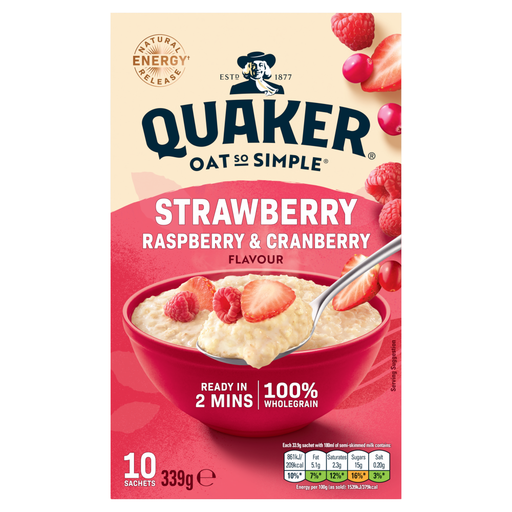
Quaker Oat So Simple Strawberry, Raspberry and Cranberry 10 Sachets 339g

Quaker Oat So Simple Strawberry, Raspberry & Cranberry 10 Sachets

A portioned microwave option for school mornings when a two-minute preparation method is useful.

The nutrition information lists 0.0g salt per 100g as sold. It is flavoured and contains sugar, so it does not offer the same control over additions as plain loose oats; check the current pack for oat, barley, soya and wheat information.

Joybuy
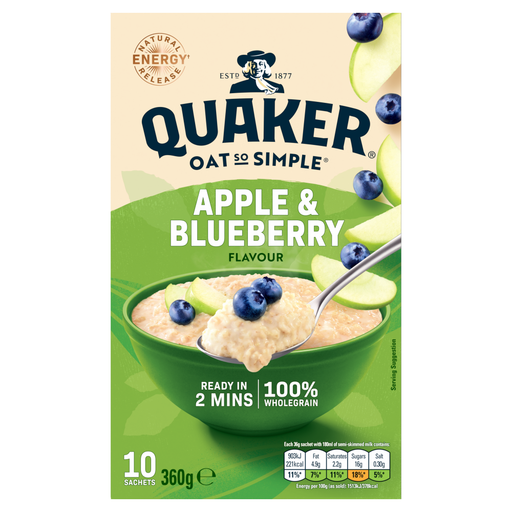
Quaker Oat So Simple Apple and Blueberry Porridge 10 Pack 360g

Quaker Oat So Simple Apple & Blueberry Porridge 10 Pack

This ten-portion microwave porridge is intended for households prioritising a stated two-minute preparation time.

The dry mix lists 0.07g salt per 36g portion and contains sugar, dried fruit and flavouring. Nutrition values prepared with milk should not be compared directly with oat-only or water-prepared figures.

Joybuy

Quaker Oat So Simple Big Bowl Original 6 Pack 231g

Quaker Oat So Simple Big Bowl Original 6 Pack

An original oat-only sachet option with a stated microwave preparation time of two and a half minutes.

The larger sachet is 38.5g and may not suit every child’s portion needs. Check the current nutrition panel for salt and the full allergen statement before choosing it for a reduced-salt routine.

Joybuy

Frequently asked questions

What counts as a reduced-salt choice for porridge oats?

Start with plain oats that declare 0g or a very low amount of salt on a comparable serving basis, then avoid adding salt during cooking. The NHS states maximum daily salt amounts of 3g for ages 4–6, 5g for ages 7–10 and 6g for age 11 and older; this includes food eaten across the whole day.

Are ordinary porridge oats suitable for someone who needs gluten-free food?

Not automatically. Under UK labelling rules, food labelled gluten-free must contain no more than 20 mg/kg gluten, so choose an explicitly gluten-free-labelled oat product when that requirement applies and check the current pack declaration.

Do oats themselves need allergen checking?

Yes. The Food Standards Agency distinguishes oat allergy from gluten intolerance, and individual products can also carry statements about possible wheat, barley, soya, milk or nut presence. Check the exact pack before serving, especially where a child has an allergy or intolerance.

Are sachets useful for back-to-school mornings?

They can be useful when speed and pre-portioned servings matter: the referenced Quaker Original sachets are stated to be ready in two minutes. Loose oats allow more flexibility over portion size and toppings but generally need longer preparation.

Should a family rely on an online product page for allergens and nutrition?

No. Retailer pages can help compare products, but Waitrose & Partners advises shoppers to check product labels because recipes can change. Use the physical pack as the final check where dietary restrictions are medically necessary.