People who sweeten porridge at home
Plain 100% oats provide a lower-sugar breakfast base while leaving you to choose measured fruit, yoghurt, nuts, seeds or sweeteners rather than buying sugar already included in a flavoured product.


For weight management, plain oats with oats as the only ingredient give you the clearest control over sweetness, portions and toppings. A no-added-sugar product is not necessarily sugar-free, so compare sugars per 100g as well as the nutrition of the bowl once milk, toppings or a ready-made pot are included.
Plain 100% oats provide a lower-sugar breakfast base while leaving you to choose measured fruit, yoghurt, nuts, seeds or sweeteners rather than buying sugar already included in a flavoured product.
Original sachets or pots can be useful when time is limited. Check dry ingredients and the nutrition for the prepared serving, especially where milk powder or the milk you add changes the bowl.
Choose a product carrying a gluten-free claim and read the allergen statement. Plain oats alone do not establish gluten-free suitability, and gluten-free oats are still unsuitable for an oat allergy.
Start with the ingredient list, compare dry products on the same per-100g basis, then check the portion and preparation you will actually use.
| Priority | What to check | Your needs |
|---|---|---|
| Added sugar control | Look for an ingredient list containing only oats; check for sugar, syrup, flavourings or milk powder. Compare sugars per 100g and distinguish no added sugar from sugar-free. | I want to decide how sweet my breakfast is, rather than start with a flavoured oat product. |
| Fibre contribution | Compare fibre using the stated serving size as well as per 100g. Oat bran can have a different fibre figure from rolled oats, so compare like for like. | I want porridge to contribute fibre as part of a balanced breakfast, while still keeping my portion and toppings in view. |
| Portion and preparation | Check the dry serving weight, the liquid used for preparation and whether milk powder is already included. Read both dry and prepared nutrition where supplied. | I need to know what is in the bowl as eaten, not only what is in the dry flakes. |
| Allergen suitability | Read the current allergen statement for oats, milk, wheat, barley and nuts. For a gluten-free requirement, choose a specifically labelled gluten-free product. | I need a product that fits a gluten-free requirement without assuming ordinary plain oats are suitable. |
Plain oats can contain naturally occurring sugars. For example, Waitrose Essential Porridge Oats list 0.9g sugars per 100g, while Quaker Rolled Porridge Oats list 1.1g per 100g.
For a strict sugar-free requirement, look for that exact current-pack claim and compare sugars per 100g. If the aim is to avoid added sugar, an ingredient list containing only oats gives more direct control over toppings.
Milk, milk powder and serving size can change sugars, energy, protein and fat. Quaker Original sachets list 8.39g sugars when prepared with semi-skimmed milk, while Waitrose Original Porridge Pot lists 8.8g sugars per pot.
Compare dry products per 100g first, then check the nutrition for your actual portion and preparation liquid before choosing a sachet, pot or topping routine.
Oat-based products can still include sugar. Mornflake Golden Syrup Sachets list sugar as an ingredient and 24.5g sugars per 100g; Flahavan's Quick Oats Pot Original and High Protein Plain Sachet also list sugar.
Check the exact variant rather than applying the nutrition of plain oats to a flavoured, protein or convenience range. Plain oats plus a separately measured accompaniment may give clearer control.
UK allergen guidance includes oats among cereals containing gluten. A gluten-free claim addresses gluten cross-contamination, but oats remain an allergen in their own right.
For coeliac-related needs, choose a specifically gluten-free product and read its current allergen statement. For an oat allergy or a severe nut, milk, wheat or barley allergy, follow professional medical advice rather than relying on a generic plain-oat description.
A mainstream porridge-oat brand with plain rolled oats, original microwave sachets and gluten-free original sachets available through Waitrose.
A UK oat specialist with organic rolled oats, faster-cooking oats and oat bran.
An Irish oat brand stocked in the UK in plain, jumbo, organic, quick and high-protein formats.
A breakfast-cereal brand with traditional plain porridge made from wholegrain rolled oats.
A UK retailer own-label route for plain oats, instant porridge pots and gluten-free rolled oats.
A breakfast-cereal brand whose current range includes muesli and granola made with ingredients such as wholegrain oats, fruit, nuts and seeds.
These Joybuy options cover plain oats, a convenient original sachet and a gluten-free oat product for shoppers comparing lower-sugar breakfast bases and preparation styles.
 No image available
A plain oat option for a defined dry portion where a gluten-free product claim is needed.
The listing states 100% gluten-free oat flakes, 1.1g sugars and 8.6g fibre per 100g. A 40g portion provides 145kcal, 3.4g fibre and 4.5g protein.
Oats remain unsuitable for an oat allergy; check the current allergen statement for any particular dietary requirement.
 No image available
An unflavoured, pre-portioned option for time-limited breakfasts.
Each 38.5g dry sachet contains wholegrain rolled oats; the dry panel lists 1.0g sugars and 9.0g fibre per 100g, with 3.5g fibre per sachet.
The listing gives 12g sugars when prepared with 245ml semi-skimmed milk, so choose and measure the preparation liquid deliberately.
 No image available
A plain oat base for shoppers who prefer to measure their portion and choose their own toppings.
The listing states 100% oatmeal, 1.0g sugars and 9.0g dietary fibre per 100g. A 40g serving provides 150kcal, 3.6g fibre and 4.4g protein before preparation.
It may contain wheat and barley; prepared figures use semi-skimmed milk, which changes the bowl's sugars and energy.
 No image available
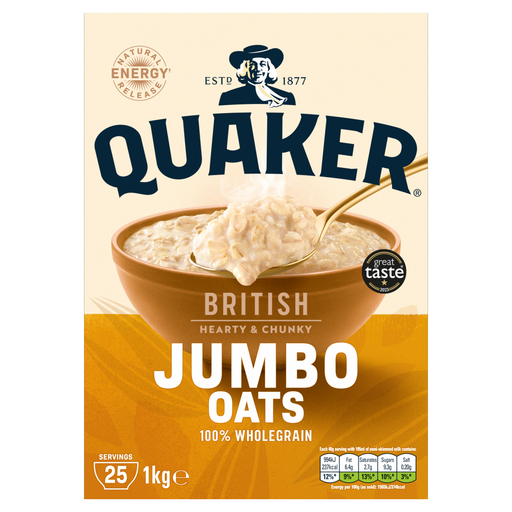
A versatile plain jumbo-oat base for porridge, overnight oats or baking with measured additions.
The sole ingredient is wholegrain oat flakes. The dry panel lists 1.0g sugars, 9.0g fibre and 11g protein per 100g.
The listing may contain traces of wheat and does not state prepared-bowl nutrition, so check the portion, liquid and toppings you intend to use.
 No image available
A plain organic oat option for shoppers who want to set their own portion and sweetness.
The listing states 100% organic wholegrain oat flakes, 0.9g sugars and 8.3g fibre per 100g. Its stated 40g serving provides 148kcal, 0.4g sugars and 3.3g fibre before liquid or toppings.
It contains oats and is not presented as a certified gluten-free option; check the current pack if gluten avoidance is required.
No. Plain oats can have no added sugar while still containing naturally occurring sugars. For a strict sugar-free requirement, check for that exact claim on the current UK pack and compare sugars per 100g rather than assuming plain oats qualify.
Compare dry products on the same basis, normally per 100g, then check the stated serving and whether it is prepared with water, milk or another drink. Also compare the ingredient list, fibre per serving and sugars in the bowl as prepared.
Do not assume they are. Check ingredients and sugars for the exact flavour: Mornflake Golden Syrup Sachets list sugar as an ingredient and 24.5g sugars per 100g, while Flahavan's Quick Oats Pot Original lists sugar and skimmed milk powder.
They can contribute fibre to a balanced breakfast, but the portion and toppings still matter. Mornflake Fibreful Oatbran lists 10.2g dietary fibre per 40g serving, yet it is not sugar-free because it lists 2.1g sugars per 100g.
Choose a specifically gluten-free oat product only when this is required for your dietary needs. The Food Standards Agency notes that gluten-free oats still need oats emphasised as an allergen, so they are not suitable for an oat allergy.