
24/7 Customer Support

Free returns

Same-day & Next-day Delivery

Quality Guaranteed

Unlock Your Welcome Offers: FREE Delivery | Up to 80% OFF | Free 30-day JoyPlus trial
Download the APP
A 58-piece magnetic building blocks set can offer creative construction, early geometry practice and portable entertainment without requiring batteries or screens. However, not every magnetic tile set provides the same value. Attractive packaging may hide weak connectors, unclear safety information or a piece count that feels limiting after a few play sessions.
This guide explains the practical details UK parents, carers and gift buyers should check before purchasing, followed by product suggestions matched to different play styles.
A large number printed on the box does not always mean a versatile set. Some collections include many small accessories or repeated shapes, while others provide a useful balance of squares, triangles and connecting pieces.
For younger children, a smaller starter set with recognisable shapes may be easier to handle. Older children or households with more than one builder may benefit from an expandable collection with more components.
Magnetic tiles for children should have smooth, sealed edges and magnets that remain enclosed during normal use. Loose or exposed magnets can present a serious hazard if swallowed, so adults should inspect pieces regularly and remove any damaged tiles immediately.
Product descriptions may mention reinforced magnets or welding technology, but buyers should also check the manufacturer information, age guidance and UK safety labelling supplied with the product.
A construction set that is difficult to tidy can quickly lose pieces. This is especially inconvenient in UK homes with limited storage or when taking toys on trains, to restaurants or on family holidays.
A magnetic building toy with storage pouch can make pack-up simpler. A pouch is useful, but it should be large enough for all components and strong enough for repeated use.
Many magnetic building toys use ABS plastic, a durable material commonly found in children’s products. Look for a clear material description, smooth surfaces and securely enclosed magnets.
Do not rely only on phrases such as “educational” or “non-toxic”. Check the product listing and packaging for relevant age guidance, warnings and applicable UK or European toy safety information, such as EN71 references where provided. Supervision remains important, particularly for toddlers and children who still put objects in their mouths.
Shape variety affects what children can build. Squares and triangles support basic 2D and 3D constructions, while unusual forms such as diamond magnetic blocks can introduce different angles and pattern combinations.
The 7.5 cm tile size listed for the Qiyuan set is relatively straightforward for small hands to position, but always compare the stated dimensions with the child’s age and dexterity. Larger pieces may be easier to grip, while smaller components can offer more detailed construction but require closer supervision.
Magnets should connect readily without making pieces difficult for young builders to separate. A useful set should allow children to build flat patterns and simple upright structures without constant collapse.
No magnetic building set can guarantee that every tall model will remain standing. Stability depends on the shape, base design and how many pieces are used. For children developing hand-eye coordination, a set that connects easily can provide a more manageable introduction to construction.
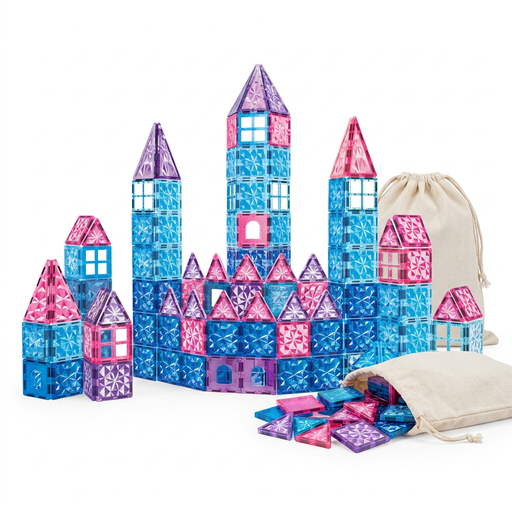
Why This Fits Their Persona: A practical introductory collection for families wanting a manageable number of pieces for creative play, early geometry activities and occasional travel in the UK.
The listing specifies 58 pieces, 7.5 cm tiles, reinforced magnets and a storage pouch, making the contents and storage arrangement clearer than a vague piece-count claim.
ABS construction, diamond-surface tiles, no assembly required and a supplied pouch for tidying and travel.
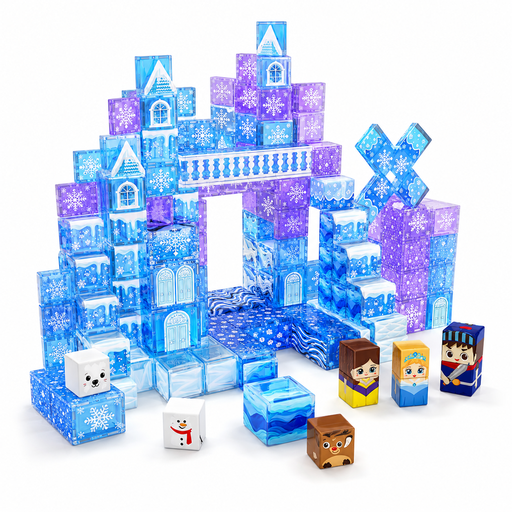
Why This Fits Their Persona: Suited to gift buyers and families who prefer a visually distinctive construction toy that can support open-ended creative play and pattern-making.
Its transparent snow-ice design is clearly stated, so the visual style is easier to assess before purchase than generic product imagery alone.
Transparent components and a design positioned for STEM-oriented building activities for children aged three and over.
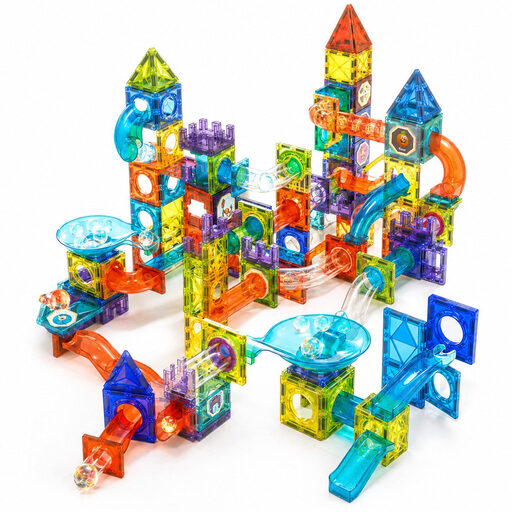
Why This Fits Their Persona: A larger option for children aged five and over who want longer building sessions, more components and a marble-run-focused form of construction play.
The stated 126-piece format and expandable design give frequent builders more scope than a small starter collection, while the age guidance helps set expectations.
ABS plastic construction, BPA-free description, 126 pieces and an expandable marble-run format.
Magnetic construction can be more than free play when adults introduce simple challenges:
These activities turn a magnetic building toy into a practical geometry learning toy and STEM construction toy, while keeping the activity open-ended rather than worksheet-based.
We have compiled a complete, real-time list of products that fully satisfy these strict selection criteria and UK safety regulations.
Suitability depends on the stated age range, component size and the child’s behaviour. Some products are listed for children from three years, while others, such as the marble-run set above, specify five years and over. Always follow the manufacturer’s guidance, supervise play and remove any cracked or opened pieces.
The lifespan depends on how often it is used, how pieces are stored and whether children pull tiles apart forcefully. Wiping ABS magnetic tiles with a damp cloth, drying them thoroughly and keeping them in a pouch or box can help maintain their condition. Inspect the magnets and plastic edges regularly.
No. Standard magnetic tiles and blocks connect through built-in magnets and do not require batteries or a power supply. This makes them convenient for quiet play at home and as a travel toy for children, although a suitable storage method is important when carrying the pieces outside the house.