
24/7 Customer Support

Free returns

Same-day & Next-day Delivery

Quality Guaranteed

Unlock Your Welcome Offers: FREE Delivery | Up to 80% OFF | Free 30-day JoyPlus trial
Download the APP
A magnetic building blocks set can offer open-ended play, early geometry and hands-on construction without needing batteries or complicated assembly. However, product listings often make similar promises, while the actual size, magnet protection and play value can differ considerably.
For UK parents and gift buyers, the main challenge is separating useful specifications from attractive packaging. A low-priced set may contain too few pieces for meaningful builds, while a large-looking box may include mostly small accessories. The right choice depends on the child’s age, storage space, preferred play style and how much scope there is for future expansion.
A high number of pieces does not automatically mean more creative possibilities. Check what is included: large tiles, connectors, windows, wheels and specialist shapes can provide more variety than many repeated squares. Also look for the individual piece dimensions, because a 150-piece set of small construction elements will feel very different from a 58-piece set with larger 7.5 cm diamond-surface tiles.
Magnetic tiles contain small magnets that must remain securely enclosed. Damaged pieces can expose magnets, and swallowed magnets can cause serious internal injuries. Always follow the manufacturer’s age guidance, inspect the set regularly and stop using any cracked or broken piece.
For children under three, magnetic building toys with small parts are generally unsuitable. Age labels should be treated as a minimum requirement, not a suggestion. Adult supervision is particularly important for younger children and during group play with siblings of different ages.
A magnetic building set can support creative play, hand-eye coordination, fine motor practice and spatial reasoning, but only if the child enjoys the format. Some children prefer free-building with colourful magnetic tiles; others are more motivated by a themed model, character or vehicle with step-by-step instructions.
Marketing terms such as “STEM toy” or “educational construction toy” should therefore be considered alongside practical details: connection strength, shape variety, instructions, storage and age suitability.
Many magnetic tiles are made from ABS plastic, a commonly used hard plastic for construction toys. Look for smooth or rounded edges, secure magnet enclosures and clear information about the materials. A listing that states “non-toxic” or “smooth without burrs” is useful, but it should not replace regular checks for cracks, splits or loose components.
For UK purchases, check that the listing provides appropriate product safety information, age warnings and details of the responsible business where applicable. A CE or UKCA marking may appear on compliant toys, but buyers should also read the full warning information rather than relying on a symbol alone.
Strong magnetic attraction can make it easier to create towers, animals, houses and geometric patterns. Yet extremely strong connections are not always necessary for younger children, who may need to separate pieces independently. Consider whether the set is intended for simple flat designs or more stable three-dimensional structures.
A sensible starter choice includes a mixture of shapes and a manageable number of pieces. Larger collections are more suitable when several children will build together or when the child already has magnetic tiles and wants to expand the system.
Storage affects how often a set is used. A pouch or box helps keep pieces together, especially in smaller UK homes or when taking a toy on train journeys and family visits. Check the cleaning instructions: some products recommend a soft, dry cloth, while others can be wiped with a damp cloth and dried thoroughly. Do not immerse magnetic toys in water unless the manufacturer specifically permits it.
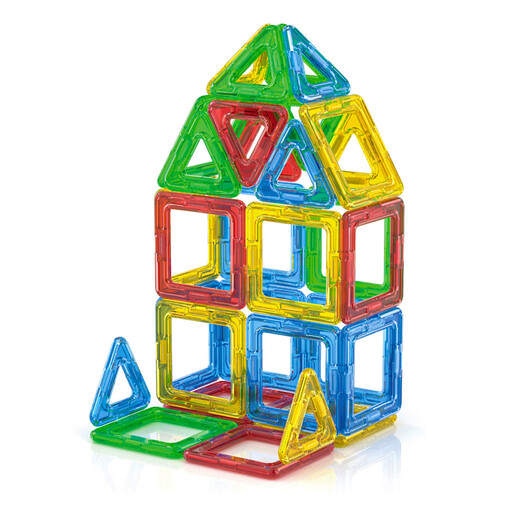
Why This Fits Their Persona: A compact introductory set for families testing whether magnetic tiles will become a regular part of play, with a 0.48 kg set weight and colour box packaging.
The listing clearly states 36 pieces, approximate single-block dimensions of 3.5 × 3.5 × 0.8 cm and an age range of 3+, making the purchase easier to assess.
ABS construction, smooth rounded edges, manual play with no batteries and a storage box.
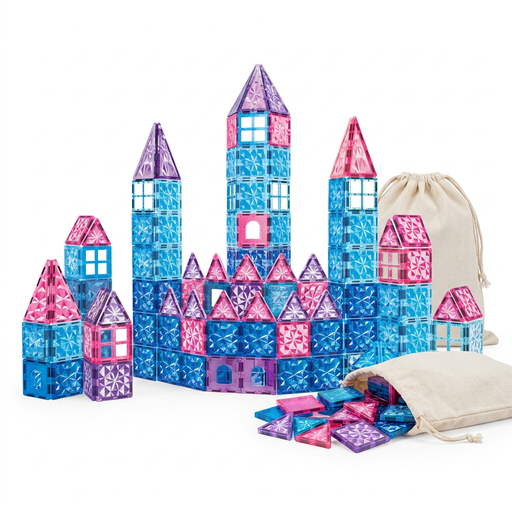
Why This Fits Their Persona: A larger 58-piece starter collection for buyers who want visibly sized magnetic building tiles, a pouch and a more structured introduction to geometry-based construction.
The stated 7.5 cm tile size helps avoid misleading piece-count comparisons, while the product description specifies enclosed magnets and smooth edges.
58 pieces, diamond-surface shapes, reinforced magnets and a lightweight storage pouch.
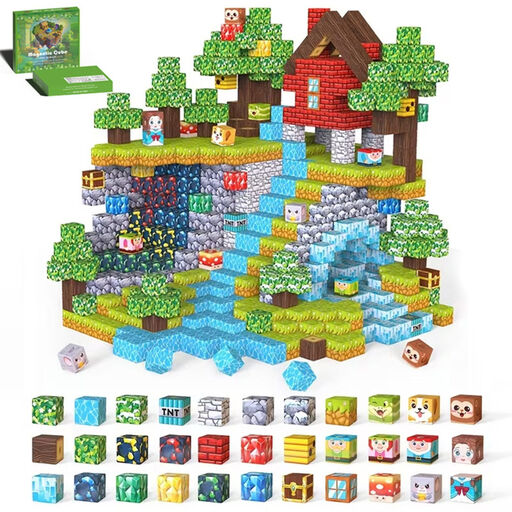
Why This Fits Their Persona: A larger collection for children who build frequently, siblings sharing one set or families looking for more parts for group construction.
The 150-piece quantity provides more scope than a mini starter kit; buyers should still confirm the exact shape mix, dimensions and safety details on the product page before ordering.
150 pieces, ABS construction stated in the listing and an age indication from 3 years.
We have compiled a complete, real-time list of products that fully satisfy these strict selection criteria and UK safety regulations.
Start with simple tasks rather than expecting a young child to follow a complex model. Ask them to build a flat pattern, match colours, make a bridge or create a shape that can stand independently. Older children can compare which structures are stable, count the pieces used or design a small farm, vehicle or building.
For travel, choose a set with a pouch or compact box. At home, use a labelled storage container so missing pieces are easier to identify. Keep magnetic tiles away from very young children, pets and food areas, and check the pieces before each extended play session.
Some sets are labelled 3+, but suitability depends on the individual design, piece size and warnings. Magnetic tiles may contain small magnets and small parts, so supervise young children, inspect pieces for damage and seek immediate medical help if a magnet is swallowed or inhaled.
Most magnetic tiles are manually connected and do not need batteries. This makes them convenient for travel and quiet indoor play. Special accessories, such as illuminated features, may have separate power requirements, so check the product specifications before buying.
Lifespan depends on construction quality, storage and how the pieces are handled. Securely enclosed magnets, smooth ABS parts and regular inspection can support continued use, but no set should be used once a tile is cracked, badly warped or showing an exposed magnet.