
24/7 Customer Support

Free returns

Same-day & Next-day Delivery

Quality Guaranteed

Unlock Your Welcome Offers: FREE Delivery | Up to 80% OFF | Free 30-day JoyPlus trial
Download the APP
Magnetic building blocks for children can offer open-ended construction, pattern-making and parent-child play. However, colourful packaging and impressive piece counts do not always tell you whether a set will suit your child, fit your home or remain enjoyable after the first few builds.
Before buying magnetic tiles, a STEM construction toy or an educational building set, look beyond the headline claims. The right choice depends on age suitability, magnet safety, connection quality and how the pieces will actually be used.
A 150-piece set may sound more attractive than a 36-piece starter kit, but quantity is only useful if the shapes support the type of building your child enjoys. A set with mostly flat squares may be suitable for simple patterns, while a marble run or farm-themed set may offer more varied play.
Check the mix of squares, triangles, connectors, wheels, doors and special parts, rather than comparing the number printed on the front of the box alone.
Magnetic strength affects whether a structure stays together, but stronger is not automatically more practical. Younger children may find very firm connections difficult to separate, while weak connections can make taller designs frustrating.
Look for information about the construction of each tile, including whether magnets are enclosed and whether the product should be inspected for cracks. If a tile becomes damaged and a magnet is exposed, remove it from use immediately. Swallowed magnets can cause serious internal injury and require urgent medical attention.
Some magnetic construction blocks are marked for children aged 3+, while detailed ABS building blocks and model kits may be intended for children aged 6 and above. A set can be suitable for one child but inappropriate for a younger sibling who shares the play area.
Age guidance should be treated as a practical safety requirement, not just a suggestion. Check for small-parts warnings, supervise younger children and store pieces securely after play.
ABS plastic is widely used in children’s building blocks because it can be formed into lightweight, rigid pieces. Smooth, rounded edges may make tiles more comfortable for small hands, but the finish should not be your only consideration.
Inspect the product listing for:
Terms such as “non-toxic” or “safe material” should be supported by clear product information. Avoid relying solely on promotional wording.
For a first magnetic tile set, 36 pieces can be easier to organise and less intimidating. Larger sets from 85 to 150 pieces may be more suitable for siblings, regular builders or children who already understand how magnetic shapes connect.
Consider storage space as well. Transparent tiles, themed pieces and expansion parts can be useful, but a complete set should still be easy to sort into a box or drawer.
Different creative building toys serve different purposes:
These products can support fine motor practice, spatial reasoning and creative planning, but no toy can guarantee a particular educational outcome. The child’s interest and the opportunity to play without excessive adult direction matter just as much.
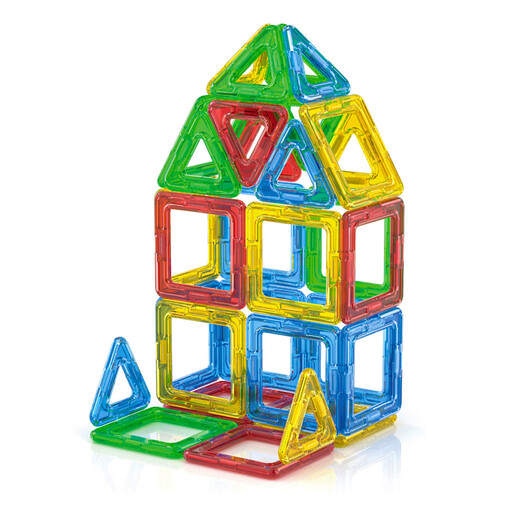
Why This Fits Their Persona: A compact introductory set for families testing whether magnetic construction suits a child’s play style, with a colour box for storage and gifting.
The 36-piece format makes the quantity clear, avoiding the need to pay for a large set before knowing whether the child enjoys open-ended building.
Listed as suitable from age 3, with ABS plastic, rounded edges and manual play requiring no batteries.
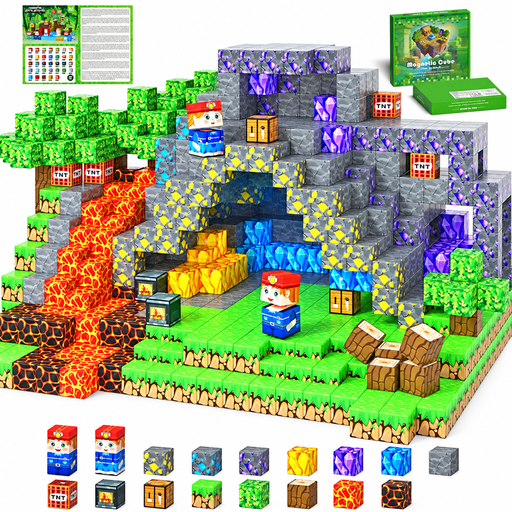
Why This Fits Their Persona: Suitable for households wanting more design flexibility, shared play or a set that can remain engaging as children move beyond simple towers.
The 150-piece count gives scope for larger builds, while the nature motif adds visual variety beyond plain geometric tiles.
An expandable magnetic building set made from ABS plastic and listed for children from age 3.
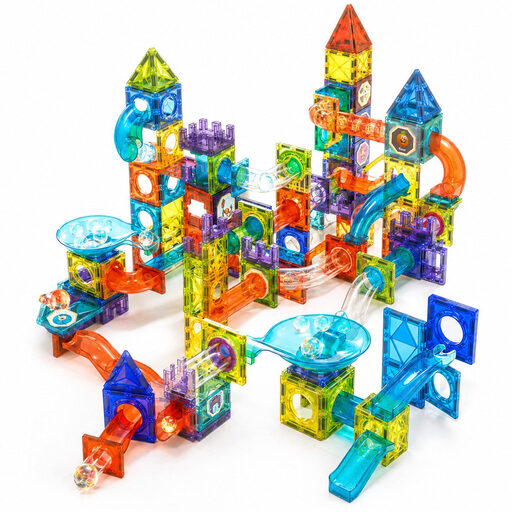
Why This Fits Their Persona: A practical match for children who prefer building tracks and testing movement rather than making static houses or shapes.
Its defined marble-run format makes the play purpose clear, reducing the risk of buying a general tile set that does not match the child’s interests.
Includes 126 pieces, uses ABS plastic and is listed as expandable for children from age 5.
We have compiled a complete, real-time list of products that fully satisfy these strict selection criteria and UK safety regulations.
Some sets are specifically listed for children aged 3+, but supervision remains important because magnetic tiles may contain small parts and magnets. Keep them away from babies and toddlers, inspect pieces regularly and stop using any damaged tile.
Lifespan depends on storage, frequency of use and whether the plastic or magnet enclosure becomes damaged. Store sets dry and away from direct heat, avoid throwing pieces and follow the manufacturer’s cleaning instructions. Replacing a damaged piece is safer than continuing to use it.
Most magnetic tiles and magnetic construction blocks use manual connections and do not need batteries. A set with lights, moving components or an illuminated feature may have different power requirements, so check the individual product listing before purchase.