
24/7 Customer Support

Free returns

Same-day & Next-day Delivery

Quality Guaranteed

Unlock Your Welcome Offers: FREE Delivery | Up to 80% OFF | Free 30-day JoyPlus trial
Download the APP
Magnetic building blocks for children can support open-ended play, early geometry and hands-on problem-solving. However, a colourful box and a large piece count do not automatically mean a set will suit your child, classroom or available storage space.
For UK parents, grandparents, gift buyers and educators, the practical questions are more important: Are the magnets securely enclosed? Is the set genuinely suitable for the child’s age? Will the pieces create useful structures, or simply become a difficult-to-store collection of mismatched parts?
This guide explains the main buying pitfalls, the specifications worth checking and a selection of magnetic construction toys for different types of user.
A 150-piece magnetic building set may sound more substantial than a 50-piece set, but the pieces can differ significantly in dimensions and function. Small 2.5 cm tiles are portable and suitable for detailed scenes, while larger 7.5 cm diamond tiles may be easier for young children to handle and more suitable for bigger structures.
Check whether the stated quantity includes small speciality pieces, character tiles or accessories. A set with fewer, larger geometric tiles may offer more usable construction possibilities than a higher-count set with limited basic shapes.
Magnetic strength is useful only when magnets remain securely enclosed inside each piece. Product descriptions should explain whether the casing is welded, sealed or otherwise designed to prevent magnets becoming exposed. You should also inspect every tile regularly for cracks, splits or loose components.
These toys contain small parts and magnets. They are not suitable for children under three, and children should not place pieces in their mouths. If a magnet is swallowed or inhaled, seek urgent medical help.
Compatibility depends on more than the word “magnetic”. Tile dimensions, connector placement, magnet polarity and shape ranges can vary. Some 2.5 cm mini magnetic tiles may work with other sets of the same format, while larger diamond-shaped systems may not connect effectively with standard square magnetic tiles.
If you plan to expand a collection, choose the same tile size and check the product listing for compatibility information before buying.
Many magnetic tiles use ABS plastic, a lightweight material commonly used for children’s products. Look for smooth or rounded edges without burrs and clear information about enclosed magnets. Terms such as “ultrasonic welded” or “securely sealed” describe a manufacturing feature, but they do not remove the need for regular inspection.
For UK purchases, check the packaging and listing for relevant toy-safety information, including the required age range, warnings and applicable CE or UKCA marking where appropriate. If a seller provides references to EN 71, ASTM or other standards, verify that the information relates to the specific product rather than a general brand statement.
Most sets in this selection are listed for children aged 3+, but age suitability is not the only consideration. A younger three-year-old may need larger pieces and close adult supervision, while an older child may prefer smaller tiles, themed accessories or a marble-run challenge.
Always follow the product warning, supervise play where recommended and keep sets away from children who still mouth objects.
For travel, a storage pouch or compact case can prevent lost pieces during train journeys, holidays or visits to grandparents. For nurseries and schools, prioritise a larger piece count, a useful variety of shapes and easy cleaning.
A magnetic marble run is generally more structured than open-ended magnetic tiles and may suit children who enjoy sequencing, gravity and cause-and-effect play. The set should be matched to the listed age range; the 126-piece example below is specified for children from five years.
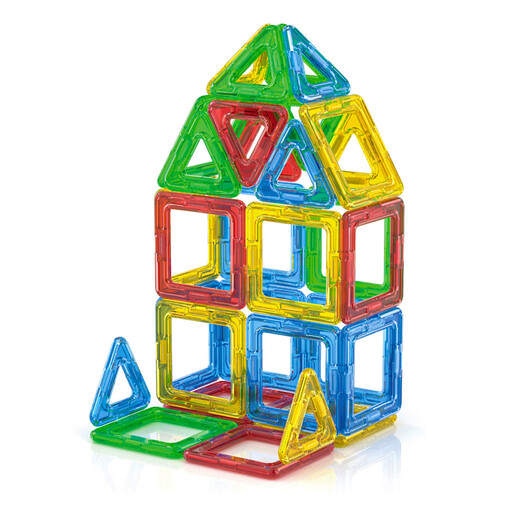
Why This Fits Their Persona: A compact entry point for families who want to introduce magnetic tiles without immediately buying a large collection. The set weighs approximately 0.48 kg and comes in gift-box packaging for storage.
The listing states the single blocks measure approximately 3.5 × 3.5 × 0.8 cm, making the format clearer than relying on the piece count alone. It also includes small-part and magnet warnings.
36 pieces, ABS construction, smooth edges and no batteries required. Suitable for children aged 3+ according to the listing.
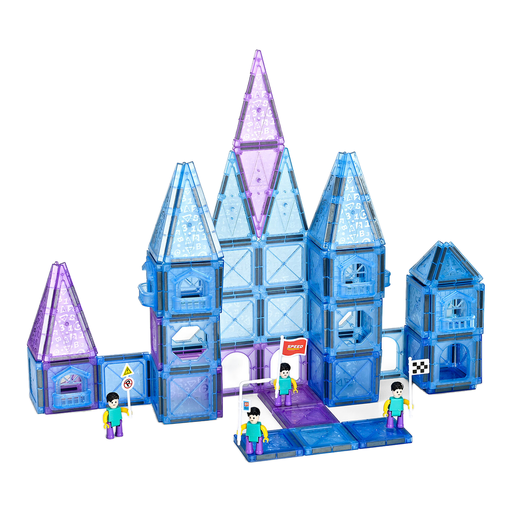
Why This Fits Their Persona: A larger themed magnetic building set for children who enjoy constructing castles, towers and imaginative scenes, with enough pieces for more involved home or group play.
The listing identifies 128 pieces, translucent ABS panels, rounded edges and securely sealed permanent magnets. It also advises checking for cracks or loose magnets before use.
Ice-blue translucent design, instruction booklet, colour box and no battery requirement. Listed for children aged 3 years and above.
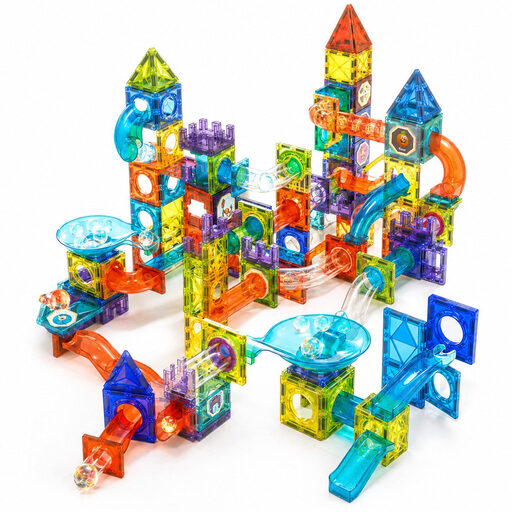
Why This Fits Their Persona: Designed for children who want more than simple flat shapes. The marble-run format introduces routes, height and movement, making it suitable for supervised STEM-style play from age 5.
Its listed age of 5+ helps prevent buying a more complex construction system for a child who is only ready for simpler magnetic tiles.
126-piece format, ABS construction and expandable design according to the product title. No batteries are needed for manual construction play.
We have compiled a complete, real-time list of products that fully satisfy these strict selection criteria and UK safety regulations.
Many products are listed as suitable from 3 years, but they contain small parts and magnets. Follow the individual warning, supervise play and choose larger, simpler pieces for children who are new to construction toys.
Standard magnetic tiles and magnetic construction toys use manual magnetic connections and do not require batteries. A themed accessory, such as an illuminated feature, may have different requirements, so check the full product specification.
Cost depends on piece count, tile size, themes, storage and specialist components. A 36-piece starter set can introduce the format, while 100- to 150-piece magnetic building sets may suit siblings, classrooms or children who already enjoy construction play. Comparing usable shapes and safety information is more helpful than choosing by price or quantity alone.