
24/7 Customer Support

Free returns

Same-day & Next-day Delivery

Quality Guaranteed

Unlock Your Welcome Offers: FREE Delivery | Up to 80% OFF | Free 30-day JoyPlus trial
Download the APP
Magnetic building blocks for children can offer open-ended play, but not every colourful box delivers good value. A set may look impressive online yet contain too few useful shapes, weak connections or pieces that are difficult to store. For UK families buying a birthday present, rainy-day activity or educational gift, the important question is not simply how many pieces are in the box. It is whether the set is safe, suitable for the child’s age and flexible enough to keep being used.
A high number can be misleading if most pieces are small duplicates or decorative accessories. Compare the mix of squares, triangles, connectors and special parts. Children usually get more creative use from a balanced selection than from a large quantity of one repetitive shape.
A smaller magnetic building set may suit a first-time builder, while a 150-piece collection can be more appropriate for siblings or children who already enjoy construction play.
Magnetic tiles and blocks should be checked regularly for cracks, loose components or exposed magnets. Swallowed magnets can cause serious internal injury, so damaged pieces should be removed immediately and medical help sought urgently if a child may have swallowed one.
Look for clear age guidance, smooth edges and a construction that keeps magnets enclosed. Products described as ultrasonic-welded or made from sealed ABS components may offer useful design information, but buyers should still inspect the pieces after delivery and during use. Age ratings are not interchangeable: magnetic tiles for ages 3+ are not suitable for younger children simply because an adult is present.
STEM toys for children can introduce geometry, balance, colour, spatial reasoning and simple engineering ideas. However, learning value depends on how the toy is used. A child who prefers role play may engage more with a farm, vehicle or wheel-themed set than with plain geometric panels.
Choose a theme and difficulty level that fit the child’s interests. This makes the set more likely to be used repeatedly rather than placed in a cupboard after one afternoon.
Many magnetic building toys use ABS plastic, a common durable material for children’s products. The listing should provide an age range, material details and safety warnings. Smooth or rounded edges can make handling more comfortable, but they do not remove the need for supervision.
For UK shoppers, check that the product information includes appropriate safety and compliance details for toys sold in Great Britain, such as relevant conformity marking and warnings. Do not rely on vague wording such as “non-toxic” alone; look for specific information about magnets, small parts, cleaning and damage inspection.
Strong attraction can help structures stay together, but “strong magnets” is not a sufficient safety specification by itself. The magnets should remain securely enclosed inside each tile or block. Connection strength also affects play: weak joins can make larger models frustrating, while overly rigid pieces may be difficult for younger children to separate.
For a first set, prioritise pieces that small hands can connect and pull apart without excessive force. For older children or group play, a wider selection of shapes and stable joins may support taller or more complex constructions.
Consider where the set will be used and stored. A 36-piece starter set may be easier to carry and tidy, while a 60-piece farm set can support themed storytelling. Larger 150-piece sets are more suitable when several children will build together or when you want an expandable collection.
A storage pouch or box is practical for UK homes where loose pieces can quickly disappear under furniture. Before purchasing an expansion set, check whether its shapes and magnetic connections are compatible with the existing collection.
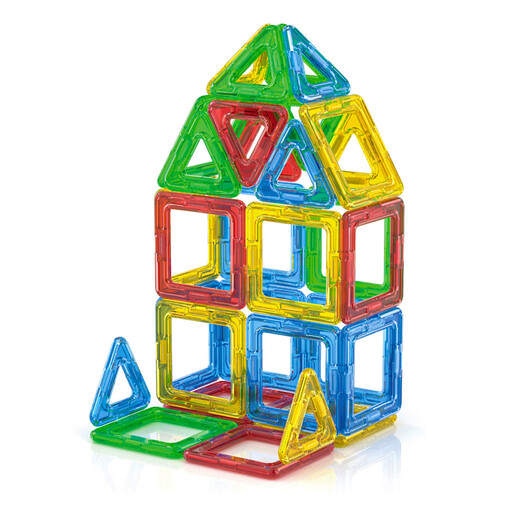
Why This Fits Their Persona: A compact starting point for families testing whether magnetic construction play suits a child aged 3 or over, without committing to a large collection.
The stated 36-piece count and mini format make the purchase easier to assess than a box with an unclear assortment. Safety information includes small-magnet and small-part warnings.
ABS plastic construction, smooth rounded edges, no batteries required and colour-box packaging for storage or gifting.
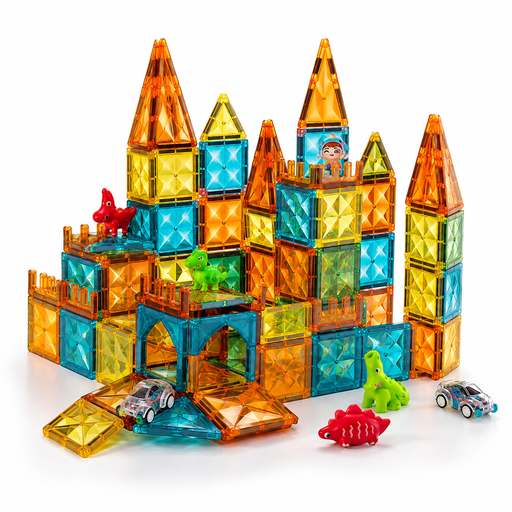
Why This Fits Their Persona: A themed option for gift buyers seeking more than plain panels, with a visual feature that can extend imaginative play for children aged 3 to 10.
The Ferris wheel gives the set a defined play theme, while the listing identifies ultrasonic-welded magnetic building blocks rather than relying only on general educational wording.
Combines magnetic construction with an illuminated Ferris wheel feature and is presented as a gift for boys and girls aged 3 to 10.
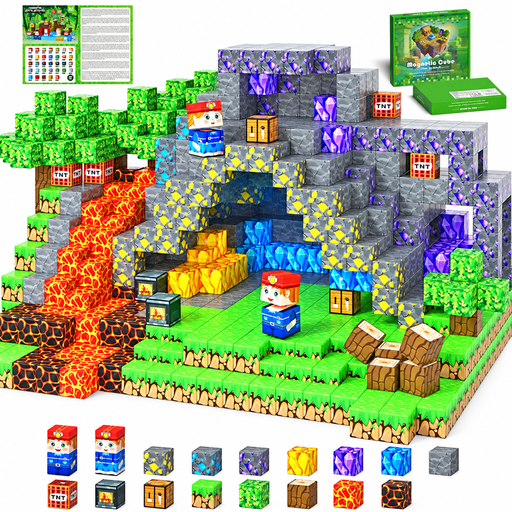
Why This Fits Their Persona: A larger collection for regular home use, sibling play or children who have moved beyond introductory magnetic tiles and want more building combinations.
The stated 150-piece quantity is clear, making it easier to judge capacity for group construction. The product is listed for children from 3 years and uses ABS plastic.
Large piece count, nature-themed parts and an expandable format suited to creative building toys and repeated construction activities.
We have compiled a complete, real-time list of products that fully satisfy these strict selection criteria and UK safety regulations.
Start with simple 2D patterns before moving to towers, houses or moving features. Ask children to predict which shapes will make a stable base, compare symmetrical designs or rebuild a model in a different way. These activities support spatial imagination and fine motor practice without turning play into a worksheet.
For families with an existing collection, a magnetic toy expansion set can add variety at a lower cost than replacing everything. Confirm compatibility first, then store pieces by shape so children can find what they need quickly.
They can be, provided the specific product is labelled for that age group and used according to its instructions. Magnets and small parts still require supervision. Inspect pieces routinely and stop using any tile or block that is cracked or has an exposed component.
Lifespan depends on construction quality, frequency of use and storage. Keeping pieces dry, avoiding bending or throwing them, and checking for damage can help preserve them. A set used by several children every day may show wear sooner than one used occasionally.
Most standard magnetic tiles and children’s building blocks are manual toys and have no running cost after purchase. Special accessories, such as illuminated features, may require batteries. Check the product listing for battery requirements and keep replacement batteries away from children.