
24/7 Customer Support

Free returns

Same-day & Next-day Delivery

Quality Guaranteed

Unlock Your Welcome Offers: FREE Delivery | Up to 80% OFF | Free 30-day JoyPlus trial
Download the APP
Choosing magnetic building blocks can look simple until you compare magnet strength, piece size, age guidance and the type of play each set supports. A colourful box may promise STEM learning, open-ended creativity and hours of entertainment, yet the contents may not suit your child’s age, available space or building style.
For UK families, the most useful approach is to look beyond the packaging. Check how the pieces connect, whether the set can be expanded and whether the safety information is clear. The following guide explains the main buying pitfalls and highlights suitable options for different users.
A large number printed on the box does not automatically mean more useful play. Some sets contain many small components but offer limited shapes or only one construction outcome. A smaller magnetic tile set with squares, triangles and connectors may support more designs than a larger set built around a single model.
Consider the range of shapes, storage method and whether additional pieces can be added later. For children who enjoy open-ended play, geometric magnetic tiles are often more flexible than a fixed character or vehicle kit.
Magnetic building blocks are not all designed for the same age group. Larger pieces may be easier for younger children to handle, while small tiles, marbles and detailed architectural parts are more appropriate for older users.
Always read the product’s stated age guidance and warning information. Products containing small parts should be kept away from children who may place pieces in their mouths. Adult supervision is particularly important when a set includes small magnetic components or marbles.
Magnetic strength is only one part of stability. The shape of the tile, the quality of its casing and the number of connection points also affect whether a structure stays upright. Tall towers made from flat tiles may still topple if the base is narrow.
Look for product information describing securely enclosed magnets, smooth edges and compatible construction pieces. Avoid relying solely on promotional phrases such as “unbreakable” or “super strong” unless the listing provides useful specifications.
For younger children, larger chunky blocks are generally easier to grip. The Mega Bloks ABC Learning Train, for example, uses big blocks designed for little hands and includes letter-printed pieces. It is listed for children from 12 months to 5 years, although its warning still advises supervision and attention to small parts.
Many magnetic building sets use ABS plastic, a common material for construction toys. Check whether the listing mentions smooth or rounded edges, enclosed magnets and cleaning instructions. A set that can be wiped clean is more practical for regular family use.
Match the challenge to the user rather than buying solely for appearance:
Storage is easy to underestimate. Loose magnetic tiles can quickly spread across a bedroom or classroom, so a pouch, bucket or dedicated container adds practical value. Also check whether the set is intended to work with additional pieces from the same range.
For schools and group activities, consider how many children can use the set at once. A larger magnetic building set may be more suitable for collaborative construction, while a compact 58-piece starter collection can work well for individual play or travel.
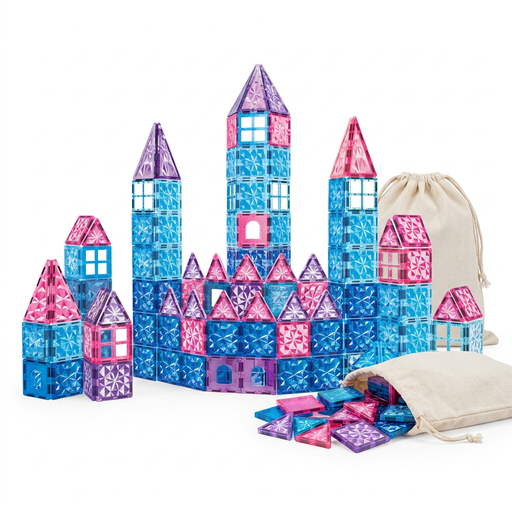
Why This Fits Their Persona: A compact starter collection for families wanting an approachable introduction to magnetic tiles without committing to a large storage-heavy set. The included pouch is useful for travel and tidying.
The listing identifies a 58-piece collection, a storage pouch and enclosed magnets, giving buyers more useful information than a vague piece-count claim.
58 diamond-surface magnetic pieces; storage pouch included; damp-cloth cleaning guidance provided.
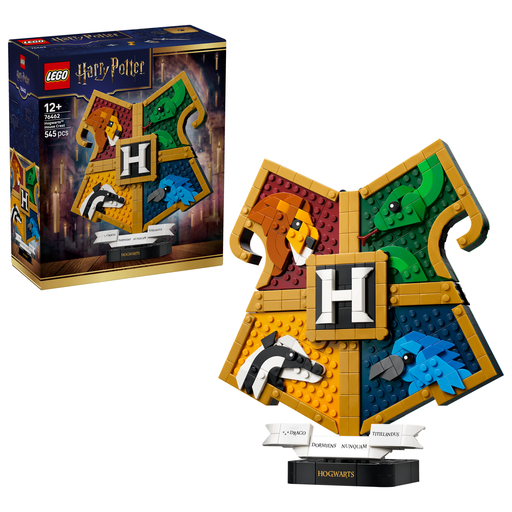
Why This Fits Their Persona: A themed construction option for older children, teenage fans and collectors who value a detailed finished display rather than magnetic, free-form building.
Its intended audience, 545-piece count and completed dimensions are clearly stated, helping buyers assess the time and display space required.
545 pieces; hidden themed compartments; stand or wall-display options; digital 3D instructions via the LEGO Builder app.
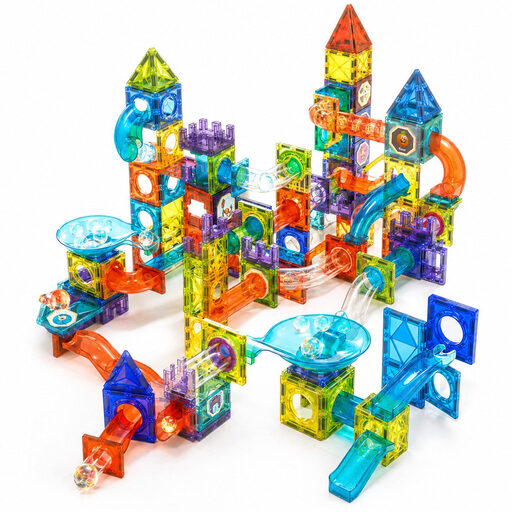
Why This Fits Their Persona: Suitable for children from 5 years who want to build, alter and replay moving track designs. It can provide a more focused STEM activity than simple free-form stacking.
The 126-piece format and stated 5+ age guidance make the product’s intended complexity clearer. Adult supervision remains important because the set includes marbles.
126 pieces; expandable magnetic marble run format; listed as an ABS STEM toy; designed for children from 5 years.
We have compiled a complete, real-time list of products that fully satisfy these strict selection criteria and UK safety regulations.
Before placing an order, check the following:
Some are designed for children from 3 years, but suitability depends on piece size, construction and the manufacturer’s instructions. Always follow the specific age guidance and supervise play, particularly if the set contains small tiles, marbles or detachable parts.
Most basic magnetic tiles and magnetic building sets do not require batteries. A set with lights, moving features or an illuminated Ferris wheel may require batteries, so check the individual product listing before buying.
Their lifespan depends on storage, handling and the condition of the plastic casing around each magnet. Keeping pieces dry, storing them in a pouch or box and removing damaged parts can help maintain a set. Sets with expansion pieces may also remain useful for longer because children can create increasingly complex designs.