
24/7 Customer Support

Free returns

Same-day & Next-day Delivery

Quality Guaranteed

Unlock Your Welcome Offers: FREE Delivery | Up to 80% OFF | Free 30-day JoyPlus trial
Download the APP
Magnetic building blocks can offer open-ended construction play without requiring glue, batteries or complicated tools. However, product listings often focus on bright colours and large piece counts while leaving out details that matter in everyday family use.
Before buying magnetic tiles or a magnetic construction set, check more than the number of pieces. Magnet strength, enclosed components, age suitability, material details and the type of models children can build all affect whether a set remains useful after the first few play sessions.
A 150-piece set may sound more appealing than a 58-piece starter kit, but the actual mix matters. A box containing many small connectors or repeated shapes may offer fewer practical building options than a smaller set with triangles, squares, windows and specialist parts.
Look for the shape selection and whether the set supports the structures your child wants to make. A themed set may be more engaging for a child who enjoys animals or vehicles, while a mixed magnetic tile starter set may provide more freedom for early experimentation.
Magnetic strength is useful when children are building taller or wider structures, but the more important question is whether each magnet is securely enclosed. Check for descriptions such as ultrasonic welding, sealed tile construction or reinforced magnet housing. Also inspect pieces regularly for cracks, splits or loose components.
Magnets can be dangerous if swallowed. Age guidance should be followed carefully and damaged magnetic building blocks should be removed immediately. Adult supervision is particularly important for younger children and mixed-age households.
ABS is a common material for durable educational building blocks, but the material alone does not confirm that a toy is suitable for a particular child. UK shoppers should check the stated age range, safety warnings, responsible-person information and relevant conformity marking on the product or packaging.
Rounded edges and smooth surfaces can make handling more comfortable, but they do not remove the need to check for small parts. Keep packaging and unused components away from children under the recommended age.
For building toys for children aged 3+, choose a set with clear age guidance and shapes that are easy for the intended user to handle. Preschool children may benefit from larger, simple tiles and familiar themes. Older children may prefer smaller construction elements, detailed models and more demanding instructions.
Do not judge suitability by the appearance of the finished model alone. A set can look simple but still contain small pieces that present a choking risk.
A magnetic tile’s usefulness depends on reliable connections. Securely enclosed magnets help tiles join consistently, while smooth, rounded edges reduce uncomfortable sharp points during handling.
The 58-piece XINQIYUAN set, for example, is described as using ABS material, reinforced magnets and ultrasonic-welded construction. These are useful details to look for when comparing magnetic building blocks, although parents should still check each tile during use.
Consider where the set will be used. A compact pouch can be practical for holidays, train journeys or visits to grandparents. Larger collections are more suitable for group play, classrooms or children who want to build substantial structures.
A set with natural, geometric or transparent pieces may combine well with future expansions. The important point is to check dimensions and compatibility rather than assuming that every magnetic tile range connects in exactly the same way.
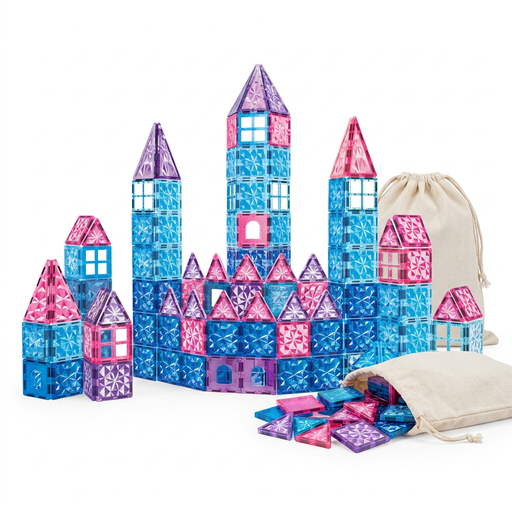
Why This Fits Their Persona: The 58-piece format is a manageable introduction for families who want to try magnetic tiles without immediately buying a large collection. The included storage pouch also suits travel and smaller play spaces.
The listing identifies the material, sealed construction method and piece count rather than relying only on general educational wording.
Diamond-surface tiles; storage pouch; damp-cloth cleaning instructions.
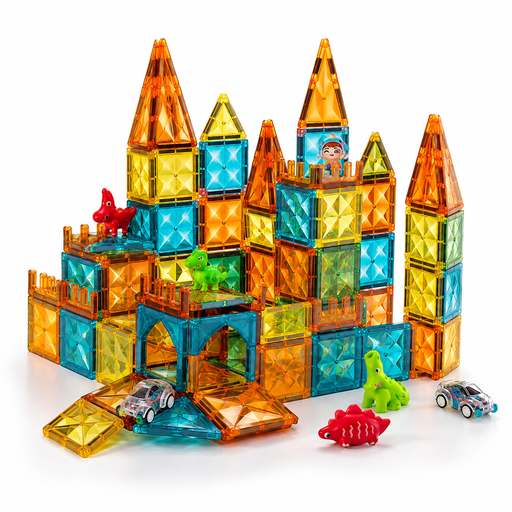
Why This Fits Their Persona: This themed creative building set may appeal to gift buyers seeking a more visually distinctive activity for children aged 3 to 10, rather than a basic collection of geometric tiles.
The Ferris wheel theme gives the piece count a clear play purpose, helping avoid paying for a box of repetitive parts with no intended build.
Illuminated Ferris wheel feature; stated suitability for ages 3 to 10.
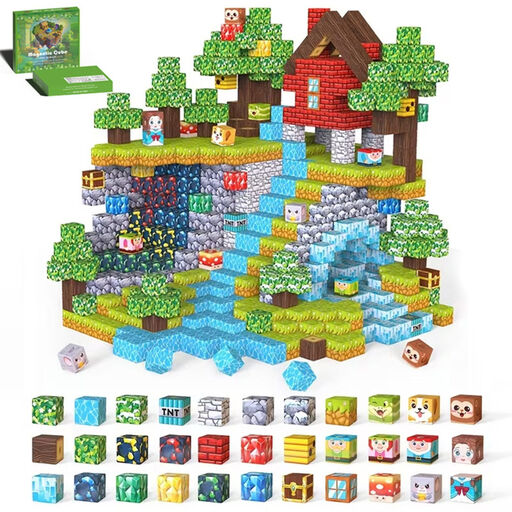
Why This Fits Their Persona: A 150-piece collection is suited to households where several children build together or where a child has moved beyond small starter sets and wants more parts for larger designs.
The stated piece count is clear, making it easier to assess capacity for shared play instead of estimating from promotional photographs.
150 pieces; ABS construction; positioned as a STEM gift.
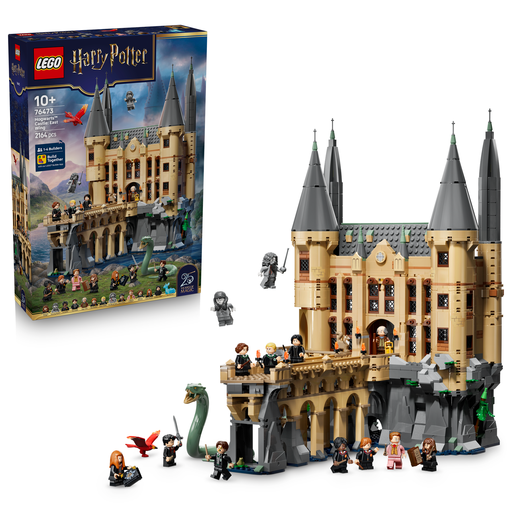
Why This Fits Their Persona: This is a conventional brick construction set rather than a magnetic toy, making it a relevant alternative for older children, collectors and fans who prefer detailed, instruction-led builds.
Its stated age guidance, 2,164-piece count, instructions and small-parts warning make the commitment clear before purchase.
2,164 pieces; suitable for ages 10+; finished model measures over 42 cm high.
We have compiled a complete, real-time list of products that fully satisfy these strict selection criteria and UK safety regulations.
Store tiles in a box or pouch rather than leaving them under furniture, where corners can become damaged. Wipe plastic pieces with a slightly damp cloth and dry them fully before storage. Avoid immersing products unless the manufacturer specifically permits it.
For family play, set a simple challenge such as building a bridge, animal enclosure or tower that can support a lightweight object. This encourages children to think about balance, shape and structure without turning play into a worksheet. Younger children can sort colours and shapes, while older children can plan symmetrical designs or combine magnetic tiles with other construction materials.
Some products are labelled for children aged 3 and over, but suitability varies by design. Always follow the individual product warning, inspect the magnets and supervise play. Sets containing small parts should not be given to younger children.
Most magnetic tiles and basic magnetic construction sets do not require batteries. A themed set with lighting or moving features may have different requirements, so check the product specification before ordering and confirm whether batteries are included.
Cost depends on the piece count, tile size, magnet enclosure, themes and included accessories. A smaller set can be sensible for a first purchase, while a larger collection may offer better practical value for siblings or frequent builders. Compare the number and type of usable construction pieces rather than relying on the advertised total alone.