
24/7 Customer Support

Free returns

Same-day & Next-day Delivery

Quality Guaranteed

Unlock Your Welcome Offers: FREE Delivery | Up to 80% OFF | Free 30-day JoyPlus trial
Download the APP
Magnetic building blocks can offer open-ended play, but choosing the right set involves more than counting pieces on the box. Parents and gift buyers often discover that a large-looking collection contains many small accessories, weak connections or repeated shapes that limit what children can build.
A sensible purchase should match the child’s age, available play space and preferred type of construction. This guide explains the main buying pitfalls, the specifications worth checking and our top recommendations for different household needs.
An 85-piece magnetic building set and a 150-piece magnetic tile set may look directly comparable, but the contents can differ considerably. Some sets include wheels, cards, marbles or decorative parts within the stated total. Check the product listing for the number of usable magnetic tiles and structural components, not just the headline piece count.
A smaller set with a balanced mix of squares, triangles and connectors may provide more useful building opportunities than a larger collection dominated by one shape.
Magnets should be enclosed securely inside each component. Loose or exposed magnets are a serious safety concern if swallowed, particularly because multiple high-powered magnets can attract each other inside the body. Before buying a magnetic construction set, look for clear information about sealed construction, age suitability and applicable toy safety requirements.
Do not rely on phrases such as “strong magnets” alone. Check whether the product has clear manufacturer information, warnings and instructions. Inspect pieces regularly and remove any tile that is cracked, split or showing a loose insert.
Many magnetic building blocks are marked for children aged 3+, but the child’s ability and supervision needs still matter. A magnetic marble run, for example, often includes small balls and moving parts that may be more suitable for older children than basic large-format magnetic tiles.
For children aged 3 to 5, choose straightforward shapes, rounded edges and easy-to-handle components. Children aged 6 to 10 may enjoy more complex structures, moving mechanisms and STEM-focused challenges.
ABS plastic is commonly used for magnetic tiles because it is rigid, lightweight and easy to wipe clean. Product descriptions may also refer to smooth or rounded edges, which can make handling more comfortable. These features are useful, but they do not replace checking the packaging and listing for appropriate warnings.
For UK purchases, look for relevant conformity markings and safety information, including references to applicable EN 71 toy safety standards where provided. A conformity mark alone should not be treated as a guarantee of suitability; always follow the stated age range and instructions.
A useful magnetic building set normally includes a mixture of:
Transparent or patterned ABS magnetic tiles can make colour, light and shape more engaging. However, themed pieces may offer fewer ways to build basic structures, so consider whether the child prefers imaginative scenes or unrestricted construction.
Magnetic construction toys are easier to use when pieces can be stored by shape. A storage pouch or gift box is practical for travel and helps reduce missing components. If the child already owns compatible magnetic tiles, check dimensions and connector arrangements before assuming that another set will integrate smoothly.
Sets with 126 or 150 pieces may suit shared play or larger builds, while a 58-piece starter collection can be easier to carry and organise. Expansion sets are worth considering when the child enjoys returning to the same toy and gradually developing more ambitious designs.
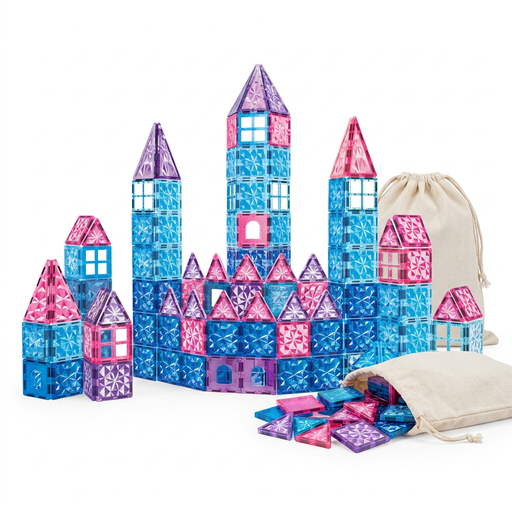
Why This Fits Their Persona: A 58-piece starter collection with a storage pouch is suitable for families introducing magnetic tiles without immediately choosing a large set.
The stated piece count is clear, and the product information describes magnets secured inside the tiles and smooth edges. Check the supplied age guidance before use.
58 pieces; storage pouch included; diamond-surface design; wipe-clean ABS material.
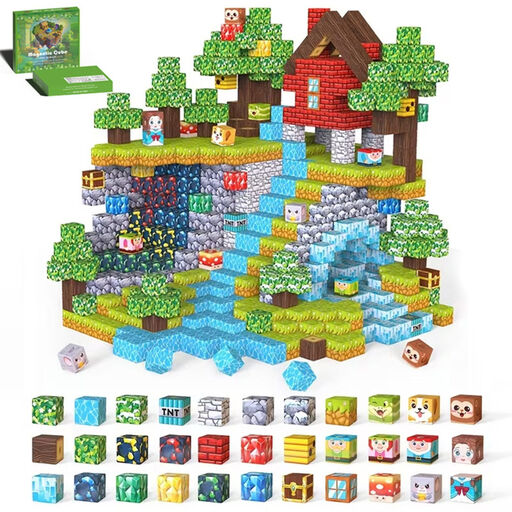
Why This Fits Their Persona: Gift buyers wanting a substantial magnetic building set can consider the larger 150-piece format for solo or sibling play.
The larger quantity provides more scope than a starter pack, but buyers should still verify the exact shape mix and certification details on the listing.
150 pieces; ABS construction; positioned as a STEM educational toy and gift set.
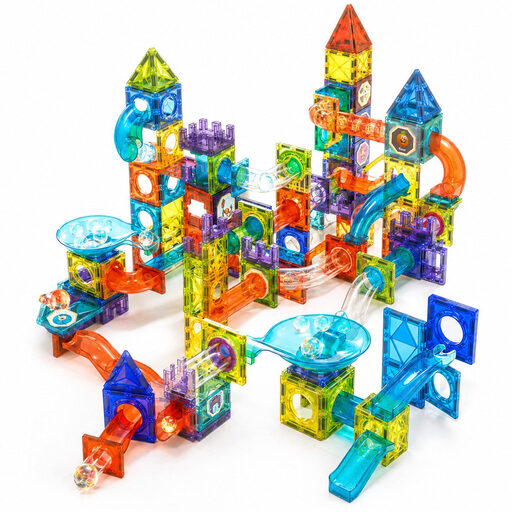
Why This Fits Their Persona: Children who enjoy construction with movement may prefer a magnetic marble run over a conventional tile-only set.
The product is listed for children from 5 years, helping distinguish it from simpler magnetic blocks for ages 3+. Small moving parts still require supervision.
126 pieces; ABS plastic; expandable format; marble-run construction and STEM play.
We have compiled a complete, real-time list of products that fully satisfy these strict selection criteria and UK safety regulations.
Start with a simple challenge, such as building a bridge, tower or animal enclosure. Ask the child what makes the structure stable rather than providing a finished design. This supports spatial reasoning, planning and hand-eye coordination while keeping the activity open-ended.
For group use in classrooms or childcare settings, sort pieces into trays before the session and count them afterwards. Establish a rule that damaged pieces are removed immediately. A wipe-clean surface and dry storage can also help keep ABS magnetic tiles in usable condition.
Sets marked 3+ are intended for that age range, but children should still be supervised. Inspect the tiles for cracks, follow the manufacturer’s instructions and keep loose magnets away from younger children and pets. A marble run or set containing small balls may require a higher minimum age.
Standard magnetic tiles do not need batteries or mains power. They connect through enclosed magnets. Some themed accessories, such as illuminated components, may require batteries, so check the individual product listing for power requirements and replacement information.
Lifespan depends on construction quality, storage and handling. Store pieces away from heat, moisture and heavy pressure, and avoid bending or throwing them. Regularly check seams and corners. Replacing damaged pieces is safer than continuing to use a tile with a visible split or loose magnet.