
24/7 Customer Support

Free returns

Same-day & Next-day Delivery

Quality Guaranteed

Unlock Your Welcome Offers: FREE Delivery | Up to 80% OFF | Free 30-day JoyPlus trial
Download the APP
A magnetic exercise bike can provide consistent indoor cardio without the noise associated with some friction-resistance models. However, product listings often focus on flywheel weight, app compatibility or maximum resistance while leaving more practical details unclear.
For UK households, especially flats and terraced homes, the right choice depends on more than headline specifications. You should consider noise, adjustability, user weight capacity, display functions and how much floor space the bike requires.
Flywheel weight can affect the feel of an indoor cycling bike, but it does not tell you everything about the resistance range or riding smoothness. A model with a heavier flywheel may feel stable, while a lighter flywheel with a well-designed magnetic system can still provide controlled resistance.
Look for the complete specification, including resistance type, flywheel weight, adjustment method and whether the system uses contact-free magnets. Avoid relying on phrases such as “professional” or “high performance” without supporting measurements.
A magnetic resistance system does not use friction pads against the flywheel, which can reduce mechanical noise and wear. Nevertheless, the belt, pedals, floor surface and frame may still create sound or vibration.
For flat use, check for a belt drive, stable base and adjustable foot pads. A rubber exercise mat can also help protect flooring and reduce movement, although it cannot compensate for an unstable frame.
An adjustable exercise bike may offer several seat and handlebar positions, but the adjustment range still needs to suit your height and riding posture. A narrow adjustment range can make regular workouts uncomfortable.
Maximum user weight is equally important. Treat the stated capacity as a limit rather than a target. Check the current product listing and manual, place the bike on a flat surface and allow sufficient clearance around the pedals and handlebars.
For a silent exercise bike, prioritise magnetic resistance with a belt drive. Magnetic systems generally allow resistance changes without direct contact between a pad and flywheel. This can provide smoother transitions and reduce the need to replace friction pads.
A resistance knob or lever is useful for manual intensity changes. If you want structured sessions, confirm whether the Bluetooth connection works with a compatible app and whether the app is included or requires a separate subscription.
Check the number and direction of adjustments rather than simply looking for the word “adjustable”. Useful measurements include:
A four-way saddle is particularly useful when more than one person uses the bike. Taller users should compare the stated adjustment range with their own inseam and riding posture.
An exercise bike with LCD monitor may show time, speed, distance, calories, mileage or heart rate. These figures can help you compare sessions, but calorie estimates are not a substitute for individually measured data.
An exercise bike with APP, Bluetooth exercise bike or tablet holder can make training more engaging. Before buying, check whether the display works independently, whether the app supports your device and whether the bike needs a phone or tablet for advanced tracking.
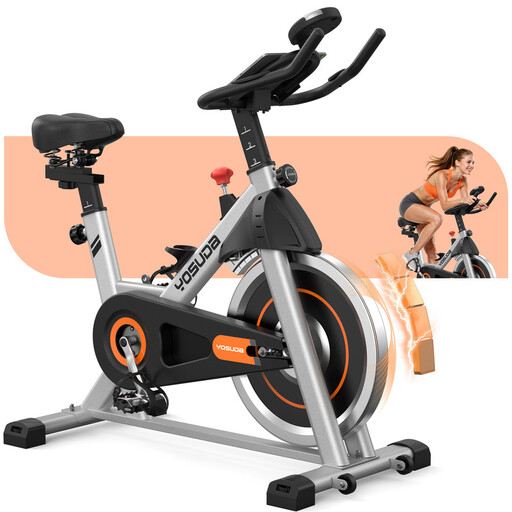
Why This Fits Their Persona: A practical choice for beginners wanting a home cardio equipment setup with app connectivity, basic workout tracking and height adjustment.
The listing specifies a V-belt drive, magnetic resistance, adjustable foot pads and an approximately 120 kg maximum capacity, making key practical details easier to check.
39 kg resistance system; eight-level saddle height adjustment, five-level handlebar adjustment, LCD monitor and tablet holder.
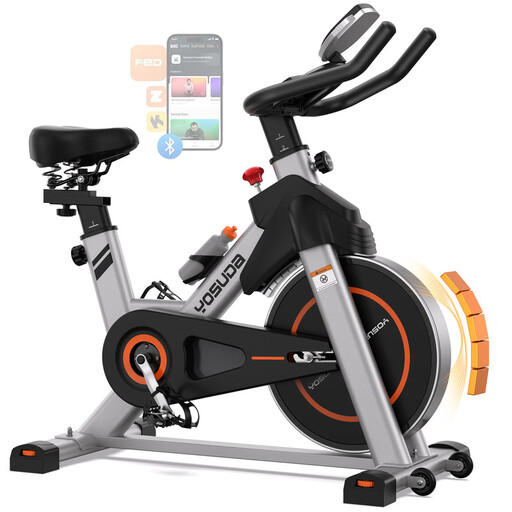
Why This Fits Their Persona: Suits frequent home riders who value a reinforced frame, quiet operation, app connectivity and a wider padded saddle.
Its non-contact magnetic system and belt drive address the noise and friction concerns found in some indoor cycling bikes. Check the product page and manual for the applicable load limit before use.
8 kg magnetic flywheel; four-way seat adjustment, bi-directional grips, LCD display, Bluetooth APP connection and two-year warranty stated in the specification.
Why This Fits Their Persona: The reinforced steel frame and stated higher load specification make this option worth considering for larger users, provided the capacity matches the current listing and manual.
It provides a thicker steel frame, cage pedals and a resistance lever for immediate flywheel stopping. Always stay below the stated maximum load.
Non-contact magnetic resistance; transport wheels, bottle cage, wide soft seat and adjustable non-slip grips for regular home workouts.
We have compiled a complete, real-time list of products that fully satisfy these strict selection criteria and UK safety regulations.
Usually, it can be a practical option because magnetic resistance and belt drives are designed for relatively quiet operation. Noise will still depend on pedalling style, floor construction, vibration and maintenance. Place the bike on a suitable mat and avoid using it directly against a shared wall.
Lifespan depends on frequency of use, user weight, frame construction and maintenance. A reinforced steel frame, belt drive and regular bolt checks can support ongoing use, but no specification guarantees a particular service life. Replace damaged pedals, belts or fixings according to the manufacturer’s guidance.
Most basic magnetic exercise bikes are manually powered and do not require mains electricity for resistance. The LCD monitor and Bluetooth functions may use batteries or low-power electronics, depending on the model. Check the supplied instructions for battery type, replacement intervals and app requirements before purchase.