
24/7 Customer Support

Free returns

Same-day & Next-day Delivery

Quality Guaranteed

Unlock Your Welcome Offers: FREE Delivery | Up to 80% OFF | Free 30-day JoyPlus trial
Download the APP
A magnetic power bank can make commuting, travelling and long days away from a socket more convenient. It attaches to a compatible phone for cable-free top-ups, while many models also include a USB-C port for faster wired charging.
However, the headline specification is not always the whole story. A 10,000mAh label does not guarantee 10,000mAh of usable phone charge, and a “15W” wireless power bank may deliver less depending on the phone, case and charging protocol. Before buying, check the details that affect everyday use.
A power bank’s stated capacity refers to the battery cells, usually measured at a lower internal voltage. Energy is lost during voltage conversion, cable charging and wireless charging. As a result, the usable output is lower than the printed capacity.
A 5000mAh power bank is generally suited to a compact emergency top-up, while a 10000mAh power bank is more practical for a full working day, travel or repeated charging. Wireless charging usually wastes more energy than a direct USB-C connection, so choose capacity according to how you will use it rather than relying on the number alone.
Magnetic alignment is most straightforward with MagSafe-compatible iPhones, including the iPhone 12 series and later models with the relevant magnetic system. Android phones may support Qi wireless charging but not magnetic attachment without a compatible magnetic case or ring.
A thick, non-magnetic case can weaken the hold and reduce charging efficiency. Cases containing metal plates may also interfere with wireless charging and can trigger foreign-object detection. Check both your phone model and case before ordering a MagSafe power bank.
Wireless output depends on the phone, charger protocol, temperature and alignment. Some product listings quote a maximum wireless figure, but an iPhone may receive a lower rate than a compatible Android device. Wired USB-C charging is normally the more predictable option when you need a quick boost.
Also check whether the advertised fast charging applies to output, input or both. A fast charging power bank with 20W or 22.5W USB-C output may still take several hours to recharge if paired with a low-power wall adapter.
For a daily commuter, compare capacity with weight and thickness:
For reference, the TORRAS MiniMag 5000mAh is listed at approximately 10.2 × 6.4 × 0.8cm and around 113g. The 10,000mAh TORRAS MiniMag is listed at approximately 4.01 × 2.5 × 0.5 inches and 182g, while the HOCO Q26A measures 102 × 67 × 13.5mm and weighs 171g.
A USB-C power bank offers greater flexibility than wireless charging alone. Look for:
The HOCO Q26A, for example, lists 20W PD wired output, up to 15W wireless output and 18W input for recharging. Its wireless performance still depends on the receiving device and alignment.
Choose a model with clearly stated protection against overcharging, short circuits and excessive temperature. Avoid using a power bank that is swollen, cracked or unusually hot. Keep keys, coins and cards away from the magnetic charging surface.
Lithium-ion power banks should normally travel in hand luggage rather than checked baggage. Airline restrictions can vary, although many carriers use a 100Wh threshold for permitted passenger batteries. The HOCO Q26A listing gives a 37Wh rating, but check your airline’s current rules before flying.
The following options suit different routines and priorities rather than one universal specification.

Why This Fits Their Persona: A practical choice for UK commuters and occasional users who want magnetic charging without carrying a larger 10,000mAh pack.
The listing states both wired and magnetic wireless outputs, rather than relying on wireless charging alone.
Listed at 119g and 9.4mm thick, with 15W Type-C output, 7.5W magnetic wireless charging and an adjustable stand.
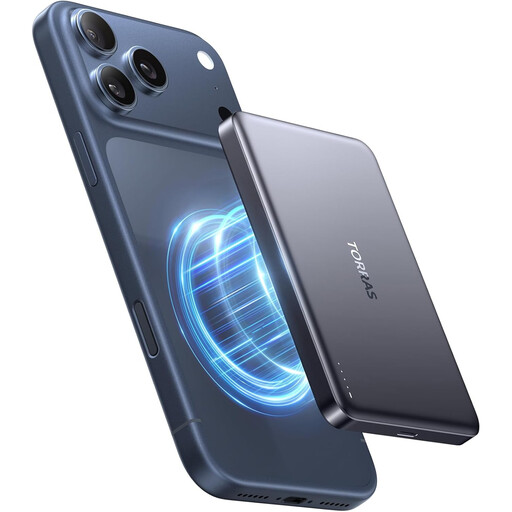
Why This Fits Their Persona: Its listed slim profile and 22.5W wired output suit iPhone users who want greater capacity without a bulky travel charger.
The listing distinguishes 15W wireless output from 7.5W iPhone wireless output, helping set more realistic expectations.
10,000mAh capacity, USB-C charging, listed NTC temperature control and overcharge protection.
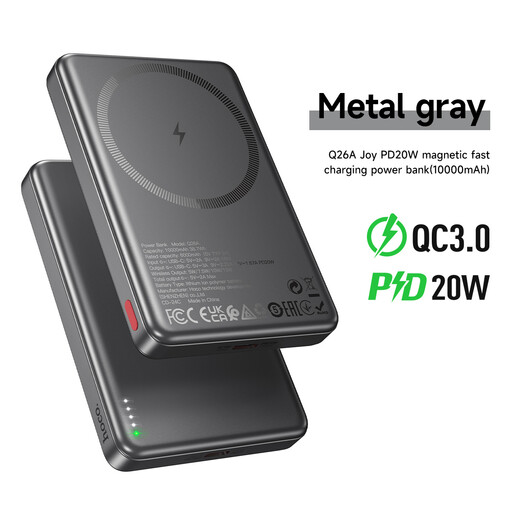
Why This Fits Their Persona: Suitable for long workdays, travel and users charging a phone alongside AirPods or another USB-C device.
Its four-LED display shows the remaining charge in 25% increments, reducing uncertainty during journeys.
20W PD wired output, up to 15W wireless output, dual charging modes and an aluminium alloy body.
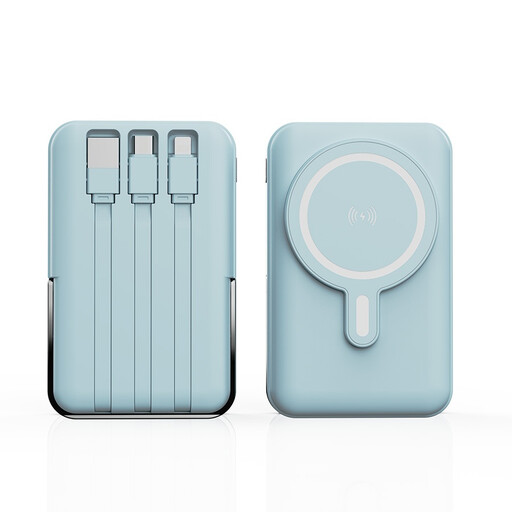
Why This Fits Their Persona: A useful option for desk work, video calls and watching content while charging at home, in a café or on a train.
The adjustable phone stand addresses a common usability issue: holding or propping up a phone while a pack is attached.
Listed 10,000mAh capacity, up to 22.5W charging and wireless compatibility with multiple phones and electronic devices.
We have compiled a complete, real-time list of products that fully satisfy these strict selection criteria and UK safety regulations.
It can be, but Qi wireless charging and magnetic attachment are separate features. An Android phone may support Qi charging without having built-in magnets. A compatible magnetic case or adhesive alignment ring may be required, and wired USB-C charging remains an option.
Battery lifespan depends on charging cycles, storage conditions and heat exposure. Avoid leaving it in a hot car, using damaged cables or storing it fully depleted for long periods. Product listings may state an expected cycle count, but actual performance varies with usage.
Wireless charging can use more energy than a direct cable because of conversion losses and alignment inefficiency. For the quickest and most energy-efficient top-up, use the USB-C output. Magnetic wireless charging is more convenient when you need to keep using the phone without managing a cable.