
24/7 Customer Support

Free returns

Same-day & Next-day Delivery

Quality Guaranteed

Unlock Your Welcome Offers: FREE Delivery | Up to 80% OFF | Free 30-day JoyPlus trial
Download the APP
By Joybuy Product Recommendation Officer
A magnetic power bank can make commuting, travelling or working away from a socket more convenient. It can attach to a compatible phone for cable-free top-ups, while a USB-C connection may provide faster wired charging when time matters.
However, product listings often make capacity, wattage and compatibility difficult to compare. A slim magnetic charger may prioritise portability over battery life, while a high-capacity model may be noticeably heavier. Before buying, check the specifications rather than relying on phrases such as “fast charging” or “strong magnets”.
A 10000mAh magnetic power bank will not transfer the full 10000mAh to your phone. Energy is lost during voltage conversion, wireless transmission and heat management. Wired charging is generally more efficient than wireless charging, while the actual result depends on the phone, cable and charging conditions.
A 5000mAh model may therefore suit a short commute or emergency top-up, but a 10000mAh power bank is more practical for long days, travel or repeated charging.
“15W wireless charging” is a maximum output specification, not a guarantee that every device will receive 15W. An iPhone with MagSafe compatibility, a Qi-enabled Android phone and wireless earbuds may each use different charging rates.
For iPhone users, check the phone generation and whether the case supports magnetic alignment. For Android users, confirm both Qi compatibility and magnetic attachment. A Qi phone may charge wirelessly without holding securely to the power bank unless it uses a compatible magnetic case or accessory ring.
Wireless charging naturally creates more heat than a direct cable connection. Thick cases, metal objects, poor alignment and direct sunlight can make charging less efficient or cause charging to slow down.
Avoid placing keys, coins or bank cards between the phone and charger. A case that is thick or not magnetically compatible may weaken the hold. Also check the dimensions and weight: a 240g power bank can feel considerably different from a compact model weighing around 113g or 119g.
Look for both the battery capacity and the available output modes. A model advertised as a wireless power bank may offer 5W, 7.5W, 10W or 15W wireless output, depending on the connected device. A fast-charging power bank should also state its wired output, such as 20W PD or 22.5W.
USB-C Power Delivery, commonly written as PD, can provide faster wired charging when the phone and cable support the relevant profile. It may also recharge the power bank itself more quickly. Do not assume that a USB-C port automatically supports high-speed charging; check the listed input and output ratings.
A MagSafe power bank is designed around the magnetic alignment system used by compatible iPhones. Some products state compatibility with iPhone 12–15 models, while others list a broader range. Check the individual product listing for the supported devices.
For Android phones, look for Qi wireless charging support and consider using a magnetically compatible case. A magnetic ring accessory may improve alignment, but it can affect case fit and should not cover cameras, buttons or wireless charging components.
A slim magnetic power bank is easier to carry in a coat pocket or small bag. Larger models may offer additional ports, a digital display or a built-in stand. A stand can be useful for video calls, navigation or watching content while charging, but it may add thickness and weight.
Check for practical safety guidance covering overcharging, short circuits, temperature control and foreign object detection. Lithium battery products should be protected from crushing, puncturing, water and excessive heat. For flights, keep a power bank in hand luggage and check your airline’s current battery rules before travelling.
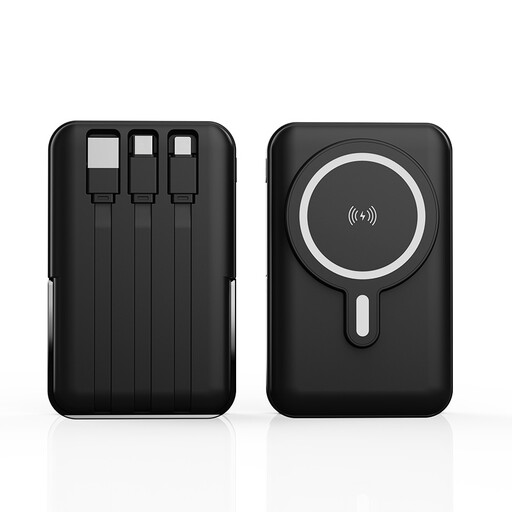
Why This Fits Their Persona: A practical choice for students, commuters and shoppers seeking a 10000mAh capacity with a built-in adjustable phone stand.
Its stated 22.5W maximum wired output and 10000mAh capacity make the key performance figures easier to compare before purchase.
10000mAh capacity; adjustable stand; available in several colours.
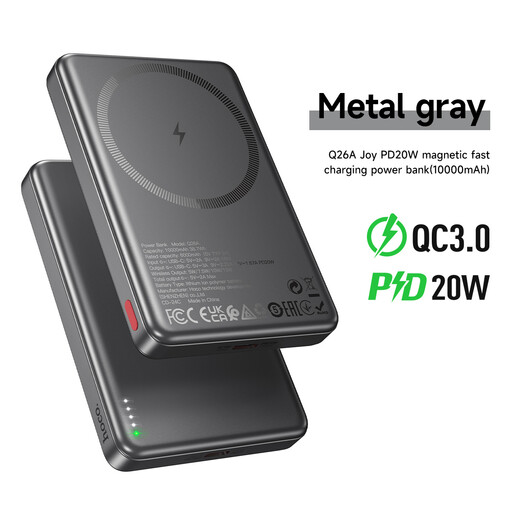
Why This Fits Their Persona: Suitable for professionals and travellers who want a metal-bodied charger with both magnetic wireless and USB-C wired charging.
The listing separates wireless output of up to 15W from 20W PD wired output, helping buyers avoid treating both modes as identical.
10000mAh capacity; 102 × 67 × 13.5mm size; 171g weight; four-LED battery display.
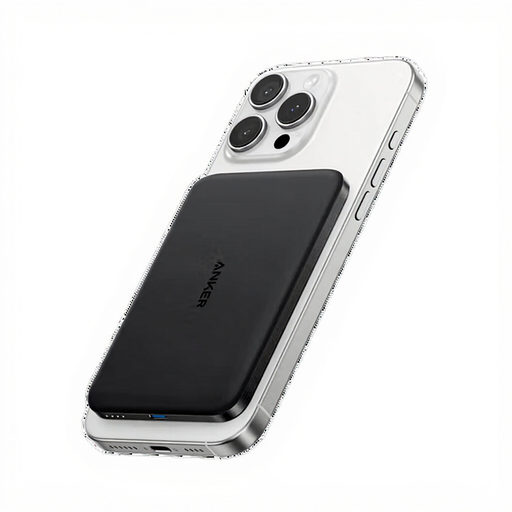
Why This Fits Their Persona: Its compact 5000mAh format suits short journeys, office commutes and anyone prioritising lower carry weight.
The stated 5000mAh capacity sets realistic expectations for a lighter emergency charger rather than a multi-day battery pack.
15W magnetic wireless charging; black compact design; guidance on case thickness and heat management.

Why This Fits Their Persona: The foldable adjustable stand is useful for video calls, streaming, navigation and hands-free work while charging.
The specification lists separate Type-C and wireless outputs, dimensions of approximately 101 × 64.5 × 10mm and a weight of about 119g.
Built-in stand; simultaneous wired and magnetic charging; USB-C cable included according to the listing.
We have compiled a complete, real-time list of products that fully satisfy these strict selection criteria and UK safety regulations.
It can be, provided the phone supports Qi wireless charging and has suitable magnetic alignment. Many Android phones do not have built-in MagSafe magnets, so a compatible case or magnetic ring may be required. Wired USB-C charging is usually the more straightforward option when magnetic attachment is not supported.
Battery lifespan depends on charging cycles, storage conditions and heat exposure. Regularly leaving a lithium battery in high temperatures can accelerate wear. Follow the manufacturer’s charging, storage and handling instructions, and replace the power bank if it becomes swollen or damaged.
Wireless charging can use more electricity than wired charging because energy is lost through heat and transmission. For occasional top-ups, the difference is modest, but a USB-C connection is generally the more efficient choice when you need to recharge quickly or conserve the power bank’s available energy.