
24/7 Customer Support

Free returns

Same-day & Next-day Delivery

Quality Guaranteed

Unlock Your Welcome Offers: FREE Delivery | Up to 80% OFF | Free 30-day JoyPlus trial
Download the APP
A 10000mAh magnetic power bank can be a convenient solution for commuting, travel and long working days. It can attach to a compatible phone, charge through a cable, or top up earbuds and other USB-powered devices. However, capacity figures and wireless charging claims do not always tell the full story.
Before buying, UK shoppers should look beyond the headline wattage and check three practical points: magnetic compatibility, real charging output and everyday portability.
A magnetic attachment does not automatically mean the product is MagSafe-certified or Qi2-certified. Some models use magnets only for positioning, while wireless charging may operate at a lower speed depending on the phone.
For iPhone 12–15 models and other MagSafe-compatible devices, check whether the product specifically states magnetic alignment and its supported wireless output. Android users should also confirm whether their phone supports Qi or Qi2 wireless charging, or whether a compatible magnetic case is required.
The advertised battery capacity refers to the internal cells. Energy is lost when voltage is converted for wired or wireless charging, so the amount delivered to your phone will be lower. Wireless charging can involve additional losses and heat.
A 10,000mAh portable charger is generally suited to daily top-ups rather than unlimited charging. Compare the rated capacity, watt-hours and charging method instead of relying on the mAh number alone.
A product described as a 20W power bank, 22.5W power bank or even 45W may provide that output only through a particular USB-C port or cable. Some multi-device chargers reduce total output when several connections are active.
Check whether the fast-charging figure applies to USB-C output, a built-in cable or wireless charging. Also confirm that your phone supports the relevant charging protocol, such as USB Power Delivery.
A Qi2 power bank uses a magnetic alignment system designed to improve positioning for compatible devices. This can make wireless charging more consistent than placing a phone loosely on a flat pad. Standard Qi devices may support wireless charging but not magnetic attachment.
A MagSafe-compatible iPhone may attach directly, while other phones may need a magnetic case or ring. Thick, non-magnetic cases can weaken the grip and reduce charging efficiency.
For quick top-ups, look for a USB-C power bank with a clearly stated output. A 20W PD output is suitable for many phones, while a 22.5W rating may support additional charging protocols depending on the device.
A power bank with built-in cable reduces the need to carry a separate lead. However, check whether the cable is USB-C, Lightning or another connector, and whether it can be replaced if damaged. Built-in cables can be particularly useful for commuting, business travel and airport connections.
A slim power bank is easier to use while holding a phone, but wireless charging naturally produces heat. Avoid charging inside a tightly closed bag or pocket, and stop using the unit if it becomes unusually hot, swollen or damaged.
For reference, the HOCO Q26A measures 102 × 67 × 13.5mm and weighs 171g. The TORRAS MiniMag is listed at approximately 182g, while the Lofree model weighs 220g. These differences may matter when carrying a charger every day.
Lithium battery power banks should be carried in hand luggage rather than checked baggage. The HOCO Q26A is listed at 37Wh, while the stated 100Wh threshold is commonly used by airlines for permitted carry-on batteries. Always check the current policy of your airline before flying.
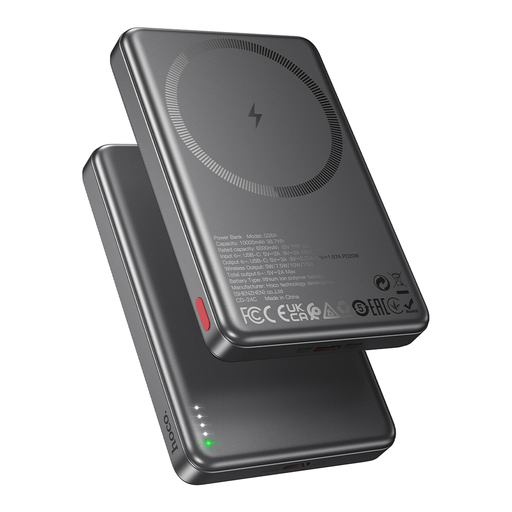
Why This Fits Their Persona: A practical option for iPhone, Android and earbud users who want magnetic charging, a visible battery display and a compact metal body without carrying a separate wireless pad.
The specifications separate wireless output of up to 15W from 20W USB-C PD wired output, making the charging method clear rather than presenting one combined speed.
20W PD wired output, four LED indicators, 171g aluminium alloy body and simultaneous wireless and USB-C charging.
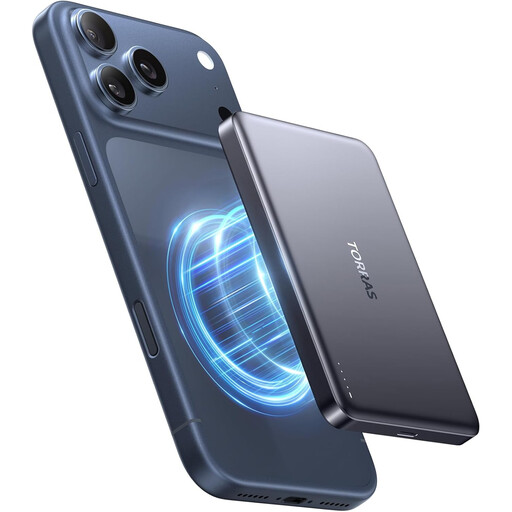
Why This Fits Their Persona: Designed for users who prioritise a slim profile, magnetic alignment and a refined finish for commuting, meetings and frequent travel.
Its listed wireless figures distinguish up to 15W wireless charging from 7.5W for iPhone, helping buyers avoid assuming that every device receives the same speed.
22.5W wired output, 15W wireless output, USB-C cable included, NTC temperature control and overcharge protection listed.
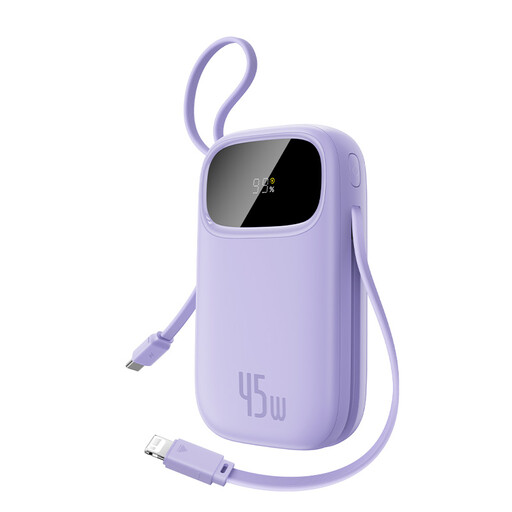
Why This Fits Their Persona: Suitable for multi-device users carrying an iPhone, Android handset, tablet, earbuds or compatible small laptop accessories.
The specifications state that 45W output applies through USB-C with one device; simultaneous charging reduces total output, setting a realistic expectation.
Built-in USB-C and iPhone cables, USB-A and USB-C ports, digital display and support for charging up to four devices.
We have compiled a complete, real-time list of products that fully satisfy these strict selection criteria and UK safety regulations.
For many smartphone users, it can provide useful additional charge during a commute or working day. The delivered amount depends on conversion efficiency, wireless losses, phone battery size and whether the power bank is used while charging. Wired charging is generally more efficient than wireless charging.
Qi2 can improve magnetic alignment and may support up to 15W wireless output on compatible devices. Actual performance depends on the phone, case, temperature and power bank. Check the stated output for your specific device rather than assuming the maximum rating applies universally.
The main running cost is the electricity used to recharge it, which is normally modest. Wireless charging may use more energy than wired charging because of conversion losses. For regular use, connect the power bank to a suitable USB-C wall charger and avoid leaving it charging unnecessarily after it is full.