
24/7 Customer Support

Free returns

Same-day & Next-day Delivery

Quality Guaranteed

Unlock Your Welcome Offers: FREE Delivery | Up to 80% OFF | Free 30-day JoyPlus trial
Download the APP
A magnetic power bank can make charging much easier on a commute, train journey or day out. It attaches to a compatible phone, reduces cable clutter and can double as a compact stand. However, not every product advertised as a MagSafe power bank delivers the same level of convenience.
The main buying pitfalls are usually hidden in the specifications:
Magnetic charging is most straightforward with compatible iPhones and a suitable magnetic case. Some Android phones support Qi wireless charging but do not have built-in magnetic alignment. In that situation, you may need a magnetic case or ring accessory, and the result may not hold as securely.
Check whether the listing clearly states:
Keep bank cards, keys and other metal objects away from the charging surface. Foreign object detection may pause charging, while metal between the phone and charger can contribute to heat.
For everyday commuting, a 5000mAh magnetic wireless power bank can provide a convenient top-up without adding much weight. It is suitable for users who usually need extra battery for navigation, messages and occasional calls.
A 10000mAh power bank offers more reserve for travel, long working days and multiple devices. It will usually be heavier and thicker, so compare dimensions and weight rather than capacity alone.
For rapid wired charging, look for a USB-C power bank with USB Power Delivery (PD). A 20W or 22.5W output can be more useful than wireless wattage when your phone is low and you need a quick boost. Also check the input rating: a power bank that accepts 18W input can recharge more quickly with a suitable wall charger and cable.
Wireless charging naturally produces heat, particularly when the phone and power bank are misaligned or covered by thick materials. Aluminium housings may help with heat dissipation, but no magnetic wireless power bank should be used in direct sunlight, inside a hot car or under insulating fabric.
Useful practical features include:
For flights, lithium-ion and lithium-polymer power banks should normally be carried in cabin baggage rather than checked luggage. Airline policies can vary, so confirm the current limit with your carrier before travelling.

Why This Fits Their Persona: Its approximately 119g body and 9.4mm profile suit commuters who want a small portable charger for daily use, rather than a larger travel power bank.
The stated 5000mAh capacity sets realistic expectations for a compact top-up, while the adjustable stand avoids relying on a separate phone prop.
7.5W magnetic wireless charging, 15W Type-C output, foldable stand and simultaneous wired and wireless charging.
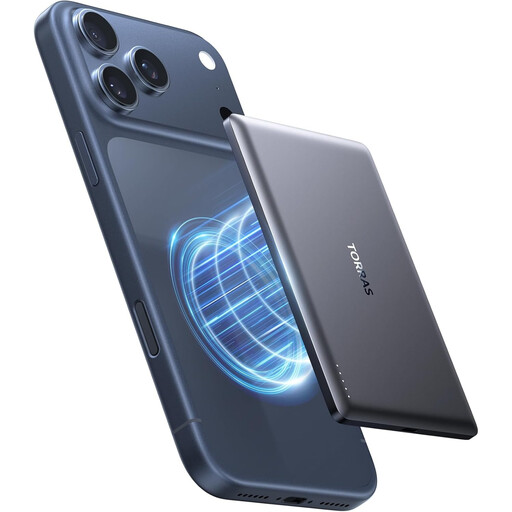
Why This Fits Their Persona: The approximately 0.86cm thickness and 113g weight appeal to iPhone users who prioritise a discreet, pocket-friendly design.
The product specification separates its 7.5W wireless output from its 18W USB-C wired output, making the speed difference clear.
Aluminium construction, USB-C cable included, 18W wired output and a stated two-year limited warranty.
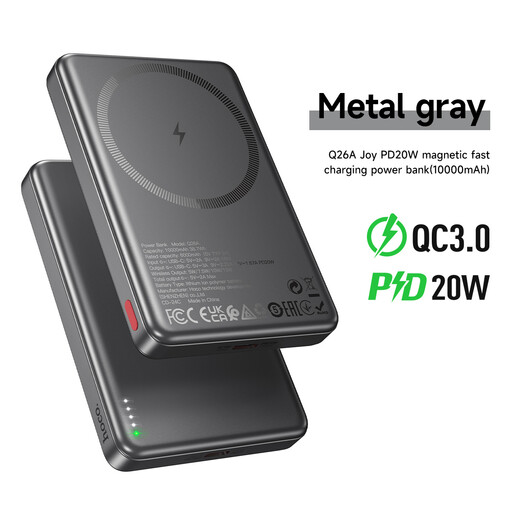
Why This Fits Their Persona: Its larger capacity and dual charging modes suit travellers, mobile workers and users carrying a phone plus AirPods or another USB-C device.
The stated 20W PD wired output and 15W wireless output distinguish cable charging from magnetic charging, while four LEDs show remaining power.
102 × 67 × 13.5mm dimensions, 171g weight, 18W input and support for simultaneous wireless and USB-C charging.
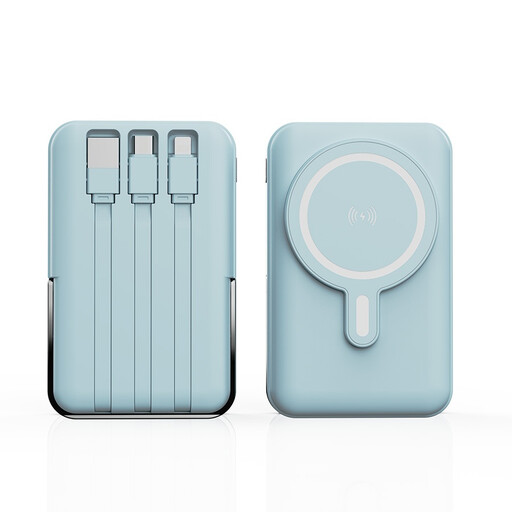
Why This Fits Their Persona: The adjustable mobile phone stand is practical for desk working, video calls and hands-free viewing while charging.
Its advertised 22.5W maximum is presented alongside a 10000mAh capacity, helping shoppers compare charging speed and battery reserve separately.
22.5W maximum charging, magnetic wireless compatibility, robust construction and several colour options.
We have compiled a complete, real-time list of products that fully satisfy these strict selection criteria and UK safety regulations.
It depends on the phone and case. Qi-compatible Android phones may support wireless charging, but magnetic attachment usually requires a magnetic case or accessory. Check the product’s stated compatibility before ordering.
Not necessarily. The usable energy is reduced by voltage conversion and wireless charging losses. A 10000mAh model generally provides more reserve than a 5000mAh model, but the number of charges depends on your phone’s battery size, charging method and efficiency.
The electricity cost of recharging a power bank is usually small, but wireless charging can use more energy than a direct cable connection because of conversion and heat losses. Use USB-C wired charging when speed and efficiency matter; choose magnetic charging when convenience is the priority.