
24/7 Customer Support

Free returns

Same-day & Next-day Delivery

Quality Guaranteed

Unlock Your Welcome Offers: FREE Delivery | Up to 80% OFF | Free 30-day JoyPlus trial
Download the APP
A 10000mAh magnetic power bank can provide useful backup during a commute, business trip or long day away from a socket. However, product listings often make similar-looking promises while hiding important differences in charging speed, compatibility and usable capacity.
Before buying, watch for three common traps:
A 10000mAh model is a practical middle ground between a small emergency charger and a larger travel battery. At a nominal voltage of around 3.7–3.85V, this capacity is roughly 37–38.5Wh internally. The power delivered to a phone will be lower after voltage conversion and charging losses.
Look beyond the capacity figure and check:
Wireless charging also creates more heat than a cable in many situations. Thick cases, poor alignment and warm environments can reduce charging speed.
A MagSafe power bank is primarily designed for magnetic alignment with compatible iPhones and cases. Android users should check whether their handset supports magnetic accessories, Qi2 or standard Qi charging. A magnetic ring case may be required.
For broader device use, a USB-C power bank is generally more flexible. Consider whether you need:
A built-in cable power bank reduces the chance of forgetting a lead, but inspect the cable’s rated output and whether it can be replaced if damaged. Port availability is useful only if the total output remains sufficient when multiple devices are connected.
A slim magnetic charger should remain comfortable when attached to a phone. Compare the stated dimensions and weight rather than relying on terms such as “ultra-slim”. A larger unit may offer more ports, a display or a stand, but can be less comfortable in a pocket.
Look for clear operating instructions and protection information covering overcharge, over-temperature, short circuit and foreign-object detection. Do not use a lithium battery pack if it is swollen, leaking, unusually hot or physically damaged. Keep it away from water and direct heat, and carry power banks in hand luggage when flying; check the airline’s current requirements before travel.
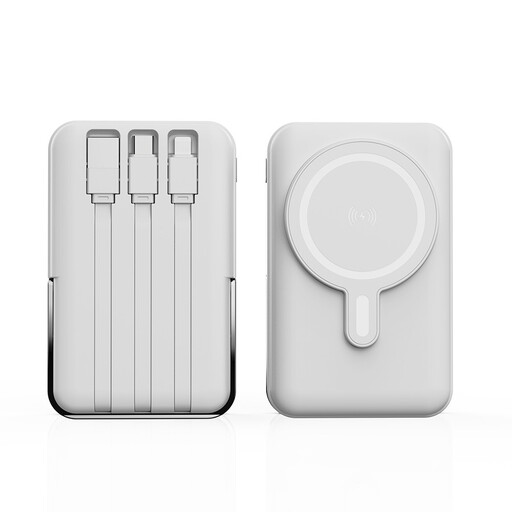
Why This Fits Their Persona: A straightforward option for UK commuters who want magnetic convenience, a 10000mAh capacity and a phone stand without moving to a higher-output laptop-oriented model.
The listing identifies a 22.5W maximum and separates wireless charging from wired output, helping buyers avoid assuming wireless charging runs at the peak figure.
10000mAh capacity, up to 22.5W stated maximum output, magnetic wireless charging and an adjustable phone stand.
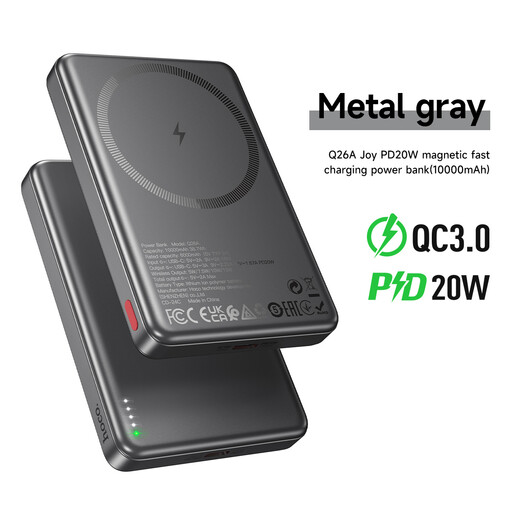
Why This Fits Their Persona: Suitable for professionals who prefer a metal-bodied charger with a battery indicator and both wired and wireless charging modes.
Its specifications distinguish 20W USB-C PD wired charging from wireless levels of up to 15W, while the instructions flag thick, non-magnetic cases as a potential issue.
102 × 67 × 13.5mm dimensions, 171g weight, four LED indicators and an aluminium alloy body.
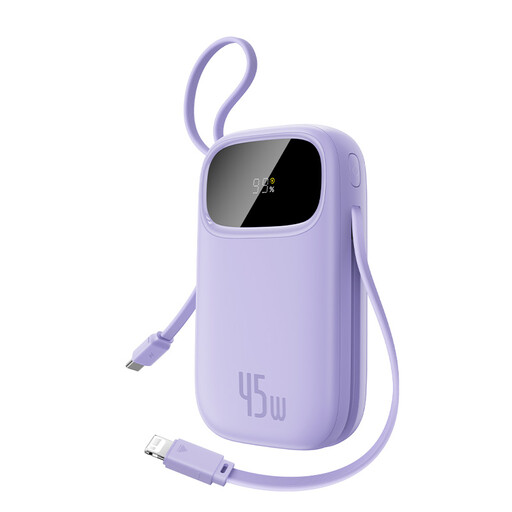
Why This Fits Their Persona: A practical match for travellers carrying a phone, tablet, laptop or several cables and wanting battery information at a glance.
The specification states that 45W is available through USB-C with one device; simultaneous charging reduces the total output. This makes the limitation clear before purchase.
45W USB-C output, built-in USB-C and iPhone cables, USB-A and a digital percentage display.
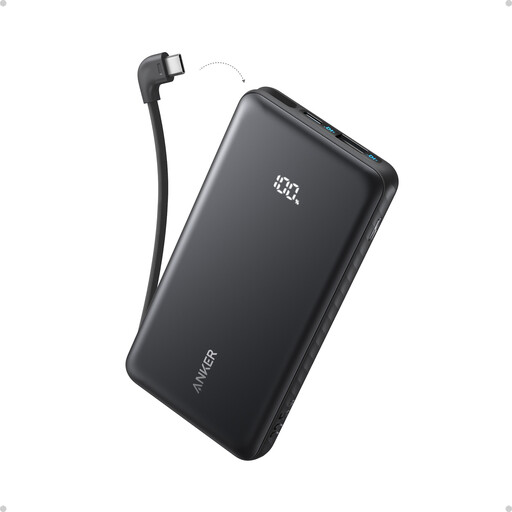
Why This Fits Their Persona: A convenient portable phone charger for train journeys, office days and anyone who regularly forgets to pack a separate cable.
The product lists its 22.5W output, 20W input and separate USB-A, USB-C and built-in USB-C connections rather than presenting one combined headline figure.
Built-in USB-C cable, 22.5W output, interactive charging screen and stated temperature-monitoring protection.
We have compiled a complete, real-time list of products that fully satisfy these strict selection criteria and UK safety regulations.
It depends on the phone, battery condition, charging method and usage. A 10000mAh unit can provide useful emergency power and may offer around one to two phone top-ups, but wireless charging losses and active navigation or streaming reduce the practical result. Check the stated wattage and use USB-C when a faster, more efficient boost is important.
It can, but compatibility varies. Android phones with a suitable magnetic case or ring may attach to a magnetic charger. Standard Qi-compatible phones may charge wirelessly without holding magnetically. Check the handset, case and charger specifications before ordering.
The power bank itself does not usually create a separate running cost beyond the electricity used to recharge it. Higher-wattage models may require a compatible charger and cable, and repeated wireless charging can use more energy than wired charging because of conversion losses. For occasional top-ups, capacity, convenience and compatibility are usually more relevant than the headline wattage.