
24/7 Customer Support

Free returns

Same-day & Next-day Delivery

Quality Guaranteed

Unlock Your Welcome Offers: FREE Delivery | Up to 80% OFF | Free 30-day JoyPlus trial
Download the APP
As a Joybuy Product Recommendation Officer, my role is to help you navigate the crowded market of children's toys. Magnetic tiles have become a staple in playrooms across the UK for good reason—they are fantastic creative building toys for children. However, not all sets are created equal. Many parents find themselves with a collection of tiles that either gather dust or worse, fall apart.
Before you invest, it's crucial to understand the common pitfalls that can lead to disappointment. Many sets suffer from three key issues: weak magnets that cause structures to collapse, unsafe materials with sharp edges or loose parts and misleading piece counts that inflate value with non-essential items. This guide will help you identify quality and choose a set that provides lasting value and endless fun.
To ensure you're getting a safe and engaging toy, focus on these core parameters. They are the difference between a toy that inspires creativity and one that causes frustration.
The single most important factor is safety. High-quality magnetic building blocks are made from non-toxic ABS plastic, a durable and impact-resistant material that is safe for children. Look for tiles where the magnets are fully enclosed within the plastic casing. The most reliable methods are sonically welded seams or metal rivets, which prevent the small, powerful magnets from ever coming loose. Swallowing magnets can cause serious injury, so this feature is non-negotiable. Always check that the product complies with UK and EU toy safety standards, such as EN 71.
The magic of 3D magnetic tiles lies in their ability to click together and form stable structures. This is entirely dependent on the strength of the magnets. Sets with weak magnets will constantly collapse, frustrating a child's attempts to build anything more than a few layers high. While brands don't typically list magnet strength, look for descriptions that mention "strong," "powerful" or "reinforced" magnets. This is often a key feature of sets designed for building taller, more complex models like a magnetic castle building set.
Pay close attention to the tile size and what is included in the piece count. Some sets inflate their numbers by including non-magnetic plastic inserts or an abundance of tiny, less useful shapes.
Based on these practical criteria, here are a few recommendations tailored to different needs and play styles.
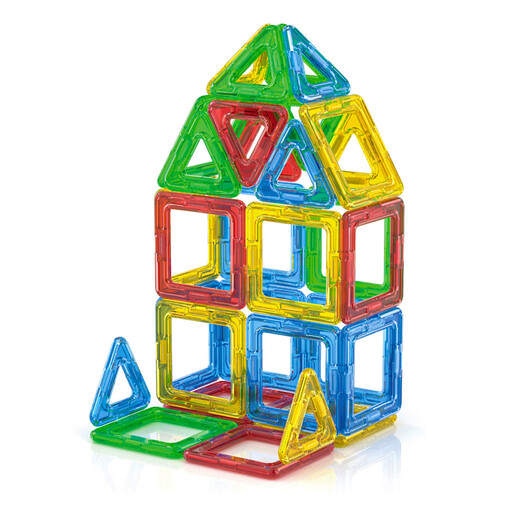
Why This Fits Their Persona: This set is an excellent entry point for families wanting to try magnetic tiles without a large initial investment. The 36-piece count is enough for a young child to grasp the concept and build simple 2D and 3D shapes, making it a great introductory educational construction toy.
It focuses on quality over quantity. The description highlights its strong magnetic connection for stable structures and its construction from safe, durable ABS plastic with smooth edges, addressing the two biggest pitfalls of cheaper sets.
The lightweight, mini-sized blocks are easy for small hands to grip and manipulate. It comes in gift-ready packaging that doubles as storage.
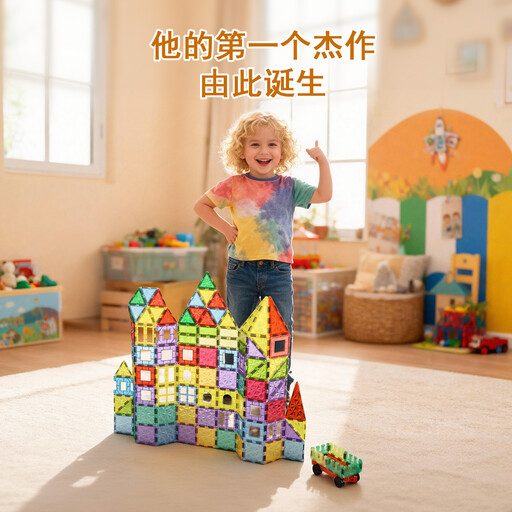
Why This Fits Their Persona: For the child who is ready to build big, this 100-piece set provides the quantity and variety needed for large, imaginative structures. It's ideal for constructing elaborate castles and scenes, satisfying a more experienced young builder's ambitions.
This set directly addresses the weak magnet problem by highlighting its "powerful magnetic structure" and upgraded design, ensuring that large creations are stable and don't collapse. It is also made from safe ABS material with rounded corners.
The unique diamond facet design offers a distinct visual appeal, creating interesting light refraction effects. The 100-piece count provides a substantial collection for immersive play.
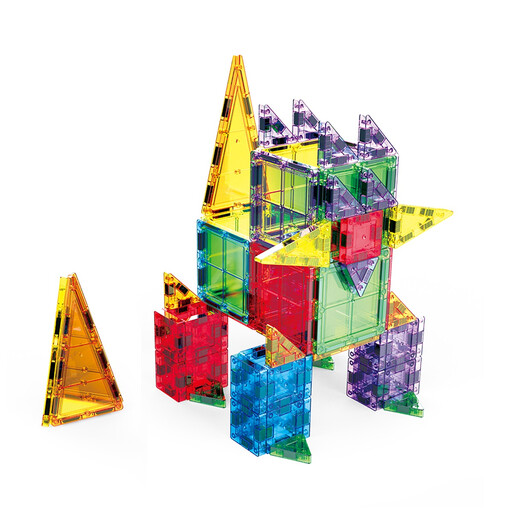
Why This Fits Their Persona: Perfect for keeping children engaged during travel, at restaurants or on car trips. The compact 3.75cm tile size and included storage box make this set exceptionally portable and easy to pack away, providing a screen-free activity anywhere.
This set is explicitly safety-certified (CPC and ASTM) and made of non-toxic ABS plastic with securely sealed magnets. Its value is in its portability and function, not an inflated piece count, offering a practical solution for parents on the move.
The flat surface design is ideal for creating intricate 2D patterns on small surfaces like an aeroplane tray table. The compact size is perfectly suited for small hands, promoting fine motor skills.
We have compiled a complete, real-time list of products that fully satisfy these strict selection criteria and UK safety regulations.
Compatibility primarily depends on size. Most brands that produce standard 7.5cm tiles are compatible with one another, as are brands that use the same mini-tile dimensions. However, unique shapes or connection points may not align perfectly. It is always a good practice to stick with the same brand or check dimensions carefully if you plan to mix and match sets.
To clean magnetic tiles, simply wipe them with a soft, dry or slightly damp cloth. Do not immerse them in water or use harsh chemical cleaners, as this can damage the plastic and potentially compromise the sealed edges that keep the magnets safely inside.
Most magnetic tile sets are rated for children aged 3 and up. This is primarily due to the presence of small magnets, which pose a serious risk if swallowed. For children aged 3 to 5, these toys are excellent for developing fine motor skills and spatial awareness. Older children, from 6 to 8, can use them for more complex STEM building toys projects, exploring principles of geometry and engineering. Adult supervision is always recommended.