
24/7 Customer Support

Free returns

Same-day & Next-day Delivery

Quality Guaranteed

Unlock Your Welcome Offers: FREE Delivery | Up to 80% OFF | Free 30-day JoyPlus trial
Download the APP
Magnetic tiles for kids can provide screen-free entertainment, open-ended construction and opportunities to explore colour, shape and balance. However, not every set offers the same value. A colourful box or a high piece count can hide practical drawbacks, particularly when buying for children aged three and over.
Before choosing magnetic building blocks, check the construction, magnet safety, piece dimensions and storage arrangements. The right set should match the child’s age, play space and interest rather than simply offering the largest number printed on the packaging.
A set containing many small pieces may not create large structures if each tile is compact. Conversely, a smaller set with appropriately sized squares and triangles can be easier for younger children to handle.
Check whether the stated quantity includes only magnetic panels or also accessories and non-building pieces. It is also useful to look for individual dimensions. For example, some sets use tiles measuring approximately 5 × 5 cm, while mini magnetic tiles may measure around 3.5 × 3.5 cm.
Magnetic strength can help pieces connect, but it does not automatically make a model stable. A tall tower still depends on its base, shape and weight distribution. Look for securely enclosed magnets and smooth, rounded edges rather than focusing only on phrases such as “extra strong”.
The product listing should also include clear warnings. Magnetic pieces are not suitable for children under three, and swallowing magnets can cause serious injury. Inspect every tile regularly and stop using the set if a casing cracks or a magnet becomes loose.
Loose tiles can quickly become difficult to sort, especially when a set contains several geometric shapes. A gift box or storage case helps keep the pieces together and makes tidying easier.
Many magnetic tile sets should be wiped with a soft, dry cloth rather than immersed in water. Moisture or unsuitable cleaning products may affect the plastic or internal magnets. Always follow the individual product instructions.
For children’s educational toys, look for a clearly stated material, such as ABS plastic, and details about edge finishing and magnet enclosure. The product descriptions featured here state smooth or rounded edges and embedded magnets. Some listings also state compliance with EN 71 and EU REACH requirements; these are useful details to review, but buyers should still read the specific safety information supplied with the product.
The 3+ age rating is important because magnetic tiles contain small parts. Adult supervision is recommended, particularly during first use and with children who may still put objects in their mouths.
A 36-piece set may suit a first introduction, while 48- or 50-piece magnetic tiles can offer more scope for flat patterns and simple three-dimensional structures. Larger sets, such as 128 pieces, are more suitable when several children want to build together or when the child already enjoys elaborate construction.
Check whether the set includes a practical mix of squares, triangles and other shapes. A themed set may be engaging, but a very narrow selection can limit free-form designs.
Magnetic tiles can support spatial awareness, pattern recognition and early problem-solving through hands-on play. Alphabet designs may add letter recognition, while translucent castle tiles can encourage themed storytelling. These are play opportunities rather than guaranteed educational outcomes.
Consider where the child will play. A large castle-building set needs a clear floor or table area, whereas mini tiles are easier to use in a bedroom, playroom or on a compact dining table.
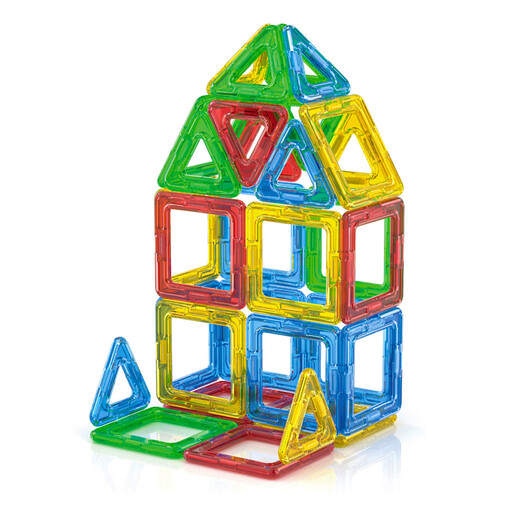
Why This Fits Their Persona: A manageable entry set for families introducing construction play without committing to a large collection. The smaller pieces are designed for easy gripping and the set includes a colour box for storage.
The listing states the individual block size, 3.5 × 3.5 × 0.8 cm, rather than leaving the dimensions unclear. It is also marked for ages 3+ with magnet and small-part warnings.
36 pieces, ABS construction, smooth edges, no batteries required and gift-box packaging.
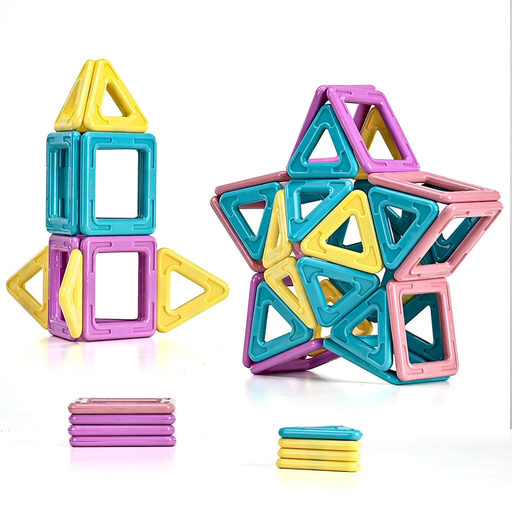
Why This Fits Their Persona: A balanced option for parents seeking a more versatile set with a softer visual style and enough pieces for both flat designs and three-dimensional builds.
The specification identifies 50 pieces, core geometric shapes and 5 cm square bases. The listing also describes ultrasonic-welded casing for the embedded magnets.
Pastel macaron colours, ABS material, no batteries, gift-box packaging and a stated 3+ age suitability.
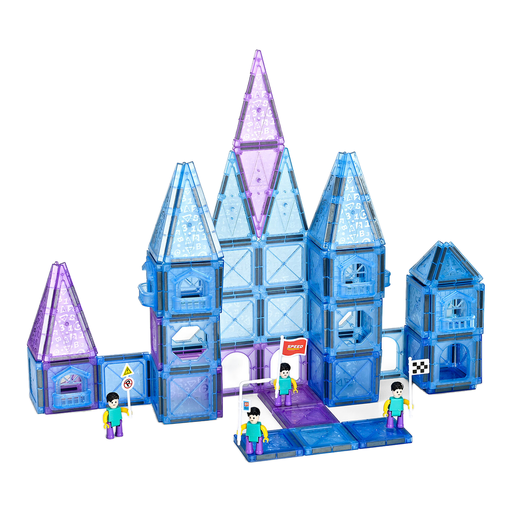
Why This Fits Their Persona: Suitable for children who already enjoy construction or for siblings building together. The ice-blue translucent theme supports larger castle, palace and tower designs.
The set gives a precise 128-piece quantity and identifies the material as transparent ABS. Safety instructions include checking for cracks, loose magnets and damaged casings.
128 magnetic panels, translucent ice-blue styling, geometric construction play, instructions and colour-box storage.
We have compiled a complete, real-time list of products that fully satisfy these strict selection criteria and UK safety regulations.
Many sets are labelled 3+, including the products listed above. They contain small parts and magnets, so supervision remains important. Age guidance should be treated alongside the child’s individual development and ability to follow safety instructions.
A 36-piece set can introduce the basic concept, while 48 to 50 pieces provide more flexibility for patterns and small structures. Choose around 128 pieces when the child has sufficient play space or wants to build larger themed models.
The featured sets use manual magnetic connections and do not require batteries. Children connect the pieces directly, although adults may need to help with sorting, balancing taller structures and tidying the set afterwards.