
24/7 Customer Support

Free returns

Same-day & Next-day Delivery

Quality Guaranteed

Unlock Your Welcome Offers: FREE Delivery | Up to 80% OFF | Free 30-day JoyPlus trial
Download the APP
A magnetic wireless power bank can make low-battery moments easier, particularly when you are commuting, travelling or using your phone for navigation. It attaches to a compatible handset and supplies power without a separate charging cable.
However, not every magnetic portable charger offers the same practical value. The headline capacity may not equal the usable output, wireless charging may be slower than expected and a weak magnetic connection can make the accessory frustrating to use. Before buying, focus on the details that affect everyday performance rather than relying on promotional wording.
A 5000mAh power bank does not transfer every milliamp-hour directly to your phone. Energy is lost during voltage conversion and wireless charging, so the delivered amount will be lower than the printed capacity. A 5000mAh model is generally suited to a convenient top-up or approximately one day of moderate use, while a 10000mAh power bank is more suitable for extended travel or heavy phone use.
Check both the stated capacity and the rated capacity where available. The latter gives a more realistic indication of the energy available at a particular voltage.
Wireless output depends on the phone, charging protocol, alignment and temperature. Some iPhones may receive wireless power at a lower rate than the maximum listed for compatible devices. For urgent charging, a USB-C fast charging power bank is often more predictable than wireless charging.
Also check whether your phone has built-in magnetic alignment. MagSafe-compatible iPhones generally attach directly, while other handsets may need a suitable magnetic case or ring. A standard non-magnetic case can weaken the hold or prevent charging.
Wireless charging creates heat, especially when the phone is being used at the same time. Thick cases, metal plates, cards and keys can interfere with charging or trigger foreign-object detection. A power bank that is technically compact may still feel uncomfortable if it is heavy or has poorly positioned magnets.
Look for clear safety instructions covering temperature control, overcharge protection and the use of certified cables. Stop using any battery pack that becomes unusually hot, swells or develops an unusual odour.
Choose capacity according to your routine:
For flights, keep lithium battery packs in hand luggage and check your airline’s current requirements before travelling. Do not place a damaged or swollen battery in baggage.
Magnetic wireless charging is convenient for navigation, messaging and desk use, but wired USB-C charging is normally preferable when you need a faster boost. Compare the advertised wireless wattage with the actual output for your phone, not just the maximum figure.
A model with USB-C input and output is also more versatile because the same cable type can recharge the power bank and charge compatible devices. Check whether the cable is included and whether the adapter you already own can provide the required power.
A secure magnetic connection needs correct alignment. For MagSafe-compatible devices, use a compatible case rather than a thick, non-magnetic cover. One reference model recommends a MagSafe-compatible case under 2.5mm, illustrating why case thickness should be checked before purchase.
Avoid placing bank cards, hotel keys or other magnetic-sensitive items between the battery pack and phone. Magnets can also interfere with some sensitive medical equipment, so follow the manufacturer’s safety guidance.

Why This Fits Their Persona: A practical option for commuters and first-time buyers who want magnetic charging, a USB-C connection and a built-in stand without moving to a larger capacity.
Its listed wireless output is 7.5W, while the Type-C output is listed up to 15W, making the difference between wireless convenience and wired speed clear.
5000mAh capacity, adjustable kickstand, USB-C cable included and approximately 119g according to the supplied specification.
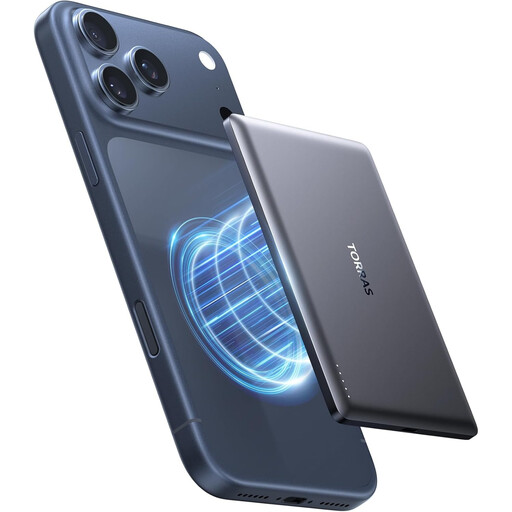
Why This Fits Their Persona: Suited to iPhone users who prioritise a light, low-profile accessory for pockets, handbags, commuting and everyday carry.
The specification separates 7.5W wireless output from 18W USB-C output, so buyers can choose the cable when a quicker top-up is needed.
Approximately 0.86cm thick, around 113g, USB-C charging and a stated 2-year limited warranty.
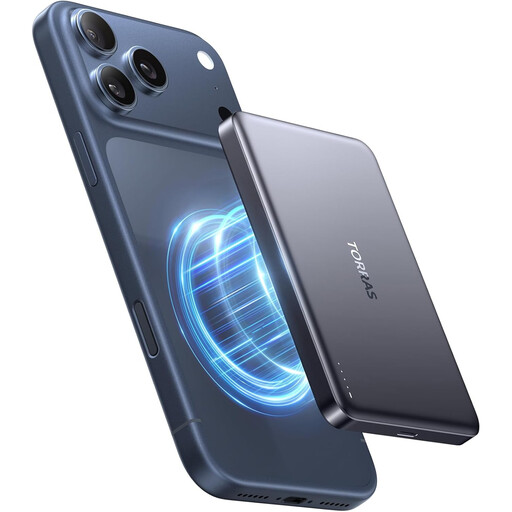
Why This Fits Their Persona: A larger-capacity choice for long rail journeys, business travel, navigation-heavy days and users charging a phone repeatedly away from a socket.
Its 10000mAh capacity is clearly paired with separate wireless and wired ratings: up to 15W wireless and up to 22.5W wired, with a lower wireless rate specified for iPhone.
USB-C cable included, NTC temperature control, overcharge protection and a listed weight of approximately 182g.
We have compiled a complete, real-time list of products that fully satisfy these strict selection criteria and UK safety regulations.
No. Magnetic attachment is generally designed for MagSafe-compatible iPhones and compatible cases. Other phones may charge wirelessly if they support the relevant standard, but they may need a magnetic case or ring and may not hold securely.
The power bank itself does not create a separate usage charge, but wireless charging is less energy-efficient than wired charging because more energy is lost as heat and conversion. Use USB-C when speed and energy efficiency matter and magnetic charging when convenience is the priority.
Battery lifespan depends on charge cycles, storage conditions and heat. Keep the pack away from moisture and extreme temperatures, avoid crushing or puncturing it and use suitable cables and adapters. A warranty period can provide useful protection against manufacturing defects, but it does not usually cover accidental damage or normal battery ageing.