
24/7 Customer Support

Free returns

Same-day & Next-day Delivery

Quality Guaranteed

Unlock Your Welcome Offers: FREE Delivery | Up to 80% OFF | Free 30-day JoyPlus trial
Download the APP
As a Joybuy Product Recommendation Officer, my role is to help you navigate the crowded market of car accessories. For UK drivers with an iPhone 12 or newer, a MagSafe car charger seems like the perfect solution for a tidy, cable-free dashboard. However, many products fail to deliver on their promises, leading to frustration and wasted money.
Before you buy, it's crucial to understand the common pitfalls. Many drivers find their new gadget is a disappointment, plagued by issues that were hidden in the marketing copy.
By understanding these issues, you can make a more informed choice and find a charger that genuinely enhances your driving experience.
To avoid the traps, focus on a few key technical specifications. These are the non-negotiable factors that separate a reliable charger from a dashboard decoration.
For an iPhone, "fast wireless charging" specifically means 15W of power. Many generic chargers cap out at 7.5W or less for iPhones, even if they are advertised with higher numbers. To achieve the full speed, the device must be MagSafe compatible. Furthermore, you must power it correctly. A standard built-in car USB port is often insufficient. You will need a separate car cigarette lighter adapter that supports at least 20W Power Delivery (PD) or Quick Charge (QC) 3.0 to supply the charger with enough energy to deliver that 15W output. Without this, even the most capable iPhone car charger will underperform.
The way a charger attaches to your car is just as important as its charging speed. For an air vent car charger, look for a design that goes beyond a simple friction clip. A superior mechanism often includes a metal hook that latches onto the back of the vent blade, combined with a rotating lock to tighten it securely. This dual-locking system provides far greater stability on bumpy British roads. For the magnetic connection, check for strong magnets, often specified as N52 magnets, which provide a firm grip on your device, ensuring your magnetic car phone holder stays put.
A quality MagSafe car mount must manage heat effectively. As it charges, electrical energy is converted, and some is lost as heat. Without proper cooling, the charger and your phone can overheat. Look for models that mention features like a metal cooling plate, built-in vents or construction from thermally conductive materials. This protects your phone's battery and ensures the charger can maintain its 15W output for longer periods, especially during navigation-heavy journeys.
We have filtered through the options to match specific products to the needs of different UK drivers.
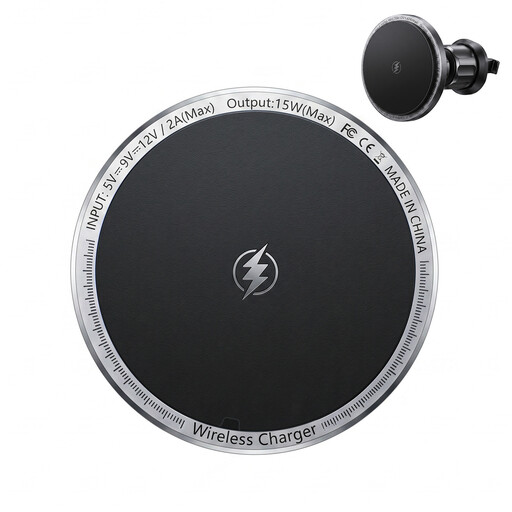
Why This Fits Their Persona: For those driving to and from work every day, reliability is key. This mount is designed to provide consistent, fast power and a secure hold, ensuring your phone is ready to go when you arrive at your destination.
It directly addresses the overheating and slow-charging pitfalls with a rear-mounted metal cooling plate and specified 15W power output for compatible iPhones.
Features dedicated thermal protection to preserve battery health and a compact design that doesn't obstruct your view. The ambient LED lighting adds a modern touch.

Why This Fits Their Persona: For those on long motorway journeys or exploring country lanes, a sturdy, adjustable mount that provides constant power for navigation is essential.
Its solid aluminium alloy base provides a stable foundation, countering the "unreliable grip" pitfall. It also delivers 15W wireless charging to keep power-hungry apps running.
The 360° rotation with a fastening anti-skid mechanism allows for precise angle adjustments for both driver and passenger. The strong magnetic suction ensures the phone stays put.

Why This Fits Their Persona: For those who simply want a secure, convenient way to mount their phone for navigation without the need for charging. This is a straightforward, cost-effective solution.
It focuses on doing one job well: holding the phone. The dual-locking vent clip and strong N52 magnets directly combat the "unreliable grip" pitfall without introducing charging complexities.
Offers excellent stability and a strong magnetic hold at an accessible price point. Its compact design keeps the dashboard uncluttered and is compatible with any MagSafe phone or case.
We have compiled a complete, real-time list of products that fully satisfy these strict selection criteria and UK safety regulations.
Yes, but only if you are using a MagSafe-compatible case or a very thin standard case (typically under 3mm). Thicker, non-magnetic cases will prevent the magnets from making a secure connection and will likely block the wireless charging signal. For the most reliable performance, a dedicated MagSafe case is recommended.
A well-designed charger with proper heat management should not cause damage. The primary risk to battery health comes from excessive heat. This is why it is important to choose a model with features like cooling plates or vents. Your iPhone also has built-in thermal protection that will automatically slow or pause charging if it detects the device is becoming too warm.
To achieve the full 15W charging speed, you almost certainly will. The charger must be connected to a car adapter (the part that plugs into the cigarette lighter socket) that can supply enough power. Look for an adapter that is rated for at least 20W and supports either Power Delivery (PD) or Quick Charge (QC) 3.0 technology. A standard 5W USB port built into your car will not be sufficient.