
24/7 Customer Support

Free returns

Same-day & Next-day Delivery

Quality Guaranteed

Unlock Your Welcome Offers: FREE Delivery | Up to 80% OFF | Free 30-day JoyPlus trial
Download the APP
Choosing between MAM soothers can seem straightforward until you compare age ranges, teat shapes, shield designs and sterilising cases. A soother that suits a newborn may be too large for an older baby, while a glow-in-the-dark button is only useful if it charges correctly during the day.
This guide explains the practical details to check before buying, helping parents, guardians and gift buyers select suitable MAM baby soothers without paying for features they will not use.
MAM dummies are designed for specific stages, including 0–2 months, 0–3 months, 6+ months, 6–18 months, 16+ months and 18–36 months. Age labels are not simply marketing categories: the shield size, teat proportions and overall weight are matched to the child’s development.
A newborn soother may be too small for a toddler, whereas a toddler model can be unnecessarily large for a young baby. Always check the stated age range before considering colour, pack size or special features.
Many MAM silicone soothers use a symmetrical, flat teat. This means the soother can sit correctly whichever way it is placed in the mouth. However, individual models differ in teat thickness, flexibility and shield shape.
For children prone to dribbling or skin sensitivity, the shield may matter as much as the teat. Large ventilation holes and reduced skin contact can help keep the area around the mouth drier, but they do not replace regular cleaning or appropriate skin care.
Glow-in-the-dark soothers need exposure to natural daylight to charge. They generally do not charge effectively under LED lighting, and the glow will not replace a bedside light for checking your child.
Self-sterilising soothers are convenient, but the case must be used with the correct amount of water, microwave power and heating time. The box, water and soother can become very hot, so cooling instructions are important. A convenient case is useful only when the instructions are followed carefully.
Start with the age printed on the product packaging. For newborn soothers, look for an extra-small and lightweight shield. The MAM Start range is designed for babies aged 0–2 months, while the MAM Comfort 0–3 Months uses a one-piece silicone construction and is also intended for very young babies.
For older children, select the correct stage rather than relying on a previous model. Examples include MAM soothers 6+ months, MAM soothers 16+ months and MAM soothers 18–36 months. If your child is between stages, follow the product guidance and consider whether the current teat or shield still looks comfortable.
SkinSoft silicone is used across many MAM products. Product information describes it as a soft silicone surface with a familiar feel. Some listings also quote a 94% acceptance rate from brand-associated research; this should be treated as product information rather than a guarantee that every baby will accept the teat.
A symmetrical teat is often marketed as an orthodontic soother design. In practical terms, it is shaped to sit correctly without needing a particular orientation. It should not be regarded as a medical or dental treatment. The teat still needs frequent inspection, particularly once a child has teeth.
For babies with sensitive skin, compare the shield design. The MAM Air range has extra-large air holes intended to improve airflow around the mouth. This may be a useful feature for dribbly babies, but the shield must still be washed regularly and checked for residue.
Many MAM products include a case that can sterilise one or two soothers in a microwave. Common instructions include adding 25ml of water, placing the soother teat-down and heating for three minutes at 750–1,000 watts. Always follow the instructions supplied with the specific product, as cases and pack formats can differ.
For UK households, dedicated soother holders should comply with EN 12586. Never attach a homemade ribbon, cord or string around a child’s neck or to clothing.
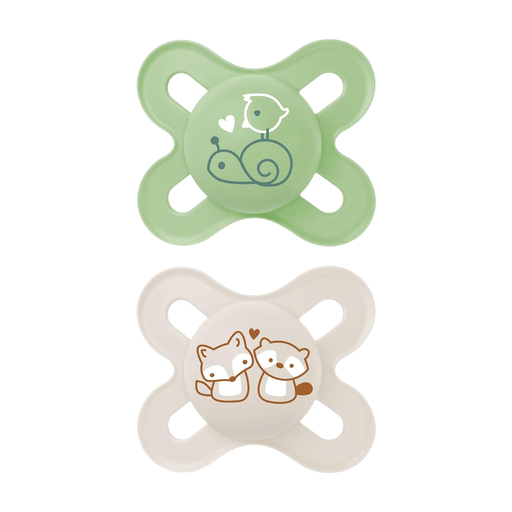
Why This Fits Their Persona: A practical twin pack for new parents who want newborn soothers for rotation at home, in the changing bag and during night feeds.
The 0–2-month label helps prevent buying a shield designed for an older baby, while the ventilated design avoids relying on appearance alone.
Two soothers, SkinSoft silicone teat, BPA- and BPS-free materials and a case that supports microwave sterilisation.
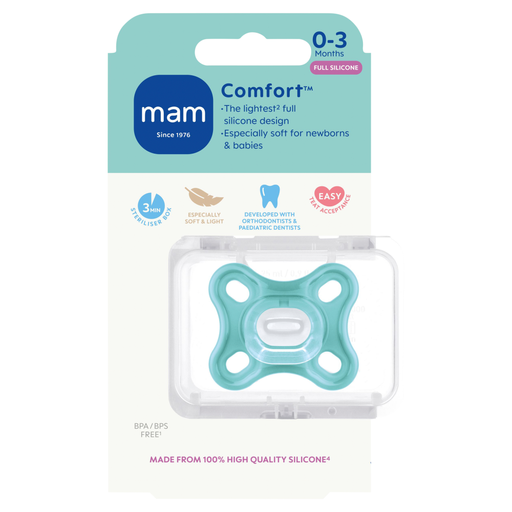
Why This Fits Their Persona: Suitable for buyers prioritising a lightweight, simple construction for a very young baby.
Its clearly stated 0–3-month range and one-piece format make it easier to assess fit and cleaning needs before purchase.
Made from one piece of soft silicone, with a lightweight design and included sterilising travel case.
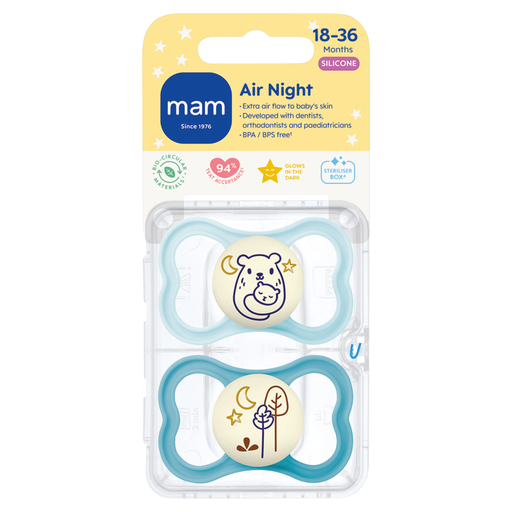
Why This Fits Their Persona: A practical option for toddlers who use a soother at night or experience frequent dribbling.
The 18–36-month age range avoids using an undersized baby model, while the glow feature is paired with a shield designed for airflow.
Glow-in-the-dark button, extra-large ventilation holes, two-pack format and BPA/BPS-free materials.
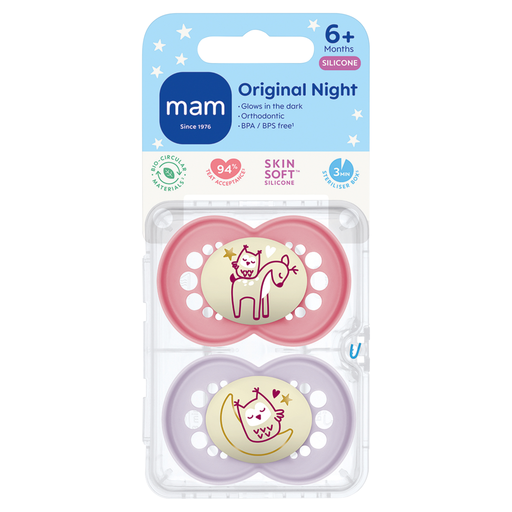
Why This Fits Their Persona: Designed for families who want a night-time soother that is easier to locate without switching on a bright light.
The glow button is a practical locating aid rather than a promise of uninterrupted sleep, and it must be charged in daylight.
Glow-in-the-dark button, SkinSoft silicone teat, ventilated shield and self-sterilising travel box.
We have compiled a complete, real-time list of products that fully satisfy these strict selection criteria and UK safety regulations.
Yes, selected models are designed for newborns, including MAM soothers 0–2 months and the 0–3-month MAM Comfort. Check the exact age range, shield size and cleaning instructions before buying.
There is no single lifespan for every child or product. Many MAM listings recommend replacing soothers every one to two months, while some advise more frequent replacement for older children with teeth. Inspect before every use and replace immediately if damaged.
The supplied product information states that the glow button should be exposed to natural daylight and may not charge under LED light. Keep it in daylight during the day, but avoid leaving it in direct sunlight or near a heat source.