Space-limited salsa makers
You usually make one small bowl of salsa and need to put the processor away in a drawer or shared cupboard rather than leave it on the worktop.


For occasional mango salsa in a shared kitchen, choose a food processor with pulse control, enough working capacity for your usual batch and parts you can clean thoroughly between users. A compact model makes sense when storage is tight; consider a larger bowl if you regularly prepare several portions. Dishwasher-safe parts can ease clean-up, but they do not replace separating equipment used for raw foods from equipment used for ready-to-eat salsa.
You usually make one small bowl of salsa and need to put the processor away in a drawer or shared cupboard rather than leave it on the worktop.
You need removable parts that are manageable to wash between users, especially when the same kitchen is used to prepare both raw foods and ready-to-eat ingredients.
You make salsa for several people or also use a processor for other meal preparation, so bowl capacity and accessories matter more to you than the smallest possible footprint.
Start with the amount of salsa you normally make, then check where the appliance and its accessories will live. In a shared kitchen, the cleaning instructions deserve as much attention as the bowl size.
| Concern | What to check | Who this matters to |
|---|---|---|
| Clean-up between users | Check which removable parts can go in the dishwasher and follow the model’s care instructions. Plan to clean equipment thoroughly and keep tools used for raw foods separate from ready-to-eat preparation. | If I share equipment with people preparing raw food, I need to be able to clean it properly before making ready-to-eat salsa. Around 38% of consumers put clean-up and hygiene first. |
| Storage and small batches | Compare appliance dimensions and accessory storage with your available space; check working capacity as well as total bowl capacity. | When I make only a small bowl, I would rather store the processor in a shared cupboard than give up worktop space. Compact storage is the primary need for around 31% of consumers. |
| Larger batches and other prep | Compare bowl capacity, included tools and pulse or moment controls, while allowing space for the appliance and accessories. | If I often prepare salsa for several people or use the machine for other dishes, avoiding repeated small batches matters more than minimum size. Around 31% of consumers prioritise batch capacity and wider preparation use. |
A processor may have a lower stated working capacity than its headline bowl volume. Kenwood, for example, lists a 1.3 L bowl but a 0.75 L working liquid capacity for the MultiPro Go FDP23.140GR.
Check the manufacturer’s working-capacity guidance against the amount of salsa you normally prepare.
Magimix recommends short, low-temperature dishwasher programmes for its accessories and warns that unsuitable dishwasher use can deteriorate plastic parts over time.
Follow the instructions for the exact model and wash the motor base as directed rather than immersing it.
Repeated unsuitable dishwasher cycles may mean replacing deteriorated plastic accessories sooner.
Ready-to-eat mango salsa can be exposed to contamination if a shared processor or its utensils have been used for raw meat, fish or poultry without adequate cleaning.
Clean equipment thoroughly before preparing salsa and keep raw-food and ready-to-eat tools separate where possible. The Food Standards Agency sets out these separation principles in guidance for food businesses in England, Northern Ireland and Wales.
Kenwood’s MultiPro Go FDP23.140GR illustrates a compact route for occasional salsa preparation where storage space is limited.
Bosch’s MultiTalent 3 MCM3501MGB is a larger-bowl reference for households that also want to tackle other preparation jobs.
Magimix is a reference for households considering a processor for frequent, varied preparation rather than salsa alone.
These food processors and choppers offer different bowl arrangements for preparing mango salsa. Compare each one’s usable capacity, storage fit and cleaning instructions with the way your shared kitchen works.
 No image available
Consider this if you want a processor with a weighing function for broader meal preparation as well as salsa.
The product name lists a 3 L bowl, 1000 W power, an integrated digital scale and eight accessories.
Check its usable working capacity and dimensions against your batch size and storage space.
 No image available
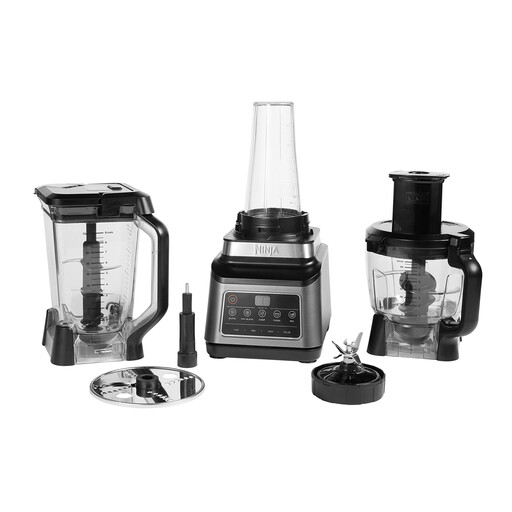
This may suit a household that wants a processor bowl alongside separate blending containers.
The product name lists a 1.8 L bowl, 2.1 L jug, 700 ml cup, 1200 W power and five automatic programmes.
Check the processor bowl’s working capacity and the full appliance dimensions before deciding whether it fits your batches and cupboard.
 No image available
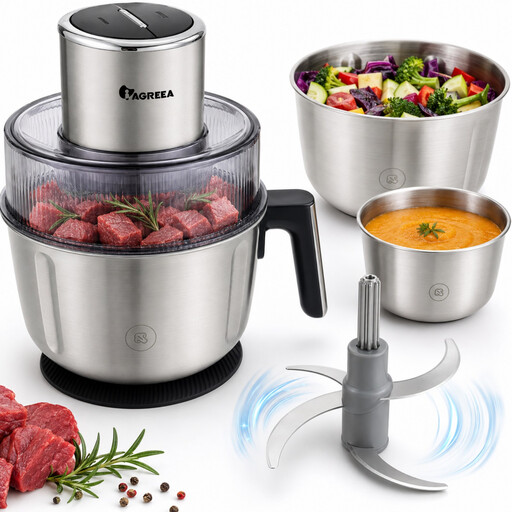
Its nesting bowls are worth considering if you want several vessel sizes without storing them separately.
The product name lists 2.5 L, 2.2 L and 1.8 L stainless-steel bowls, 350 W power and two speed settings.
Check usable working capacities and the care instructions for both bowls and blades before using it in a shared kitchen.
 No image available
Consider the combined processor and blender format if both kinds of preparation are useful in your kitchen.
The product name states 750 W power, a 2 L bowl and a further 1.8 L capacity.
Check the bowl’s usable capacity, the dimensions and the cleaning instructions for the parts you will share.
 No image available
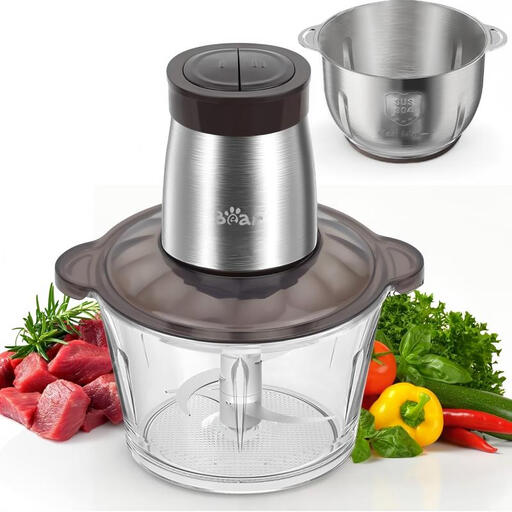
The two separate containers may be useful if you want to organise different preparation tasks, though both still need thorough cleaning.
The product name lists a glass container, a stainless-steel container, 300 W power, two speed settings and four blades.
Check usable bowl capacities, storage dimensions and the permitted continuous running time before purchase.
A pulse or moment control lets you stop after short bursts and inspect the mixture before processing more. Kenwood lists pulse control for the MultiPro Go FDP23.140GR, while Bosch lists a moment function for the MCM3501MGB; neither specification guarantees a particular texture.
Do not assume the full bowl volume is usable for every recipe. Kenwood lists a 1.3 L bowl but a 0.75 L working liquid capacity for the MultiPro Go FDP23.140GR, so check the working-capacity guidance for the ingredients you intend to process.
No: wash parts thoroughly and keep equipment used for raw foods separate from ready-to-eat salsa preparation. Follow the appliance’s care instructions too; Magimix recommends short, low-temperature dishwasher programmes for its accessories.
Make sure the processor, utensils and preparation surfaces are clean, particularly if they were previously used with raw meat, fish or poultry. The Food Standards Agency’s guidance for food businesses in England, Northern Ireland and Wales explains the importance of separating raw-food tools from those used for ready-to-eat foods.